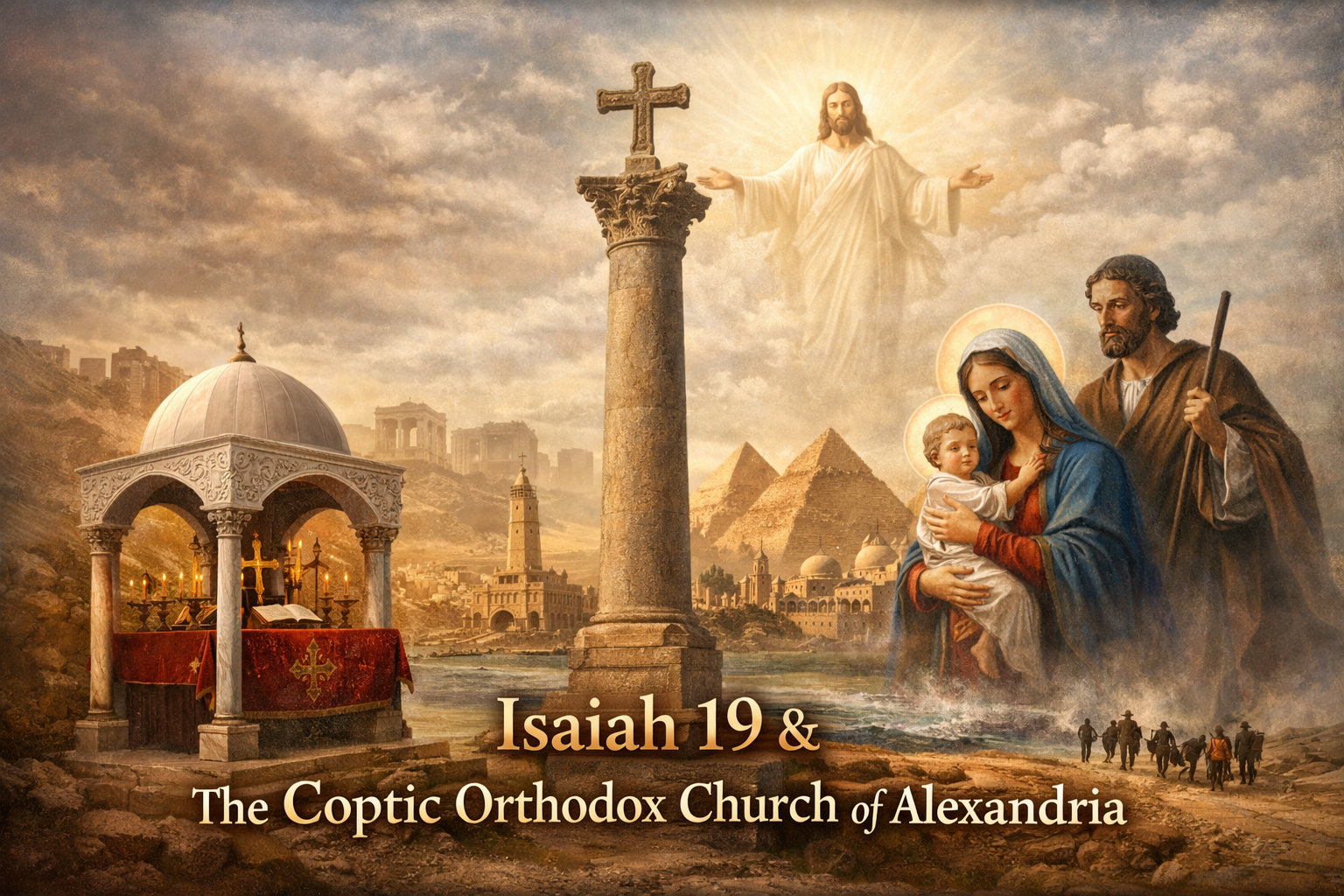
Context of Isaiah’s Prophecy and the Forbidden Altar
The prophecy in Isaiah 19:19–25 speaks of a future blessing for Egypt: “In that day there will be an altar to the LORD in the midst of the land of Egypt, and a pillar at its border… the Egyptians will know the LORD in that day and offer sacrifice and offering…” This message was startling in Isaiah’s time. Under the Old Covenant law, the only place an altar to the Lord was permitted was the Jerusalem Temple. No altar for Yahweh could lawfully exist outside Solomon’s Temple. Deuteronomy had commanded Israel to worship in one chosen place (ultimately Jerusalem) and forbade multiple altars (Deut. 12:13–14). Thus, Isaiah’s prediction of an altar in Egypt – a land of Gentiles and idols – would have sounded radical. As one commentator notes, “the Levitical altar was confined to one place,”, so Isaiah must be envisioning “not a Levitical, but a spiritual and evangelical altar” to the Lord. In other words, this prophecy looked beyond the old Temple-centric worship to a coming era when God would be worshiped beyond the bounds of Israel. Isaiah foresaw a time when even Egypt, formerly known for idolatry, would erect an altar to the true God – a sign of true worship in an unlikely place.
“Altar in the Midst of Egypt” – The Coptic Church’s Birth
According to ancient and patristic interpretation, this prophecy was fulfilled with the establishment of the Christian Church in Egypt, i.e. the Coptic Orthodox Church. In the first century A.D., Christianity was brought to Egypt by St. Mark the Evangelist, and with it the first Christian altars were set up in the land. This, the Copts believe, is the very “altar to the Lord in the midst of Egypt” of which Isaiah spoke. Early Church Fathers themselves made this connection. St. Cyril of Alexandria (5th century) explicitly interpreted Isaiah’s words in light of Christ’s coming: “The ‘altar’ which was established in the midst of the land of Egypt is the Christian Church, which replaced the pagan temples as the idols collapsed…in the presence of the Lord Jesus.”. In other words, once Egypt turned to Christ, the sacrifices of paganism ceased and were replaced by the Eucharistic altar of the Church.
St. Jerome in the 4th century marveled at how Isaiah’s prophecy had come true in his own time. He wrote, “Now truly is Isaiah’s prophecy fulfilled: ‘In that day shall there be an altar to the Lord in the land of Egypt’… Where sin hath abounded, grace doth much more abound. They who fostered the infant Christ now with glowing faith defend Him in His manhood…”. Here Jerome alludes to Egypt’s transformation: the land that once harbored the fleeing Christ Child later became a bastion of Christianity, “glowing” with faith and even defending orthodoxy (as Egyptian saints and monks did in the early Church). The formerly pagan Egypt turned into “Egypt My people”, as Isaiah 19:25 says, with thriving churches and monasteries. By the late 4th century, one observer could even say “He that hath not seen the cathedral church of Alexandria hath never seen the glory of Israel”, implying that the glory of God’s people was now manifest in the Church of Egypt.
It is noteworthy that even before Christ, some Jewish exiles in Egypt sensed this prophecy’s significance. In the 2nd century B.C., the Jewish priest Onias IV, barred from the Jerusalem priesthood, built a temple in Leontopolis, Egypt, and cited Isaiah 19:19 as justification for an altar to the Lord in Egypt. This suggests Isaiah’s words were long seen as extraordinary. However, that temple of Onias was a temporary and controversial measure – it lacked prophetic confirmation like miracles or messianic fulfillment. The full realization of Isaiah’s oracle came with Christianity. Unlike Onias’s short-lived temple, the Christian altars in Egypt were established by divine mandate, accompanied by the coming of the Messiah and the conversion of Egyptians to the Lord. In Christian understanding, once Christ inaugurated the New Covenant, worship of God was no longer tied to one location (John 4:21). Altars “in every nation” became acceptable. Thus the altar in Egypt stands as a symbol of the spread of true worship beyond Israel, fulfilled when Egypt embraced the Gospel.
“He Shall Send Them a Savior” – A Reference to Christ
Isaiah continues, “They will cry to the LORD because of oppressors, and He will send them a Savior and a Mighty One, and He will deliver them” (Isa. 19:20). The Coptic Orthodox interpretation sees this as a clear reference to Jesus Christ, reinforcing that the prophecy points to the Christian era. In the time of Isaiah, no purely Jewish context would describe God sending a “savior” to Egypt that causes Egyptians to “know the Lord” (v.21) en masse. Indeed, some historical figures have been suggested as partial fulfillments – for example, Alexander the Great was welcomed as a liberator in Egypt (freeing it from Persian rule) and was even called “the Great” and sōtēr (“savior”) by some. Yet, while Alexander’s arrival (and the later benevolence of the Ptolemaic kings) did bring relief and even exposure to Jewish religion in Egypt, these events only foreshadowed a greater salvation. The ultimate “great Savior” who truly made the God of Israel known to Egyptians was Christ. As one commentary notes, “doubtless this prediction…refers to that spiritual redemption and salvation which the Egyptians…received by the coming of Christ, the great and only Saviour of lost mankind, and by the publication of His gospel to them”.
Early Christians saw an even more literal sign of this in the Gospel story: the infant Jesus’ sojourn in Egypt. The Holy Family fled to Egypt to escape King Herod, and thus the land of Egypt literally “cried unto the Lord because of oppressors” and received the Christ Child as a savior in exile. The prophet Isaiah had earlier declared, “Behold, the Lord rides on a swift cloud and will come into Egypt; the idols of Egypt will totter at His presence” (Isa. 19:1). Church Fathers like St. Cyril taught that the “swift cloud” was the Virgin Mary carrying baby Jesus into Egypt. According to ancient tradition, when Christ entered Egypt, the idols fell and the temples were deserted – a fulfillment of Isaiah 19:1 and a harbinger of Egypt’s conversion. Thus, Jesus is the divinely-sent Savior who entered Egypt quietly as a child and later, through the preaching of Christianity, “delivered” the Egyptians from the oppression of spiritual darkness.
Egypt, Assyria, and Israel – United by God’s Favor
Isaiah’s oracle concludes with a remarkable vision of unity: “In that day there will be a highway from Egypt to Assyria… and Israel will be one of three with Egypt and Assyria – a blessing in the midst of the land, whom the LORD of hosts shall bless, saying, ‘Blessed be Egypt My people, and Assyria the work of My hands, and Israel My inheritance’” (Isa. 19:23–25). This was a revolutionary concept in the ancient world. Egypt and Assyria were longtime enemies of Israel; yet here God calls these Gentiles “My people” and “the work of My hands,” titles elsewhere reserved for Israel. The patristic understanding is that this prophecy finds its fulfillment in the New Testament Church, where former foes and foreigners are reconciled in Christ. As one Coptic commentary explains, the coming of Christ “brought peace to all and all can worship together.” The old national rivalries fade as “all nations gather together” in “spiritual unity,” sharing in the blessings of knowing the true God. The once-pagan Egypt and once-pagan Assyria are no longer outside God’s covenant; they join Israel as equal recipients of God’s grace. The three together symbolize the universal Church.
Conclusion: A Prophecy Vindicated by History and Tradition
In summary, both scripture and sacred tradition strongly support the view that Isaiah 19:19–25 foresees the conversion of Egypt and the founding of the Coptic Orthodox Church. At the time Isaiah spoke, an altar to Yahweh outside Jerusalem was unthinkable – yet he prophesied one in Egypt, signalling the coming of a new covenant where Gentiles would worship the God of Israel. The advent of Christ and the work of St. Mark in Alexandria fulfilled this in full. Patristic writers like St. Cyril and St. Jerome rejoiced in seeing Egypt transformed into “God’s people,” with thriving altars of Christian worship. The “savior” sent to Egypt is none other than Jesus Christ, who delivered the Egyptians from spiritual oppression and through the Gospel made them God’s own. And the once-hostile nations – Egypt, Assyria (representing the Gentile world), together with Israel – are envisioned as united in the worship of the Lord, which the Church realizes by gathering all peoples into one Body. Far from being a vague or still-unfulfilled prophecy, Isaiah’s words have been corroborated by the dramatic religious shift in Egypt two millennia ago. The existence of the Coptic Orthodox Church—one of the most ancient churches in the world—stands as a living “sign and witness to the LORD of hosts in the land of Egypt.”
All of this highlights the providence of God: He foretold the extension of His grace to Egypt, and in the age of the Church it came to pass. The Coptic Church today cherishes Isaiah 19:25, “Blessed be Egypt My people,” as a biblical validation of its unique place in salvation history. Through the rise of the altar in the midst of Egypt, we see the broader truth that Christ’s salvation knows no boundaries. What was once an “abhorred” land to Israel became a beloved people of God. Thus the prophecy not only exalts Egypt’s conversion, but also reveals the universal scope of the Messiah’s kingdom – uniting Jew and Gentile, Israel and Egypt and Assyria, in one blessed family under the Lord of hosts.