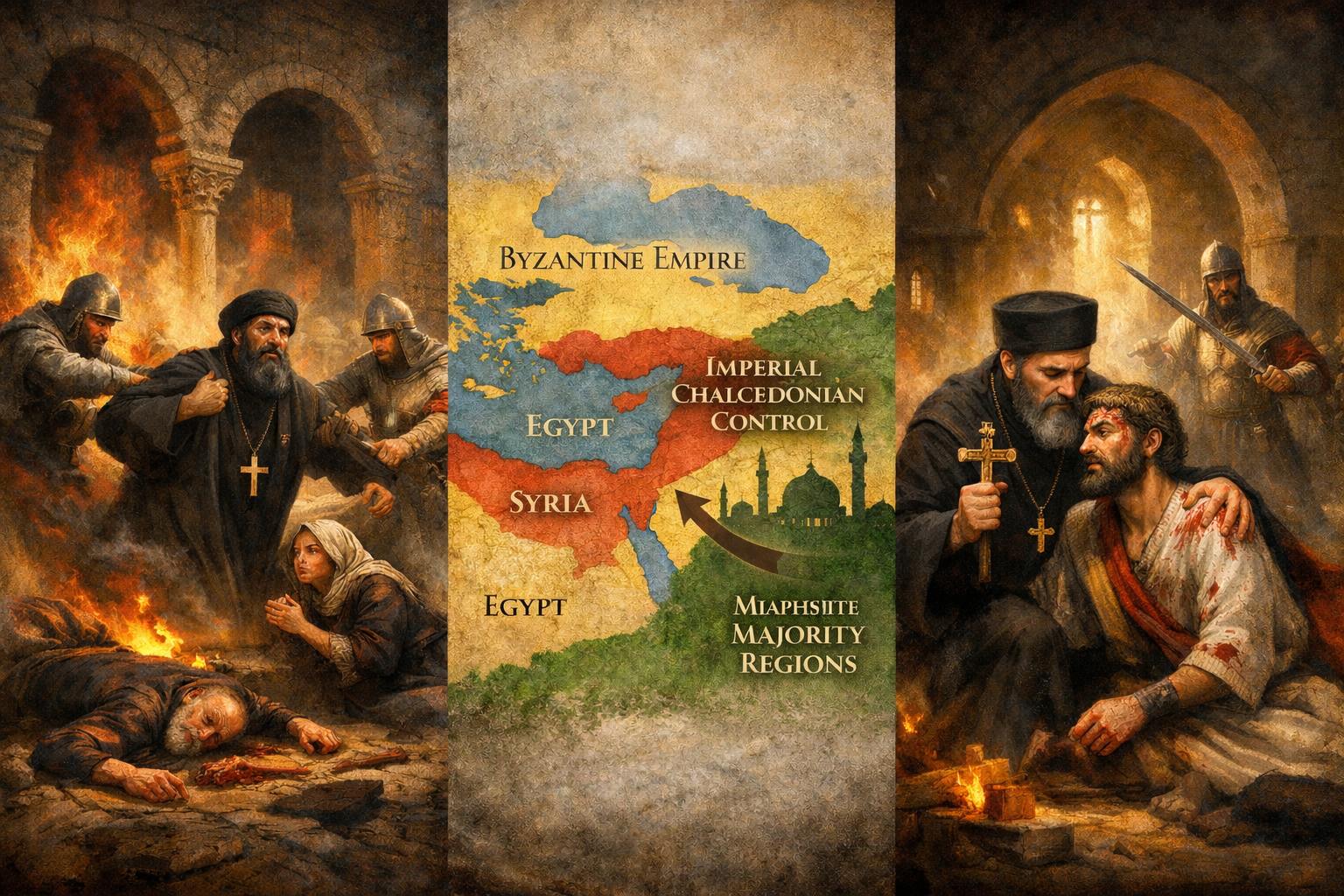
Introduction: The Council of Chalcedon in 451 AD marked a watershed in Christian history, splitting Eastern Christianity into Chalcedonian (Dyophysite) and Miaphysite (often called “Monophysite” by opponents) camps. In its wake, those Christians who refused to accept the Chalcedonian Definition – notably the Coptic Egyptians and other Oriental Orthodox communities – faced waves of persecution by Chalcedonian authorities and even mobs. This persecution spanned nearly two centuries under the Byzantine (Eastern Roman) Empire, from the immediate aftermath of Chalcedon until the Arab Muslim conquests of the 7th century – and in later centuries revived again under the Latin Crusaders , who treated Miaphysites as heretics. What follows is a detailed look at how Miaphysite Christians, especially the Egyptian Copts, were oppressed for their refusal to accept Chalcedon, including key events, statistics, and a timeline of this turbulent era under Byzantine rule, as well as a later epilogue on Coptic Miaphysite persecutions under the Latin (Chalcedonian) Crusaders..
The Schism of 451 and Immediate Aftermath
In 451, the Council of Chalcedon declared that Christ is “in two natures” (divine and human), a formulation the Miaphysites rejected as a betrayal of the earlier Alexandrian teaching of St. Cyril and of the Council of Ephesus I. Chalcedon deposed Dioscorus, the Miaphysite Patriarch of Alexandria, and installed a Chalcedonian replacement, igniting outrage in Egypt and Syria. Resistance was especially fierce in Egypt, where the vast majority of Christians sided with Dioscorus’s Miaphysite theology. Only a small minority in Alexandria supported the Chalcedonian party – contemporary sources suggest 30,000 Greek Chalcedonian loyalists in Egypt versus millions of Coptic Miaphysites.
Chalcedon’s decisions were met with immediate unrest. In Palestine, anti-Chalcedonian monks rioted and even forced the Chalcedonian Patriarch of Jerusalem to flee temporarily. In Alexandria, tensions exploded into bloodshed. Riots broke out as the people rejected Proterius, the imperial-appointed Chalcedonian patriarch. Imperial troops were deployed to suppress the anti-Chalcedonian rebels. Emperor Marcian at first tried letters and diplomacy, but ultimately sent in the army to restore order. The result was brutal: Byzantine troops crushed the rebellion with force, allegedly raping women and killing large numbers of civilians. According to historians, around 10,000 people were killed in Alexandria during the imperial crackdown of 457. (Later Coptic tradition holds the figure of martyrs to be even higher – as many as 30,000 killed – in what Copts remember as a massacre for the faith.)
On Holy Thursday 457, shortly after Emperor Marcian’s death, an anti-Chalcedonian mob in Alexandria took revenge by lynching Patriarch Proterius while he was celebrating the liturgy. The Miaphysites then enthroned Timothy Aelurus (Timothy II) as the rightful Coptic patriarch. This early cycle of sectarian violence tragically set the tone for decades to come. It was said that from this point “Chalcedon, the Ominous” led Christians to persecute fellow Christians for the first time in history.
Byzantine State Repression of Miaphysites
Over the next century and a half, the Eastern Roman (Byzantine) state employed systematic repression to enforce Chalcedonian, particularly in Egypt and Syria. Successive emperors regarded church unity as vital for imperial unity and treated Miaphysitism as religious dissent. This often meant exiling Miaphysite bishops, shutting down their churches, and punishing their followers.
Emperor Leo I (reigned 457–474) initially wavered on how to handle the Egyptian situation. When Timothy Aelurus (the Miaphysite Patriarch) refused to relent, Leo dispatched troops to arrest him, triggering a popular uprising in Alexandria. The army’s suppression of this revolt was so harsh that around 10,000 Alexandrians were slain. Timothy was exiled, and a more conciliatory Chalcedonian, Timothy “Salophakiolos”, was appointed patriarch. Despite these measures, most Egyptians still refused communion with any Chalcedonian clergy; they continued to recognize the exiled Timothy Aelurus as their true pope. This pattern – imperial authorities imposing Chalcedonian hierarchs on a resistant Miaphysite populace – recurred frequently.
For a brief moment, the Miaphysites found relief during the rule of Basiliscus in 475–476. Basiliscus allied with them, restoring exiled Miaphysite bishops like Timothy Aelurus to their sees and even issuing an edict condemning Chalcedon. In Egypt, Timothy Aelurus returned from exile to a hero’s welcome – crowds cheered him as he entered Alexandria, and Basiliscus openly repudiated the Council. However, this triumph was short-lived. Emperor Zeno soon regained the throne, abrogating Basiliscus’s measures. In 482 Zeno tried a compromise via the Henotikon, a decree sidestepping Chalcedon’s contested phrases to reunite Christians³. While the Henotikon kept peace for some years (especially under the Miaphysite-friendly Emperor Anastasius I, 491–518), it did not end the schism. The Church of Rome rejected the Henotikon outright, condemning both its ambiguity and its refusal to affirm Chalcedon explicitly. This rejection triggered the Acacian Schism (484–519) between Rome and Constantinople, even as Miaphysites and Chalcedonians inside the empire continued to interpret the decree differently and quarrel. In practice, therefore, each side maintained its convictions.
By Anastasius’s reign, Miaphysites held high offices in the Church in some eastern regions. In 512, Miaphysite theologian Severus of Antioch was made Patriarch of Antioch, with imperial support. But Chalcedonian laity often fought back. A dramatic incident occurred in Constantinople (512) when the Miaphysites introduced a new theopaschite verse (“…who was crucified for us…”) into the Trisagion hymn. The Chalcedonian crowds of the capital erupted in riot – they tore down statues of Emperor Anastasius and violently attacked Miaphysite worshipers. This event underscores that persecution was not only top-down from the state; Chalcedonian mobs and local factions also terrorized Miaphysites, viewing them as heretics. Similar unrest flared elsewhere – for example, in Syria, Severus of Antioch faced hostility and was expelled by Chalcedonian opponents more than once.
Renewed Persecutions under Justin I and Justinian
The tolerance (or ambivalence) of Anastasius ended abruptly in 518 when Justin I took power. A devout Chalcedonian, Justin I immediately reinstated Chalcedon as non-negotiable policy and restored communion with the Church of Rome, ending the compromise of the Henotikon. He expelled leading Miaphysite bishops – including Severus of Antioch – from their sees across the East. (Egypt was the one province largely exempted, because the Miaphysite Church there was too popular to uproot.) Nevertheless, in Alexandria the Miaphysite patriarch Timothy IV was deposed and replaced by a Melkite (imperial Chalcedonian) patriarch. This sparked street violence in Alexandria between the Coptic faithful and Byzantine troops. Chroniclers report that under Justin’s orders many “who refused to accept Chalcedon” were killed and their churches seized. Indeed, Coptic Church history calls Justin’s accession the start of an era of persecution and oppression lasting over a century.
Justin’s successor, Justinian I (527–565), pursued a two-pronged approach: coercion and conciliation. In practice, his policy oscillated between forcing Miaphysites to accept Chalcedon by persecution and offering compromise formulas to appease them. On one hand, Justinian continued to punish Miaphysite clergy: early in his reign, he summoned the Miaphysite Patriarch of Alexandria, Theodosius, to Constantinople and then exiled him, installing a Chalcedonian replacement in Alexandria. He likewise confirmed the exile of Severus of Antioch (who had briefly returned under Theodora’s protection), and exiled others who resisted Chalcedon. Justinian tried to impose religious unity on his subjects by cracking down on Miaphysite bishops and monks – which only embittered the Egyptian and Syrian populations further. It is said that churches were closed and guarded by imperial troops, especially in Egypt, to starve the Miaphysite church of its meeting places. Coptic sources relate that Justinian even ordered all Coptic churches in Egypt to be shuttered, reducing Egypt to an impoverished spiritual state while the rest of the empire enjoyed freedom.
On the other hand, Justinian – prodded by his influential Empress Theodora, who was herself secretly Miaphysite – attempted theological compromise. He convened the Second Council of Constantinople in 553, which condemned the “Three Chapters” (writings associated with Nestorian leanings) in a bid to reassure Miaphysites that Chalcedon did not endorse Nestorianism. Despite such efforts, Miaphysite leaders remained wary; many perceived the 553 council’s outcome as proof that Chalcedon had been flawed to begin with, rather than a true reconciliation. Justinian’s reign thus saw a mix of appeasement and oppression: he would invite Miaphysite bishops for debates, even integrate their preferred hymns into imperial liturgy (e.g. adding the Miaphysite-favored hymn “Only Begotten Son” to the Eucharistic service), yet if they would not submit, he did not hesitate to exile or intimidate them. This mixed approach ultimately satisfied neither side.
Notably, Theodora provided covert protection to some Miaphysite clergy. She harbored the deposed Patriarch Anthimus of Constantinople in her palace for years, and sponsored the ordination of Jacob Baradaeus – a monk who became legendary for sustaining the Miaphysite hierarchy. Jacob Baradaeus, secretly consecrated as a bishop around 542, traveled in disguise through Syria and Mesopotamia ordaining “underground” Miaphysite clergy by the thousands. He and colleagues like John of Tella ensured that despite persecution, the Syriac Miaphysite Church (later called the Syrian Orthodox or Jacobite Church) survived with its own bishops and priests. The very nickname “Baradaeus” (meaning “raggedly-clothed”) reflects how he evaded authorities by dressing as a beggar. These secret efforts were vital because official pressure was unrelenting – imperial governors and Chalcedonian bishops actively tried to hunt down Miaphysite clergy or force them to conform.
Elsewhere, the Armenian Apostolic Church also rejected Chalcedon (at the Council of Dvin in 506) and remained Miaphysite in Christology. Though mostly outside direct Byzantine rule, Armenians, too, mistrusted imperial motives. Justinian at times attempted to persuade the Armenians to accept Chalcedon; when persuasion failed, Byzantine authorities in Armenian regions resorted to coercion and punitive measures. The Armenians stood firm, turning away Justinian’s envoys and deepening their schism with Constantinople. Thus, across the Near East – from Egypt to Syria to Armenia – a broad Miaphysite front persisted, often suffering for its persistence.
Conflict and Martyrdom in Coptic Egypt
Throughout this period, Egypt’s Coptic Church endured the harshest repression. Copts remember these centuries as a new “age of martyrs,” rivaling the Roman persecutions of an earlier era. Imperial edicts demanded that the Copts renounce Miaphysitism and accept the Tome of Leo (Chalcedon’s doctrine) – a demand most refused. Those who stayed loyal to the Coptic Patriarch (the non-Chalcedonian Pope of Alexandria) faced loss of civil rights, property confiscation, or worse. Coptic sources recount that under the Byzantine yoke, churches were seized and handed over to Melkite (imperial) clergy, and Coptic priests were often jailed or exiled if caught. Some monks and faithful were arrested, beaten, and/or tortured for their refusal to recant their Miaphysite Christology.
Later hagiographies and chronicles attest to thousands of Egyptian Christians martyred for their Miaphysite faith during the century after Chalcedon. For instance, one Coptic chronicle commemorates an episode (perhaps reflecting the events of the late 450s) where imperial forces massacred tens of thousands in Alexandria. While the exact number of deaths cannot be ascertained, modern historians agree the persecution was real and at times severe. The cumulative toll by the 7th century was significant enough that Miaphysite leaders lamented a “cloud of witnesses” – an entire generation of confessors and martyrs who suffered under fellow Christian rulers. This sustained persecution galvanized a strong Coptic identity opposed to Byzantine rule. It also fostered a sense of national resistance in Egypt: Chalcedon became entwined with “foreign” Greek domination, while Miaphysitism became linked with native Egyptian faith and even nationalism.
By the early 600s, Egypt and Syria both had parallel church hierarchies – one Chalcedonian (backed by Constantinople) and one Miaphysite (beloved by the local populace).
The Last Years: Heraclius, Monothelitism, and the Arab Conquest
By the 7th century, seeing that force hadn’t healed the division, the Byzantine emperors made one last attempt at theological compromise. Emperor Heraclius (610–641) and Patriarch Sergius of Constantinople developed the doctrines of Monoenergism and Monothelitism – claiming Christ had “one energy” or “one will” – as a subtle bridge between Chalcedonian and Miaphysite positions. They hoped this formula would satisfy Miaphysites without explicitly repudiating Chalcedon’s two-nature doctrine. Many Eastern bishops cautiously agreed at first, and Heraclius issued an edict (the Ecthesis of 638) imposing Monothelitism as imperial policy.
In Egypt, however, the Miaphysites were not convinced. Heraclius appointed Cyrus (a Chalcedonian who embraced Monothelitism) as both Patriarch and civil Governor of Egypt – an extraordinary measure meant to enforce unity. Patriarch Cyrus ruthlessly attempted to bring the Copts into line. He offered mild concessions in wording but simultaneously carried out a persecution of the Coptic Church. Coptic sources and later historians describe Cyrus as a fanatic who tortured Miaphysite clergy and laity who resisted his union formula. The Coptic Patriarch Benjamin I initially went into hiding to avoid endorsing the compromise. Even while Egypt was under attack by the rising Arab Muslim armies, Cyrus’s regime imprisoned and mistreated Coptic dissidents. Notably, during the Arab siege of Babylon Fortress (Old Cairo) in 640, Cyrus is said to have allowed Coptic prisoners to be tortured within the fortress, prioritizing persecution of Miaphysites even as the empire’s defenses crumbled. This myopic policy earned Cyrus great infamy in Coptic memory.
The arrival of Islam (640s) effectively ended Byzantine persecution. The Arab general ʿAmr ibn al-ʿAs invaded Egypt in 639–641, defeating the Byzantine forces (a defeat hastened, many believe, by local disloyalty fomented by religious grievance). Patriarch Cyrus fled and died in 642. The Coptic Pope Benjamin I emerged from exile to negotiate with the Arabs and was peacefully reinstated as the head of the Church. In some accounts, Egypt’s Miaphysite Christians welcomed the Arabs as liberators from the hated Byzantine yoke. While “welcome” might be an overstatement, it is clear that religious fatigue and resentment meant the Copts offered little resistance to Muslim rule. Similarly in Syria, many Jacobite Syriac Christians did not actively oppose the Arab conquest, having felt alienated under Byzantine rule.
It is telling that chroniclers like John of Nikiu later interpreted the Muslim conquests as divine punishment on the “Chalcedonian persecutors.” The centuries of intra-Christian strife had weakened the empire’s eastern provinces and helped ease the Islamic takeover. After the dust settled, the once-persecuted Miaphysite churches found themselves under new rulers. Although life as dhimmi (non-Muslim subjects) brought its own challenges, the immediate effect was that the Chalcedonian-Miaphysite schism was politically frozen: Egypt and Syria were now cut off from the Byzantine (Chalcedonian) realm. The Oriental Orthodox were free from Byzantine oppression, but they also became isolated from the wider Christian world. As one historian observes, the Copts – once a leading voice in Christendom – were reduced to a localized community, under Muslim rule rather than participants in a global church.
Later Echoes: Miaphysites and the Latin Crusades (11th–14th Centuries)
Medieval chronicles and modern summaries alike note that during the eleventh and twelfth centuries Copts were “harassed by the Arabs for being Christian, and by the Crusaders for being heretics.” As Latin armies entered the Eastern Mediterranean, the small Frankish Catholic minority regarded non-Latin Eastern Christians (including Copts) as schismatics rather than natural allies for their refusal to accept Chalcedon. The Coptic Encyclopedia records that after the Frankish conquest of Jerusalem in 1099, the new Latin rulers appropriated the Holy Sepulchre and barred Eastern Christians, Copts included, from entering the holiest sites because of their ‘heretical’ faith. To pious Copts, this ban on pilgrimage was experienced as a direct act of hostility by Western Christians.
Coptic sources also describe the Crusaders’ military campaigns in and around Egypt as a threat to Christian as well as Muslim populations. The History of the Patriarchs recounts King Baldwin I’s raid on al-Farama (Pelusium) in 1106, highlighting Coptic loyalty to the Fatimid rulers and thanking God for delivering Egypt from the Franks’ attack. Later, the notorious Alexandrian Crusade of 1365, led by King Peter I of Cyprus, devastated a major Mediterranean port with a strong Coptic community: both Muslims and Copts were massacred; mosques and churches were sacked or burned. The ships of the retreating Crusaders were reportedly so overloaded with captives and loot that some of the plunder had to be thrown into the sea on the journey home.
Demographically, this double pressure under Muslim taxation and Latin incursions accelerated the decline of the Coptic community. By the high Middle Ages, Copts were already a shrinking minority in their own land, as many converted to Islam or emigrated. The Crusader period shows that Miaphysite Christians remained vulnerable long after the fall of Byzantine rule in Egypt and Syria. For the Copts especially, the arrival of Western Crusaders did not bring relief from earlier persecutions; it added a new front of hostility, in which they were simultaneously suspect to Muslim rulers and condemned as heretics by Latin Christians.
Timeline of Key Events (451–Crusades)
- 451 – Council of Chalcedon: The fourth ecumenical council declares Christ “in two natures.” Alexandrian Patriarch Dioscorus is deposed for refusing this doctrine. The Chalcedonian Schism begins, with Egypt and much of the East rejecting the Council. Imperial authorities back the council’s decrees.
- 452–454 – Aftermath in Egypt: Pro-Chalcedon Patriarch Proterius is installed in Alexandria, but riots and resistance flare up. Egyptian bishops who sided with Dioscorus face violence at home, and many refuse to accept Chalcedon out of fear of their flocks.
- 457 – Murder of Proterius & Imperial Crackdown: Upon Emperor Marcian’s death, an anti-Chalcedon mob in Alexandria lynches Proterius. Timothy Aelurus is enthroned as the Coptic patriarch. Emperor Leo I responds by sending troops; thousands of Alexandrians are killed in the suppression of the uprising. (Later Coptic accounts say 30,000 were martyred.) Timothy Aelurus is exiled, and a Chalcedonian replacement appointed.
- 475–476 – Basiliscus’s Reversal: Basiliscus temporarily seizes power in Constantinople. He issues an encyclical condemning Chalcedon and restores Miaphysite bishops like Timothy Aelurus and Peter the Fuller to their sees. Massive celebrations in Miaphysite communities (especially Egypt and Syria). Basiliscus, however, is deposed by Zeno within a year.
- 482 – Henotikon of Zeno: Emperor Zeno, advised by Patriarch Acacius, promulgates the Henotikon, aiming to end the schism by omitting mention of “two natures.” It is a vague formula affirming core Nicene and Cyrilline doctrine. Many Eastern bishops (Miaphysite and Chalcedonian) sign it to keep their posts. The schism with Rome (the Acacian Schism, 484–519) begins as Pope Felix III of Rome rejects the Henotikon.
- 512 – Constantinople Riot: Under Emperor Anastasius, Miaphysites gain influence. Severus of Antioch leads a Miaphysite revival. When a Miaphysite phrase is added to the Trisagion hymn in the capital’s cathedral, Chalcedonian laity riot violently, attacking Miaphysites and nearly overthrowing Anastasius. Anastasius appeases the mob but continues supporting Miaphysite clergy in the East.
- 518 – Justin I’s Ascension: With the death of Anastasius, Emperor Justin I (a staunch Chalcedonian) comes to power. He abolishes the Henotikon compromise, restores communion with Rome, and expels Miaphysite bishops across the empire. Severus of Antioch flees to Egypt. Beginning of intense Byzantine persecution of Miaphysites, especially under Justin and (soon) his nephew Justinian.
- 527 – Justinian I begins reign: Emperor Justinian takes power (with Empress Theodora). Justinian initially continues Justin’s hardline policy: Miaphysite patriarchs (e.g. Anthimus of Constantinople, Theodosius of Alexandria) are deposed and exiled. Theodora secretly aids some of them. Miaphysite worship is restricted in many areas.
- 532–537 – Attempts at Reconciliation: Justinian engages in dialogue with Miaphysite leaders. He invites Miaphysite bishops to Constantinople for debates (532) and later issues edicts condemning Nestorian-leaning writings (Three Chapters) to win Miaphysite goodwill. In 553, Justinian convenes the Second Council of Constantinople, which anathematizes the Three Chapters and affirms Cyrillian theology. This fails to win back the Miaphysites, who see it as too little, too late. Meanwhile, persecutions continue sporadically: Justinian’s officials still punish disagreeable Miaphysites even as theological talks proceed.
- 540s – Miaphysite “Underground” Church: In Syria and Mesopotamia, Jacob Baradaeus (supported by Theodora) ordains scores of bishops and hundreds of priests secretly. This ensures a parallel Miaphysite hierarchy survives outside imperial control. Similar secret activity happens in Egypt’s monasteries.
- 565–578 – Reign of Justin II: Justinian’s successor initially tries a softer approach. Justin II lifts some persecutions and even met with Miaphysite patriarchs, hoping to broker unity. However, mistrust runs deep and unity efforts collapse. Under pressure from Chalcedonian bishops (and to please Rome), Justin II returns to a firm Chalcedonian stance, though without the brutality of Justin I.
- 577–590s – Continued Struggles: Under emperors Tiberius II and Maurice, persecution of Miaphysites is intermittent. Miaphysite communities, now well-organized underground, continue to resist. In Persian-ruled Syria/Egypt (briefly during the Perso-Byzantine War, 602–628), Miaphysites find a respite as the Persians favor religious toleration to win support against Byzantium.
- 610–622 – Heraclius and Monoenergism: Heraclius becomes emperor (610) amid war with Persia. He and Patriarch Sergius promote Monoenergism (one energy in Christ) as a compromise. Many Miaphysite leaders remain skeptical, though a few agree to discuss terms.
- 631 – Cyrus in Egypt: Heraclius appoints Cyrus as both Patriarch of Alexandria and Governor, empowered to enforce a union. Cyrus announces the Nine Chapters (633) espousing Monoenergism and demands Coptic acceptance. This begins a final, harsh wave of persecution in Egypt: Coptic Patriarch Benjamin flees, churches are taken over, and dissenters are cruelly punished.
- 633–638 – Monothelite Edict: Sergius and Heraclius refine the doctrine to Monothelitism (Christ has one will). The imperial Ecthesis in 638 makes Monothelitism official. It is rejected by both staunch Chalcedonians (like the Pope of Rome) and the Miaphysites – satisfying no one.
- 639–641 – Arab Conquest of Syria and Egypt: Muslim Arab armies, energized by Islam, invade the Levant and Egypt. Jerusalem falls in 637, and Alexandria by 642. In Egypt, Cyrus’s double role as persecutor and military commander ends badly – he negotiates capitulations and is blamed by Emperor Heraclius for the loss of the province. The Byzantine era in Egypt ends, and with it the state persecution of Miaphysites.
- 641 – Aftermath: Coptic Patriarch Benjamin I returns from 13 years in hiding to lead his people under the new Muslim rule. The Oriental Orthodox (Miaphysite) churches of Egypt and Syria are now separated from the imperial church. Over the next decades, they will adjust to life as tolerated minority churches under Islam, free from Chalcedonian coercion but subject to new forms of pressure.
- 1099 – Latin Capture of Jerusalem: The First Crusade establishes a Latin kingdom in Jerusalem. The new Latin authorities bar many Eastern Christians – including Copts – from the Holy Sepulchre on account of their “heretical” Miaphysite doctrine.
- 1365 – Alexandrian Crusade: King Peter I of Cyprus sacks Alexandria. Muslims and Copts alike are massacred; churches and mosques are looted or burned, and large numbers of captives are taken to Cyprus.
Conclusion
From the council chamber of Chalcedon to the deserts and cities of Egypt and Syria, the period beginning in 451 AD witnessed the tragic spectacle of Chalcedonians persecuting fellow Christians over doctrinal differences – persecution which would resurface again, centuries later, when Chalcedonian/Latin Crusaders treated Coptic Miaphysites as heretics rather than allies. The Miaphysite Orthodox—the Copts of Egypt, together with the Syriac Orthodox and Armenian Apostolic Churches – chose to endure exile, intimidation, and bloodshed rather than compromise their theological convictions. Imperial Byzantine policy, motivated by a desire for religious unity, became “systematic, brutal, and relentless” in its repression of Miaphysitism. By the eve of the Arab conquests, this policy had only succeeded in alienating large segments of the empire’s population.
Countless Miaphysites were murdered, imprisoned, exiled, or tortured for refusing Chalcedon. Persecution also manifested in the form of taxation pressure. Persecution also manifested in the form of taxation pressure. Nearly 200 years of “fluctuating peace and oppression” under nine Byzantine emperors left the Coptic Church traumatized and largely isolated. By the time Islam entered the Eastern Mediterranean, Miaphysitism had become more than theology. It was identity—rooted in shared suffering. It is little wonder that when Islamic rulers arrived, many Miaphysite Christians felt a grim sense of relief. And if the persecutions under Byzantine and Islamic rule were not enough, Latin Crusaders also took their own toll of persecutions on the Miaphysites of Egypt.
In hindsight, the persecution of the Miaphysites weakened the Byzantine Empire’s social cohesion and helped pave the way for the loss of its most ancient provinces to Islam. Yet the Miaphysite Churches survived. The Coptic Orthodox Church, the Syriac Orthodox Church, and the Armenian Apostolic Church continued to preserve their faith and identity through the ensuing centuries – a testament to the resilience of those communities and their deep convictions with their faith. Today, historians view this chapter as a cautionary tale of how theological disagreements, if handled with intolerance, can fracture societies and undermine imperial stability. What began at Chalcedon as a dispute over Christology thus had profound human and political consequences, and the echoes of those conflicts of the 5th century lasting to the Crusades and beyond, are still felt in the enduring divisions of Eastern Christianity.
Sources:
- M. Smith, Christology and Conflict: The Chalcedonian Schism (University Press, 2019).
- Wikipedia: “Chalcedonian Schism”³, “Council of Chalcedon”¹¹, “Justinian I”⁴⁶, “Miaphysitism.”
- Coptic Church Synaxaria and Histories: e.g. St. Mark & St. George Coptic Church history page.
- W.H.C. Frend, The Rise of the Monophysite Movement (1972).
- John Meyendorff, Imperial Unity and Christian Divisions (1989) – analysis of Byzantine religious policy.