Introduction
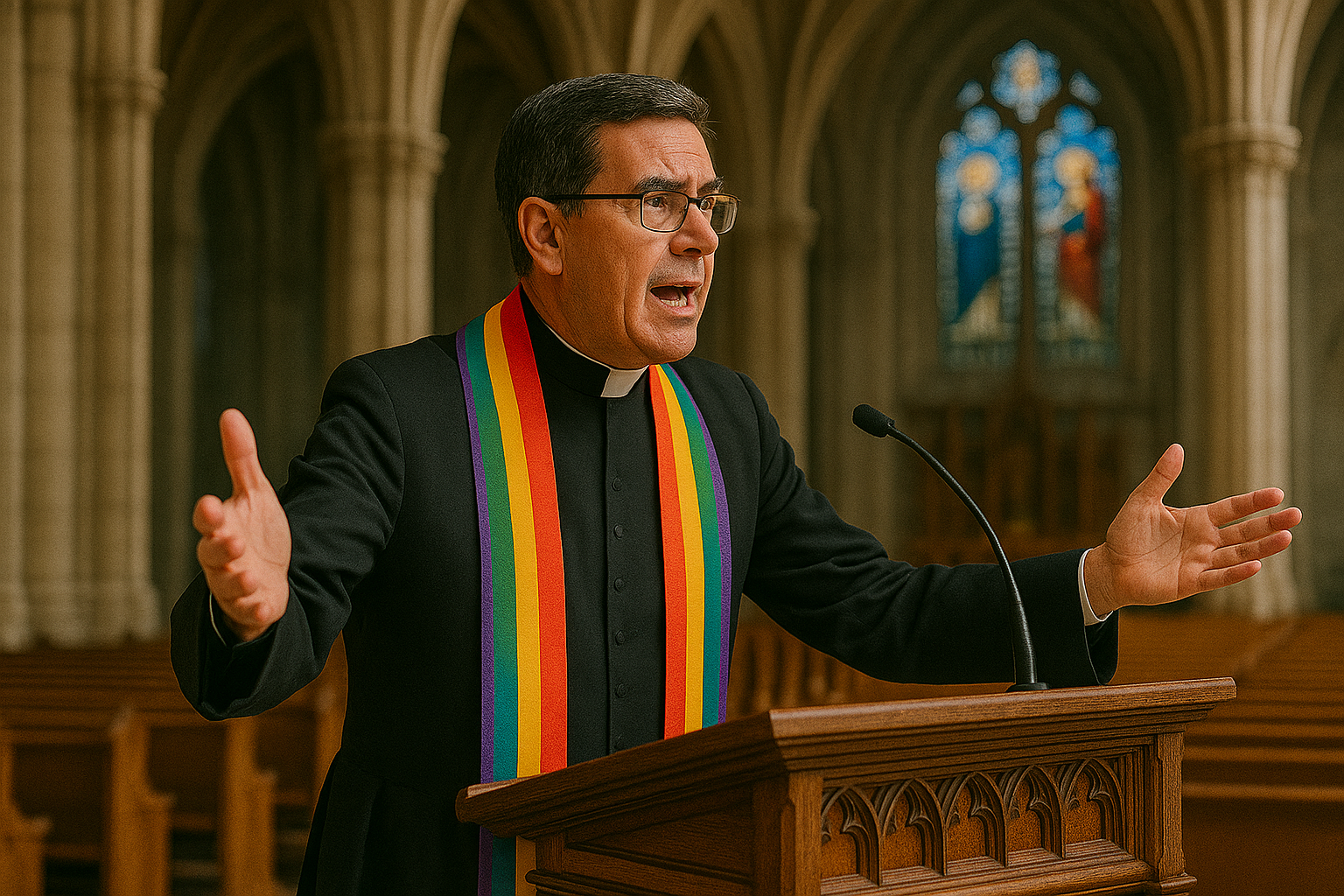
This article examines the emerging phenomenon of openly gay priests in the Roman Catholic Church, and the doctrinal, pastoral, and spiritual consequences that have followed. While only a small number have publicly announced their homosexuality so far, their visibility represents a major shift in the Church’s landscape—and signals the deeper demographic and theological currents that have long been in motion. Through a historical and theological lens, we will examine the origins of the celibacy requirement, its impact on priestly vocations, the pastoral behaviors it fosters, the leadership tone set by Pope Francis, and the eternal stakes for the faithful.
In 325 A.D., the Council of Nicaea advised that priests should marry, and St. Paul taught that clergy should be the husband of one wife and blameless (1 Timothy 3:2). The Roman Catholic Church later mandated celibacy, diverging from these early guidelines—a decision that inevitably contributed to a chronic shortage of priests. Over time, this created a predictable distortion: men who had no intention of marrying—including many with homosexual inclinations—entered the priesthood because the prohibition against marriage posed no obstacle to them.
This demographic distortion is not accidental. In the general Western population, only about 2%–4% of men identify as homosexual. That means the vast majority are heterosexual—and if celibacy had never been mandated, the Roman Catholic Church could have drawn from the far larger pool of marriage-minded men. Today, estimates suggest about 30% of Catholic priests may be gay. A demographic comprising 2–4% of the population becoming an estimated 30% of the priesthood is not natural variation; it is structural selection pressure created by an unbiblical mandate. It filtered out the men most suited to marriage and vocation, and disproportionately attracted candidates whose motivations or inclinations were sometimes secretly at odds with the Catholic Church’s stated moral framework. This is the case, even though the Catholic Church traditionally barred men with “deep-seated homosexual” tendencies from becoming priests.
The Current Issue
A growing number of Catholic priests are beginning to publicly announce their homosexuality—though still only a handful have done so openly. Many more remain silent, not yet willing or ready to come forward, but their presence within the clergy is widely acknowledged. While the Church teaches that individuals with homosexual inclinations can be blameless if they resist temptation and remain celibate, the actual problem is the message these leaders convey—explicitly or implicitly.
Two patterns dominate among the priests who are openly gay:
- Active Revisionists who openly challenge the Catholic teaching that homosexuality is disordered (e.g., Fr. James Martin).
- Passive Normalizers who avoid condemning homosexual acts and treat homosexuality as morally neutral and designed by God (e.g., Fr. Gregory Greiten).
And in all cases, openly gay priests align themselves with the LGBTQ community, a movement the Church has long viewed as celebrating behavior it classifies as sinful. This alignment functions as an implicit doctrinal statement—whether they preach it or not. Even more revealing is this: gay priests who now actively challenge Catholic teaching on homosexuality remain in full ministry, uncorrected and unremoved. This is evidence clearly showing where the Catholic Church is heading—not hypothetically, but in practice.
Answering the “So What?” Question
“So what if a priest is openly gay if he remains celibate?” Because priests are not private individuals; they are leaders who shape doctrine by example. Their silence—or their activism—becomes the teaching. And, unfortunately, the problem was magnified by the tone set from the highest levels. Pope Francis has not formally changed doctrine, but his ambiguity has changed pastoral reality. His remarks (“Who am I to judge?”), public praise of LGBTQ-affirming clergy, and consistent refusal to discipline priests who reject Catholic moral teaching amount to tacit authorization.
This is doctrinal drift through pastoral ambiguity, if not outward affirmation. When doctrine is not proclaimed, culture rushes to fill the void. In parishes led by openly gay priests, the virtue of chastity is not merely underemphasized—it is absent. These priests routinely say, “There is nothing wrong with being gay… you are created in God’s image,” without calling homosexuals to celibacy or restraint. When leaders avoid affirming the Church’s own teaching that homosexual acts are sinful and disorderly—whether out of personal conflict, sympathy, or self-exoneration—they create moral neutrality where the Church demands moral clarity. Passive evasion leads souls astray just as effectively as active revisionism. Both are mounting in the Roman Catholic Church with regard to homosexuality.
Conclusion
Unless the Roman Catholic Church reaffirms its teachings and returns to scriptural instruction and its early canons with regard to criteria for the priesthood, as well as the explicit condemnation of homosexual acts, it faces a self-inflicted moral, doctrinal, and administrative collapse. The crisis is not merely demographic—it is spiritual. A distorted clergy inevitably produces distorted doctrine. And the clearest sign of the Church’s trajectory is this: priests who actively reject Catholic teaching on homosexuality now remain fully active in ministry, with Rome’s knowledge and explicit approval. If the Church continues on this path, it will not merely continue in confusion—it will lead souls into sin under the guise of compassion, and will one day answer before God for the destruction of the flock entrusted to its care.
Truth.