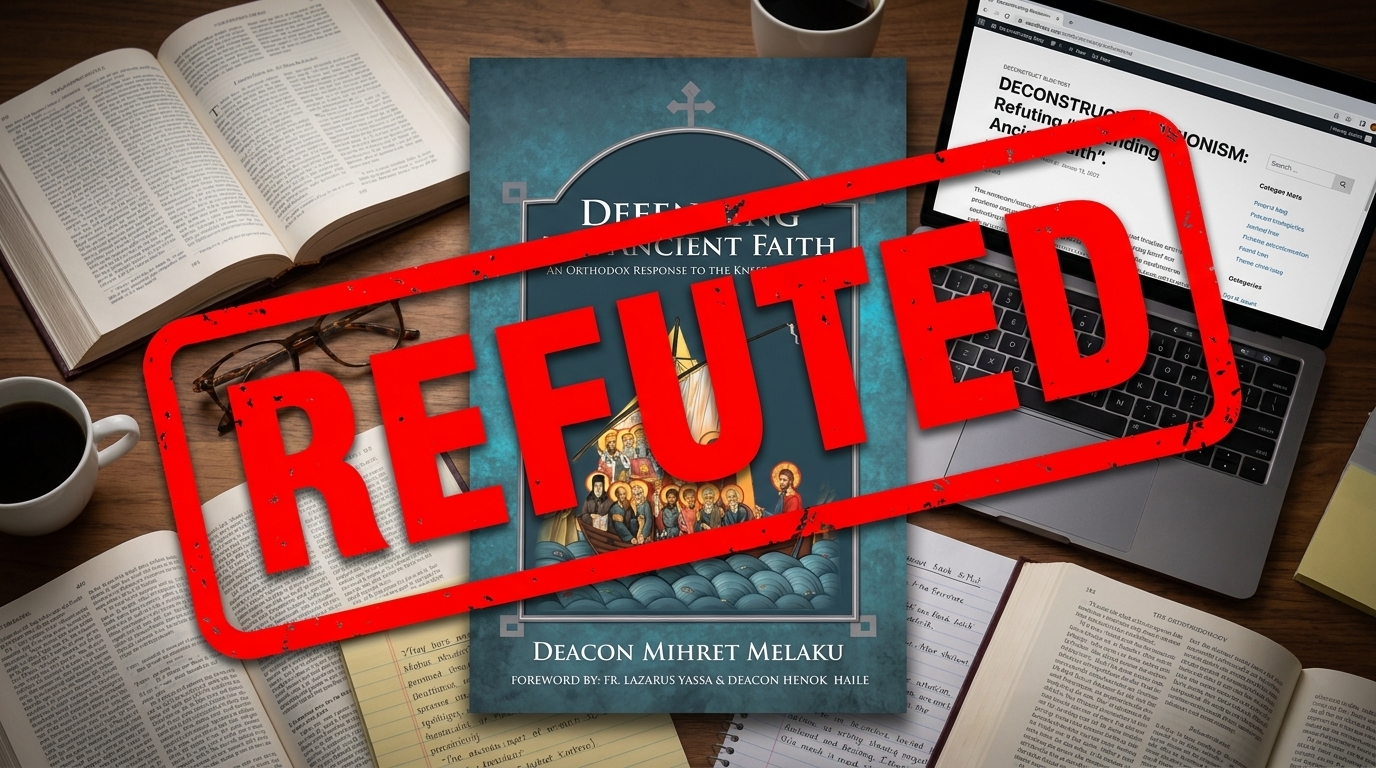
When engaging contemporary theological literature in the Oriental Orthodox tradition, believers and inquirers alike often encounter works aimed at defending our faith against modern secularism or Protestant campus evangelism. A prominent example is Defending the Ancient Faith: An Orthodox Response to the Knechtle Debate by Deacon Mihret Melaku—a Harvard graduate and deacon in the Ethiopian Orthodox Tewahedo Church whose public debates have gained wide acclaim among youth. Endorsed by respected clergy, including a foreword by Coptic priest Fr. Lazarus Yassa (alongside Deacon Henok Haile), the book naturally commands the trust of faithful believers seeking sound patristic answers.
To be fair to the author, Deacon Mihret makes a genuine effort to refute real Protestant errors—such as absolute predestination, total moral depravity, and nominalist legal fictions. Unfortunately, in attempting to dismantle these extremes, he swings violently to the opposite extreme, utilizing modern revisionist theology that rejects nature-level collective guilt, real divine acquittal, and substitutionary sacrifice.
Chapter IX of the book turns its sights specifically to the Fall, Original Sin, and Justification. The author’s arguments form a cascading error: by rejecting collective condemnation and real acquittal, he is forced to deny debt-payment and propitiation on the Cross.
Crucially, in his discussion of justification, Deacon Mihret claims that God simply “makes us righteous” through subjective moral improvement, while failing to ground our justification in the foundational apostolic reality that Christ Himself is “our righteousness” (Christos Dikaiosyne hemon).
To equip believers with an uncompromising defense of the apostolic deposit, this article systematically evaluates the core claims of Chapter IX against conciliar decrees, the pre-451 AD Alexandrian and Coptic patristic standard—specifically St. Irenaeus of Lyons, St. Cyril of Alexandria, St. Athanasius, and St. John Chrysostom—and the living worship (Lex Orandi) of the Coptic Church.
1. Denying Inherited Guilt, Collective Condemnation, and Original Sin in Adam
The Author’s Direct Statement (p. 242)
In Chapter IX, Deacon Mihret explicitly rejects the transmission of guilt or judicial liability from Adam to human nature, appealing to individual moral responsibility:
“For Luther, man is not found initially guilty because of a sin we ourselves did, but that the sin of Adam becomes ours through birth. In other words, Luther (and Calvin by extension) believes that sin itself together with the guilt can be transmitted from father to son. This however goes against the scriptures. In Deuteronomy 24:16 God says: ‘Fathers shall not be put to death for their children, nor shall children be put to death for their fathers; a person shall be put to death for his own sin.'” (p. 242)
Methodological Clarification: Collective vs. Personal Dimensions
Before evaluating patristic texts, it is vital to clarify the two distinct dimensions through which patristic theology addresses both original sin and justification:
-
The Collective Dimension: Refers to human nature as a single, unified organism rooted in Adam (and subsequently restored in Christ as the Second Adam).
-
The Personal Dimension: Refers to the individual appropriation of that shared reality through personal choices, faith, and the Holy Sacraments.
When revisionist writers blur these categories, they create false dichotomies.
The Pelagian Echo in the Author’s Argument
It is vital to recognize that Deacon Mihret’s use of Deuteronomy 24:16 (“a person shall be put to death for his own sin”) to deny collective inherited guilt is not a new Orthodox discovery; it is precisely the identical text and argument used by the ancient Pelagians to deny original sin.
During the 5th-century Pelagian controversy, Pelagius and Caelestius argued that because God stated in Deuteronomy 24:16 and Ezekiel 18:20 that children do not bear the guilt of their fathers, infants must be born morally neutral and entirely unaffected by Adam’s sin. The Church Fathers and the universal councils flatly rejected this misapplication.
Why Deuteronomy 24:16 Does Not Apply to Romans 5 (Original Sin)
Deacon Mihret and the Pelagians confuse personal, individual moral retribution with nature-level collective solidarity:
-
Deuteronomy 24:16 governs individual civil justice and personal moral culpability under the Mosaic court system. God forbids a human earthly judge from executing an innocent child because his biological father committed a capital crime.
-
Romans 5:12–19 addresses collective ontological solidarity. We do not die because an earthly court falsely blamed us for Adam’s personal choice; rather, we die because Adam was the collective head and root of human nature. When the root corrupted itself, the entire tree fell under the sentence of mortality, sin, and condemnation. As St. Paul states, “through one man’s trespass condemnation came to all men” (Romans 5:18).
St. Cyril of Alexandria Explicitly Answers Deuteronomy 24:16 / Ezekiel 18:20
In his Commentary on the Epistle to the Romans (on Romans 5:18), St. Cyril of Alexandria explicitly raises this exact objection from Deuteronomy 24:16 / Ezekiel 18:20 and refutes it, explaining why Deuteronomy 24:16 does not invalidate the collective condemnation of Romans 5:
“What has Adam’s guilt to do with us? Why are we held responsible for his sin when we were not even born when he committed it? Did not God say: ‘The parents will not die for the children, nor the children for parents, but the soul which had sinned, it shall die’ [Deut 24:16 / Ezek 18:20]? How then shall we defend this doctrine? Yes, ‘the soul that sinneth, the same shall die.’ But we have become sinners through the disobedience of Adam in this way: Adam, you see, had been made for incorruption and life… But when he fell into sin and slipped into corruption, from then on pleasures and impurity invaded the nature of the flesh, and a savage law was born in our members. Nature became sick with sin through the disobedience of one, that is, Adam. It is in this way that the many have been made sinners—not as though they had transgressed with Adam (for they did not yet exist), but because they are of his nature, the nature that fell beneath the law of sin.” — St. Cyril of Alexandria, Commentary on Romans 5:18 (P.G. 74: 788-789)
Deconstructing the Revisionist Misuse of St. Cyril’s Exegesis
Deacon Mihret and modern revisionists frequently isolate St. Cyril’s phrase—“not as though they had transgressed with Adam… but because they are of his nature”—to claim that St. Cyril teaches we inherit a purely biological sickness without any original sin, legal debt, or divine condemnation.
This argument rests on a superficial reading that conflates personal culpability with collective condemnation:
-
Denial of Personal Transgression: When St. Cyril asks rhetorically “Why are we held responsible for his sin?” and answers “not as though they had transgressed with Adam,” he is clarifying that descendants are not blamed for committing Adam’s individual personal act. Infants did not physically stand in the Garden of Eden eating from the tree.
-
Affirmation of Collective Condemnation and Judgment: However, St. Cyril explicitly acknowledges that humanity is held accountable under the Fall because human nature itself fell beneath the law of sin, contracting real collective condemnation, curse, and divine wrath.
In On Worship in Spirit and Truth (Book 11, P.G. 68:757), St. Cyril explicitly confirms that Adam’s sin brought real collective judgment and divine wrath upon all humanity:
“In Adam we became communicants in his transgression. But not only that, those things committed by him also brought judgment having spread the curse to all, and in a certain manner allotted the wrath to his offspring.” — St. Cyril of Alexandria, On Worship in Spirit and Truth, Book 11 (P.G. 68: 757)
For St. Cyril, human nature is a single organism. When Adam fell, human nature contracted a real state of alienation, curse, and judgment before God. To claim St. Cyril denied collective guilt or original sin is to quote his denial of personal infant culpability while ignoring his explicit affirmation of nature-level collective condemnation.
The Conciliar Decree of Carthage (418 AD) and its Universal Ecumenical Ratification
The Church’s official conciliar definition on original sin was enacted at the Council of Carthage (418 AD). Canon 2 explicitly anathematizes anyone who denies that infants inherit original sin from Adam requiring baptism for its remission:
“Likewise it seemed good that whosoever denies that infants newly from their mother’s wombs should be baptized, or says that baptism is for remission of sins, but that they derive from Adam no original sin, which needs to be removed by the bath of regeneration… let him be anathema. For on account of this rule of faith even infants, who could have committed as yet no sin themselves, therefore are truly baptized for the remission of sins, in order that what in them is the result of generation may be cleansed by regeneration.”
— Council of Carthage (418 AD), Canon 2
[cite: 5, 7]
This Carthaginian canon was subsequently received, confirmed, and universally ratified across the Christian East and West:
-
The Ecumenical Council of Ephesus (431 AD): Under the leadership of St. Cyril of Alexandria, the Council of Ephesus explicitly condemned Pelagians and received the anti-Pelagian synodical decrees of Carthage.
-
The Council in Trullo / Quinisext (692 AD, Canon 2): Explicitly named and ratified the Canons of the Council of Carthage (418 AD) as universal canon law.
-
The Seventh Ecumenical Council (Nicaea II, 787 AD, Canon 1): Re-affirmed and sealed Canon 2 of Trullo, solemnly ratifying the Canons of Carthage for the entire universal Church.
By claiming that infants derive no inherited original sin or collective condemnation from Adam, Deacon Mihret stands directly condemned by the conciliar canons of the universal Church.
2. Rejecting Scriptural Imputation, Recapitulation, and Christ as “Our Righteousness”
The Author’s Direct Statements (pp. 266, 269)
In Chapter IX, Deacon Mihret attempts to dismantle the concept of imputation (logizomai / reckoning), writing:
“In brief, in Reformed theology imputation most often refers to the legal… crediting of Jesus’s perfect righteousness to believers by faith… The Protestant doctrine of imputation teaches that ‘on paper’ we are counted as righteous… whereas we really don’t become righteous.” (p. 266)
“Imputation, aside from intentional mistranslations by Protestant authors, is altogether a foreign concept to the mind of St. Paul, because contrary to being entrenched in the legal view of society like Luther, St. Paul was immersed in the Hebrew idea of a covenantal relationship.” (p. 269)
Evaluating the Author’s Critique: “Made Righteous” vs. “Christ Our Righteousness”
To evaluate Deacon Mihret’s claim, a critical theological distinction must be made. Deacon Mihret attempts to refute Protestant legal fictions by claiming that God simply “makes us righteous” in an isolated, subjective moral sense through spiritual therapy, while claiming that “imputation” is a foreign concept.
However, Deacon Mihret’s framing creates a severe theological flaw: in Orthodox soteriology, human beings are not made righteous by a moral grace infused apart from Christ, but because Christ Himself IS “our righteousness” (Christos Dikaiosyne hemon) (1 Corinthians 1:30; Jeremiah 23:6).
A. Is the Author Correct in Critiquing Protestant “Double Imputation”?
Yes, in a limited sense. Protestant Scholasticism formulated a doctrine of Double Imputation:
-
The legal imputation of humanity’s sin to Christ on the Cross.
-
The legal imputation of Christ’s personal “active obedience” (His individual keeping of Mosaic ceremonial and moral laws during His 33 years on earth) credited to the believer’s legal ledger.
Under certain hyper-Protestant formulations, this creates a legal fiction: a person is declared legally righteous on paper while remaining intrinsically corrupt and unrenewed (simul iustus et peccator). Deacon Mihret is correct to reject this nominalist legal fiction.
B. Where the Author Commits an Overcorrection and Error
However, in his eagerness to attack Protestantism, Deacon Mihret commits a severe error: he asserts that “imputation is altogether a foreign concept to the mind of St. Paul” (p. 269).
This claim directly contradicts Holy Scripture. In Romans 4 alone, St. Paul uses the Greek verb for imputation/reckoning (logizomai) no fewer than 11 times. Most notably, he quotes King David in Psalm 32:1–2:
“David also describes the blessedness of the man to whom God imputes righteousness apart from works: ‘Blessed are those whose lawless deeds are forgiven, and whose sins are covered; Blessed is the man to whom the LORD shall not impute sin.‘”
— Romans 4:6–8 / Psalm 32:1–2
C. The True Patristic Dynamic: Recapitulation and the Two-Way Movement of Imputation
The issue with imputation in Orthodox soteriology is not the existence of a two-way transaction, but how the second movement is explained. The bestowal of righteousness is entirely downstream of and grounded in the first movement: because our sins, guilt, and debt were truly placed upon Christ and judged in His flesh, His victory and righteousness are communicated to us.
St. Irenaeus of Lyons provides the foundational collective framework for this through his doctrine of Recapitulation (Anakephalaiosis):
“For if no one can forgive sins but God alone, while the Lord remitted them and healed men, it is plain that He was Himself the Word of God made the Son of man… in order that since as man He suffered for us, so as God He might have compassion on us, and forgive us our debts, in which we were made debtors to God our Creator… ‘He has destroyed the handwriting’ of our debt, and ‘fastened it to the cross;’ so that as by means of a tree we were made debtors to God, [so also] by means of a tree we may obtain the remission of our debt.”
— St. Irenaeus of Lyons, Against Heresies, Book V, Chapter XVII
Through Recapitulation, Christ takes our disobedience and debt upon Himself (the first movement), cancels the handwriting against us, and by His own obedience re-constitutes human nature, imparting His righteousness to us so that He becomes our righteousness (the second movement). As St. Paul declares, bridging Isaiah 53:11 and Romans 5:19:
“By His knowledge My righteous Servant shall justify many, For He shall bear their iniquities.” (Isaiah 53:11)
“For as by one man’s disobedience many were made sinners, so also by one Man’s obedience many will be made righteous.” (Romans 5:19)
3. Redefining Grace (Charis) to Erase Divine Acquittal
The Author’s Direct Statement (p. 267)
To erase divine pardon and legal acquittal from soteriology, Deacon Mihret restricts the biblical word grace (charis) exclusively to the uncreated power or energy of God:
“Grace is not an abstract declaration of righteousness, it is the power of God itself, the energies of God which St. Paul mentions throughout his epistles. It is God in action, His activities and operations… Thus the grace of God is identified as the uncreated and divine energies of God.” (p. 267)
“If we are considering salvation to be one big courtroom episode, then the best thing grace amounts to is just a legal declaration of our innocence, a mere status marker. This is not the Orthodox and the biblical understanding of grace.” (p. 267)
The Patristic Orthodox Correction
The author commits the fallacy of totality: taking one valid meaning of a biblical term and asserting it as its sole, exclusive definition.
While St. Paul and the Church Fathers frequently use charis (“grace”) to denote the active, uncreated operational power of God that sanctifies and deifies the believer (e.g., 1 Corinthians 15:10), the Apostle and the Fathers also use charis to denote unmerited divine favor, pardon, and acquittal from condemnation.
In Romans 3:24, St. Paul writes that believers “are justified freely by His grace (charis) through the redemption that is in Christ Jesus.” Here, grace is directly yoked to redemption (apolytrosis) and acquittal (dikaioō), functioning as an unmerited divine pardon granted by God to the guilty.
Authentic Coptic theology holds both dimensions without compromise: grace is both the unmerited favor that acquits human nature on account of Christ’s blood and the uncreated divine power that deifies us in the Church.
4. Denying Collective Restoration, Deification (Theosis), and the “Great Exchange”
The Author’s Direct Statements (pp. 267, 269)
By rejecting any judicial standing before God, Deacon Mihret reduces justification entirely to individual subjective therapy. In doing so, he completely obscures the foundational Alexandrian patristic doctrine of Collective Restoration and the Great Exchange (Admirabile Commercium).
A. Restoration at the Collective (Nature) Level vs. Personal Appropriation
Patristic soteriology maintains two distinct, harmonious levels of restoration:
-
Collective (Nature-Level) Restoration: Just as human nature as a single collective organism was condemned in Adam, human nature as a whole was justified, reconciled, and renewed in Jesus Christ as the Second Adam. By taking created human flesh into personal union with His divine Person, the sinless Logos rendered human nature whole in Himself. Through His voluntary obedience, death, and Resurrection, He acquitted human nature from the ancient sentence of death.
-
Personal (Individual) Appropriation: Applied subjectively to the individual person when they are incorporated into Christ through faith, Holy Baptism, Chrismation, the Eucharist, and a life of repentance.
St. Cyril of Alexandria explicitly outlines this collective restoration of human nature:
“For though it was after us that He was made man for us… still He is therefore called and is the ‘First-born’ of us, because, all men being lost according to the transgression of Adam, His flesh before all others was saved and liberated… since all men were under sentence of death, He, being other than them all, might Himself for all offer to death His own body; and that henceforth, all having died in Him, the word of that sentence might be accomplished.” — St. Cyril of Alexandria, Commentary on the Gospel of St. John, Book X
“Human nature has been justified in Christ, and has turned back to incorruption, and has gained access to God, having been set free from the ancient curse.” — St. Cyril of Alexandria, Commentary on the Gospel of St. John, Book XI
B. The Great Exchange and Christ as “Our Righteousness”
In explaining justification, patristic Orthodoxy establishes a crucial distinction from modern revisionist reductions: Christ Himself is “our righteousness” (Christos Dikaiosyne hemon). Justification is not an abstract legal fiction, nor is it merely moral self-improvement; it is the ontological and relational reality of being in Him.
This is intrinsically bound to The Great Exchange: the divine Logos took what was ours (our mortal flesh, our curse, our debt, and our judicial sentence) to bestow upon us what was His (His righteousness, incorruption, divine sonship, and deification).
By reducing salvation entirely to individual moral therapy and rejecting any judicial verdict for human nature, Deacon Mihret obscures the foundational Alexandrian framework where Christ acts as the new collective head of humanity. As St. Athanasius of Alexandria defines this exchange:
“God took what is ours and gave us what is His… He put on a created nature and became like us in body… that in Him we might be capable of being renewed and deified.” — St. Athanasius of Alexandria, Against the Arians
Likewise, St. Cyril of Alexandria writes:
“For although in that He is perceived to be, and is God, He is free, yet He took the form of a slave, that He might bestow upon us those things which are His, and enrich the slave with His own excellencies.” — St. Cyril of Alexandria, Commentary on Luke, Sermon LXXI
5. Rejecting the Transfer of Sin, Debt, and Substitutionary Judgment
The Author’s Direct Statements (p. 207, p. 266)
Throughout Chapters VIII and IX, Deacon Mihret rejects any transfer of debt or legal liability to Christ, asserting:
“Forgiveness means for a debt to be cancelled not for a debt to be transferred…” (p. 207)
“The problem with imputation goes back to the legalistic paradigm the West has constructed to understand both atonement and salvation…” (p. 266)
The Patristic Orthodox Correction
Deacon Mihret’s assertion directly contradicts Holy Scripture, the Church Fathers, and the living worship (Lex Orandi) of the Coptic Orthodox Church.
A. St. John Chrysostom on the Transfer of Death and Guilt
St. John Chrysostom, in his Homilies on Second Corinthians (Homily 11 on 2 Cor 5:21), explicitly utilizes an analogy of a king transferring both death and guilt to his innocent son to explain Christ bearing our judgment:
“If one that was himself a king, beholding a robber and malefactor under punishment, gave his well-beloved son, his only-begotten and true, to be slain; and transferred the death and the guilt as well, from him to his son, (who was himself of no such character,) that he might both save the condemned man and clear him from his evil reputation…”
— St. John Chrysostom, Homilies on Second Corinthians (Homily XI)
B. St. Cyril of Alexandria on the Transfer of Debt
St. Cyril of Alexandria explicitly utilizes the exact concept and word “transferred” when explaining the transfer of human debt and sentence onto Christ:
“The goat, then, male or female, was sacrificed for sins. But the death was our desert, inasmuch as by sin we had fallen under the divine curse. But when the Savior of all Himself, so to speak, undertook the charge, He transferred to Himself what was our due, and laid down His life, that we might be sent away from death and destruction.” — St. Cyril of Alexandria, Commentary on Luke, Sermon LIII
“So also He paid the debt that was incurred for us, and we ourselves became righteousness in Him; for those who have been freed from debts are righteous, and are not termed liable.”— St. Cyril of Alexandria, Letter 41 to Acacius
C. The Coptic Liturgical Confirmation (Lex Orandi, Lex Credendi)
This transfer of debt is enacted in every Coptic Divine Liturgy during the Rite of the Choice of the Lamb and confessed explicitly in the Fraction to the Son:
“He ascended upon the Cross that He may bear the punishment of our sins. We are the ones who sinned, and He is the One who suffered. We are the ones who were indebted to divine justice because of our sins, and He was the One who paid the debts on our behalf.“— Fraction to the Son, Coptic Divine Liturgy
Before the oblation is offered upon the altar, the Coptic priest places his hand directly upon the Lamb, dramatizing Leviticus 16:21 to signify the transfer of human sin, guilt, and liabilities onto Christ, the Lamb of God who bears the sin of the world.
D. Substitutionary Bearing of Divine Judgment
St. Athanasius of Alexandria explicitly affirms this substitutionary bearing of divine judgment:
“He suffered these things, not for His own sake but for ours… ‘Thou hast made Thy wrath to rest upon me’ [Psalm 88:7]… He suffered for us, and bore in Himself the wrath that was the penalty of our transgression.”
— St. Athanasius of Alexandria, Letter to Marcellinus on the Interpretation of the Psalms
[cite: 3]
“He takes to Himself a body capable of death that it… might be worthy to die instead of all… He gave it over to death in the stead of all, and offered it to the Father.” — St. Athanasius of Alexandria, On the Incarnation, Chapter 2, Section 9
Summary Matrix of Soteriology & Imputation Views
| Concept | Western/Protestant View | Modern Revisionist View (Mihret) | Authentic Patristic / Coptic Orthodox View |
| Original Sin / Condemnation |
Inherited personal moral guilt biologically transmitted. |
Reduces Fall strictly to biological mortality; denies nature-level condemnation. |
Collective Condemnation: Human nature as a single organism fell under divine sentence/condemnation in Adam (Council of Carthage Canon 2; Rom 5:18). |
| Imputation (Logizomai) |
Double Imputation: paper credit of Mosaic active obedience. |
Claims imputation is “altogether a foreign concept to St. Paul”. |
Recapitulative Imputation: Non-imputation of sin + imputation/impartation of Christ’s righteousness through union with Him via Recapitulation (Rom 4:6–8; St. Irenaeus; St. Cyril). |
| Remission vs. Righteousness |
Righteousness is a nominal legal credit separate from transformation. |
Reduces justification purely to subjective medical therapy. |
Inseparable Unity: Remission removes punishment/debt; Christ is our righteousness, granting divine sonship, glory, and deification (theosis). |
| Scope of Restoration |
Strictly individual legal transaction. |
Denies collective restoration at all levels. |
Collective & Personal: Human nature was collectively restored/deified in Christ as Second Adam on Calvary; personally applied via faith and Baptism. |
Conclusion: Reclaiming the Fullness of Patristic Soteriology
Chapter IX of Defending the Ancient Faith demonstrates the severe danger of theological overreaction. While Deacon Mihret makes a commendable effort to refute Protestant errors, he unfortunately adopts revisionist theology that errs in the opposite extreme.
Authentic Orthodoxy refuses both Protestant legalistic fictions and modern anti-juridical reductions. As St. Cyril of Alexandria, St. Irenaeus, and St. Athanasius faithfully proclaim:
-
Human nature collectively fell under a sentence of death and divine condemnation in Adam, a conciliar truth enshrined in Canon 2 of the Council of Carthage (418 AD) and ecumenically ratified at Ephesus (431 AD), Trullo (692 AD), and Nicaea II (787 AD). Deacon Mihret’s use of Deuteronomy 24:16 mirrors the refuted arguments of the ancient Pelagians.
-
St. Paul’s doctrine of imputation (logizomai) in Romans 4:8 (“Blessed is the man to whom the Lord will not impute sin”) is a vital scriptural truth; while we reject Protestant legal fictions, God truly non-imputes sin and imputes righteousness to those united to Christ, recognizing Christ as our righteousness.
-
Human nature as a whole was collectively restored, healed, and deified (theosis) in Christ as the Second Adam through Recapitulation and the Great Exchange.
-
Christ objectively paid our debt, bore our curse, and offered a Godward substitutionary sacrifice to the Father on Calvary, transferring our guilt and death to Himself.
-
This collective salvation is personally appropriated by the believer through living faith and participation in the Holy Sacraments of the Church.
Orthodox youth, servants, and clergy are urged to be wary of modern reductionist explanations masquerading as “Orthodoxy” that are predominately over-reactions to Western theology. and to hold fast to the complete, uncompromised patristic deposit delivered to the Orthodox Church.