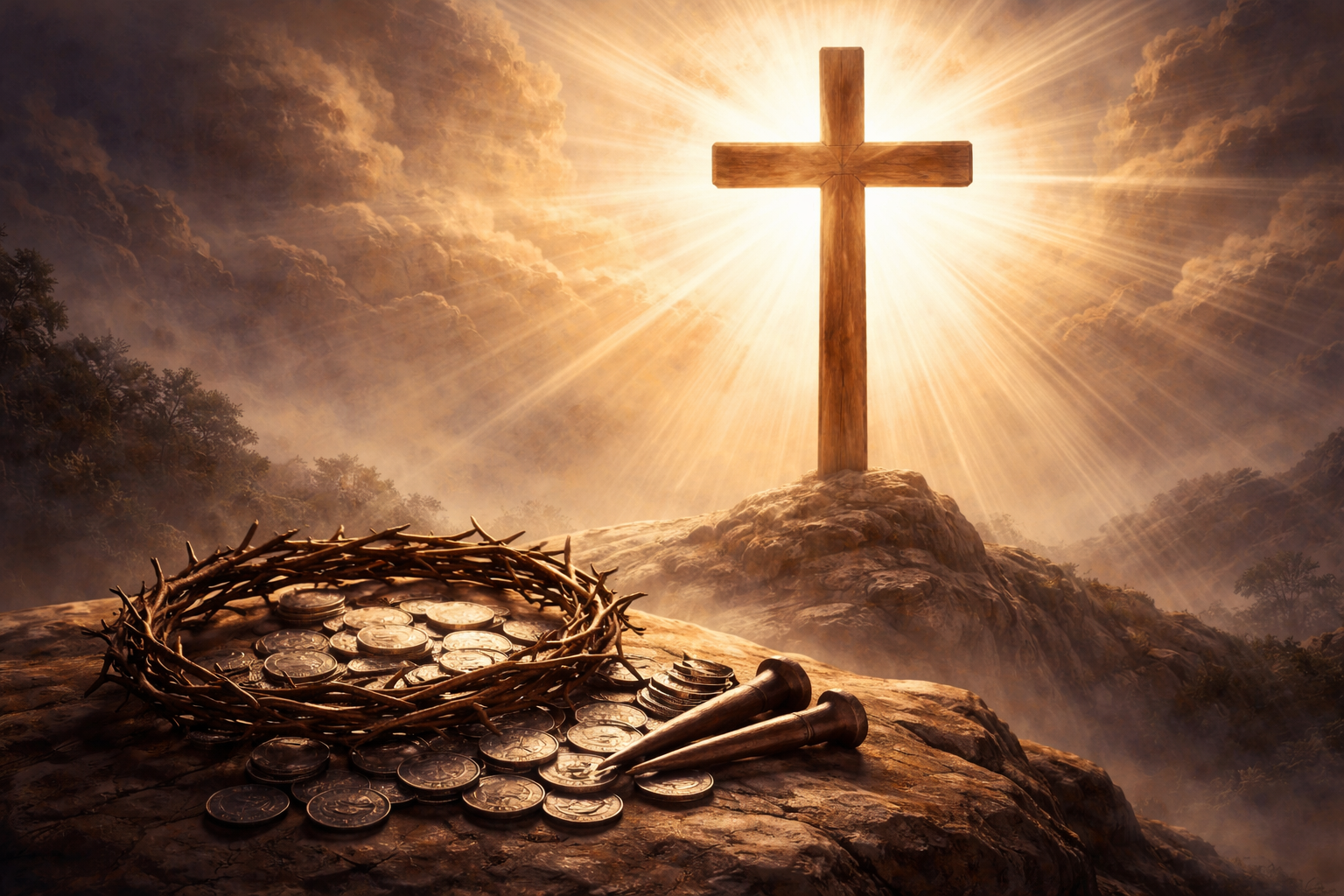
The Lord’s utterance upon the cross—“Eli, Eli, lema sabachthani?” (“My God, My God, why have You forsaken Me?”) recorded in Matthew 27:46 and Mark 15:34—represents one of the most profound Christological and soteriological moments in sacred Scripture. Quoting the opening line of Psalm 22 (Psalm 21 in Septuagint), Christ speaks from the depths of His passion, invoking a text that historically functioned as both an agonizing lament and a universal hymn of redemption.
In modern theological discourse, two primary errors frequently obscure the patristic understanding of this event. On one end, twentieth-century “neopatristic” revisionists attempt to strip early Christian soteriology of its forensic, substitutionary, and penal dimensions, asserting that terms such as “penalty,” “debt,” “satisfaction,” and “substitution” are medieval Western corruptions foreign to the early Church Fathers. On the opposing end, extreme forensic formulations portray an ontological breach within the Trinity, representing God the Father as venting personal emotional rage upon the Son.
An examination of ante-Nicene and post-Nicene Fathers prior to the Council of Chalcedon (451 AD) demonstrates an integrated, balanced soteriology. The early Church Fathers understood Christ’s cry of forsakenness not as a literal rupture of the divine essence, nor as an expression of personal despair, but as an act of representative appropriation (oikeiosis) of the human race. In His Incarnation, the sinless Logos assumed fallen human nature, entering into humanity’s cursed and condemned state as our legal representative and substitute. By bearing the debt, sentence, and penalty of sin upon the tree of the cross, Christ satisfied the divine sentence, fulfilled the divine law, destroyed death, and reconciled humanity to God without compromising Trinitarian indivisibility.
This article will explain how Christ’s redemptive work on the cross ties in with the phrase “Why have you forsaken me?” by:
-
Grounding Psalm 22 within its broader Old Testament and apostolic context, linking Christ’s cry to the prophetic strands of Zechariah 13:7, Isaiah 53, the Sign of Jonah, and Galatians 3:13.
-
Examining how early Church Fathers prior to 451 AD—specifically St. Athanasius, St. Gregory of Nazianzus, and St. Cyril of Alexandria—interpreted Christ’s “forsakenness” as a vicarious, representative act rather than a personal separation from the Father.
-
Exposing the modern “neopatristic” revisionism that attempts to expunge legal and penal language from Orthodox soteriology, while simultaneously refuting straw arguments that depict the Father as an emotionally angry, bloodthirsty deity.
-
Comparing the patristic consensus with sixteenth-century Protestant Reformer formulations, evaluating whether classical Reformation views genuinely create a Trinitarian rift or if such claims are caricatures.
Psalm 22, Isaiah 53, and the Struck Shepherd
In ancient Jewish liturgical practice, reciting the opening line of a Psalm served as an explicit invocation of the entire composition. Psalm 22 does not terminate in defeat or abandonment; rather, it follows a structured movement from acute lamentation (vv. 1–18) to triumphant vindication, global evangelization, and universal worship (vv. 21–31). The psalm explicitly foretells the precise mechanics of the crucifixion—the piercing of hands and feet (v. 16), the mocking by onlookers (vv. 7–8), the drying up of strength (v. 15), and the casting of lots for garments (v. 18)—before concluding with the proclamation that “all the ends of the world shall remember and turn to the Lord” (v. 27). By proclaiming the incipit of Psalm 22, Christ publicly identifies His suffering as the long-awaited fulfillment of messianic prophecy, announcing that His imminent death is the precise mechanism by which divine salvation is accomplished.
This prophetic framework aligns directly with several other major Old Testament messianic strands:
- The Stricken Shepherd (Zechariah 13:7): Prophetically announcing the divine decree, Zechariah writes: “Awake, O sword, against My Shepherd, against the Man who is My Companion, says the Lord of hosts. Strike the Shepherd, and the sheep will be scattered.” Christ applies this verse directly to Himself on the night of His betrayal (Matthew 26:31). The “sword” executing judgment against the Shepherd illustrates the divine necessity of Christ’s vicarious sacrifice, wherein the Shepherd willingly submits to the judicial sentence of death so that the scattered flock may be gathered into eternal life.
- The Suffering Servant (Isaiah 53): Isaiah details the substitutionary character of the Messiah’s passion. The Servant “has borne our griefs and carried our sorrows” (v. 4); He was “wounded for our transgressions” and “bruised for our iniquities” (v. 5); “the Lord has laid on Him the iniquity of us all” (v. 6); and His soul was made “an offering for sin” (v. 10). St. Cyril of Alexandria and St. Athanasius cite Isaiah 53 extensively to explain that Christ, though personally guiltless, assumed the liability and penalty of human transgression.
- The Sign of Jonah and Descent into the Deep (Jonah 2:1–7 & Matthew 12:39–40): In Jonah 2, the prophet cries out from the belly of Sheol after being cast into the surging deep, lamenting, “I have been cast out of Your sight; yet I will look again toward Your holy temple” (Jonah 2:4). Christ explicitly identifies Jonah’s three-day entrapment in the abyss as the preeminent “sign” of His own burial and descent into death (Matthew 12:39–40). Jonah’s experience of divine judgment and apparent abandonment while submerged in the depths of the earth mirrors Christ’s voluntary entry into human dereliction and death on the cross, anticipating both the acute suffering of forsakenness and the certainty of miraculous deliverance and resurrection
- Bearing the Divine Curse (Galatians 3:13 & Deuteronomy 21:23): St. Paul writes that “Christ has redeemed us from the curse of the law, having become a curse for us; for it is written, ‘Cursed is everyone who hangs on a tree.'” This curse was not merely a human sentence or a Roman civic execution, but the judicial execution of the divine decree pronounced upon human transgression (“Cursed is everyone who does not continue in all things written in the book of the law”). By voluntarily hanging upon the wood of the cross, Christ stepped into humanity’s place of condemned abandonment, absorbing the divine curse of the broken law into His own sinless flesh so that the divine sentence might be legally satisfied and life restored.
This scriptural harmony is reiterated in apostolic teaching. St. Paul writes that God “made Him who knew no sin to be sin for us, that we might become the righteousness of God in Him” (2 Corinthians 5:21). The cry of Psalm 22:1 serves as the Scriptural summary of this vicarious exchange.
Patristic Explanation of “Forsakenness”: Representative Appropriation
The early Church Fathers consistently interpreted the “forsakenness” expressed in Psalm 22:1 through the Christological principle of Representative Appropriation (oikeiosis in Greek, or appropriatio). Because the divine Logos assumed a complete, uncorrupted human nature, He functioned as the Second Adam—the supreme representative and Head of the human race. Consequently, when Christ spoke on the cross, He spoke in the person of fallen humanity, taking upon His own lips the lament of those who were truly forsaken by God on account of sin.
This dynamic of representative substitution operates across distinct Christological dimensions:
-
Assumption of Human Nature: The divine Logos assumes fallen human flesh and soul, taking on the full reality of human mortality.
-
Representative Appropriation: Christ takes humanity’s legal abandonment, curse, and lament onto His own sinless lips as the representative Head.
-
Substitutionary Atonement: Christ pays the penalty of death, satisfying divine law and justice on the tree of the cross.
-
Restoration and Deification: By absorbing humanity’s death sentence and fulfilling it, Christ destroys death and grants eternal incorruptibility (theosis).
St. Gregory of Nazianzus (The Theologian)
In his Third Theological Oration (Oration 30.5), St. Gregory directly addresses the text of Psalm 22:1, refuting any notion that the Son was personally abandoned by the Father:
“It wasn’t the Son, in His own person, whom the Father forsook. Nor was He forsaken by His own divinity, as some think, as if His divine nature were frightened of the cross, and fled from Him in His sufferings… But as I said, Christ was, in Himself, representing us—and we were the ones who were forsaken and rejected, before He came to save us. But now, by the sufferings of Him who could not suffer, we have been reconciled to God and saved. Likewise, He makes our foolishness and our sins His own… Thus in carrying our salvation, Christ makes our condition His very own.” [cite: 9, 12]
St. Gregory clarifies that Christ takes our dereliction pro nobis (for us). Humanity was under divine rejection due to Adam’s transgression; Christ, by entering into our state and voicing our condemnation, transformed our condition from within, and reconciled us to God.
St. Athanasius of Alexandria
St. Athanasius echoes this principle in his anti-Arian treatises and his Letter to Marcellinus. He explains that Christ did not utter the cry of forsakenness for His own sake—as if the eternal Son could ever be separated from the Father—but rather for our sakes:
“The Lord uttered these words on our behalf… He was not forsaken by the Father, for He was ever in the Father, both before He spoke and when He spoke. But we were the forsaken ones, and He, taking our abandoned state upon Himself, transformed it.” [cite: 5, 13]
In On the Incarnation, St. Athanasius connects this representative voice with the legal necessity of paying a penalty. Death was a judicial sentence pronounced by God upon Adam’s disobedience (“in the day that you eat of it you shall surely die”). Because God could not act untruthfully by waiving His own divine decree without compromising divine consistency (to eulogon), Christ assumed a mortal body “capable of death” and offered it as an equivalent substitute “in the stead of all”.
St. Cyril of Alexandria
St. Cyril emphasizes the legal and representative role of Christ as the High Priest and Advocate of mankind. In his Commentary on the Gospel of St. John, Cyril writes:
“We were, then, accursed and condemned, by the sentence of God, through Adam’s transgression… For we are justified, now that Christ has paid the penalty for us; for by His stripes we are healed, according to the Scripture.” [cite: 8]
For Cyril, Christ’s cry on the cross is the moment where the Representative of humanity absorbs the condemnation of the divine law, bearing the sentence in His own flesh so that the sentence against us might be legally canceled.
Trinitarian Orthodoxy: Preserving the Indivisible Unity of God
A central requirement of Orthodox soteriology is that any explanation of atonement must strictly preserve Trinitarian dogmatics. The Holy Trinity is consubstantial (homoousios), possessing one indivisible divine essence (ousia), one divine will (thelema), and one undivided divine energy (energeia).
Consequently, the early Church Fathers rejected any interpretation of Psalm 22:1 that suggested:
-
An ontological rupture or detachment within the Godhead.
-
The Father turning away from the Son in divine abhorrence or personal hostility.
-
The divine nature of Christ departing from His human nature during the Crucifixion.
The Hypostatic Union dictates that the divine and human natures were united in the single Person (hypostasis) of the Logos “without confusion, without change, without division, without separation.” Even when Christ died on the cross and His human soul separated from His human body, His divinity remained inseparably united to both His body in the tomb and His soul in Hades.
Furthermore, the cross was not an act of the Father inflicting punishment upon a reluctant Son; it was a single, harmonious Trinitarian operation. As Scripture affirms, the Father out of love gave His Son (John 3:16); the Son voluntarily laid down His life (John 10:17–18); and the offering was made “through the eternal Spirit” (Hebrews 9:14). The Father’s stance toward the Son on the cross was not personal wrath, but Divine pleasure and love, as Christ Himself declared: “Therefore My Father loves Me, because I lay down My life that I may take it again” (John 10:17).
Deconstructing Modern Revisionism (Neopatristic Reductions)
In the early twentieth century, a movement arose—spearheaded by theologians such as Metropolitan Anthony Khrapovitsky (1917) and later popularized by Gustaf Aulén’s 1930 work Christus Victor—which sought to redefine Orthodox soteriology by expunging all forensic, substitutionary, and penal terms. These writers claimed that concepts such as “satisfaction,” “penalty,” “debt,” and “substitution” were Anselmian or Protestant corruptions alien to early Christianity.
However, historical examination of ante-Nicene and post-Nicene texts demonstrates that this modern “neopatristic” reductionism misrepresents primary source material. The Church Fathers held a comprehensive soteriology that integrated both the Juridical/Substitutionary dimension (paying the debt, satisfying divine justice, fulfilling the law) and the Ontological/Therapeutic dimension (conquering death, recreating fallen nature, deification/theosis).
The primary patristic evidence for juridical and substitutionary language includes:
-
St. Athanasius of Alexandria:
-
On Death as a Penalty: “Corruption held sway over them because it was the penalty of which God had forewarned them for transgressing the commandment.” (On the Incarnation, Chapter 1, Section 5)
-
On Fulfilling Divine Consistency: “In order that the law involving the ruin of men might be undone… and that divine consistency might be preserved.” (On the Incarnation, Chapter 2, Section 8)
-
On Substitution: Christ took a body capable of death and “gave it over to death in the stead of all, and offered it to the Father.” (On the Incarnation, Chapter 2, Section 9)
-
On Satisfying Debt: Christ “satisfied the debt by His death” and put away death “by the offering of an equivalent.” (On the Incarnation, Chapter 2, Section 9)
-
On Bearing Wrath: Christ “bore in Himself the wrath that was the penalty of our transgression.” (Letter to Marcellinus)
-
-
St. Cyril of Alexandria:
-
On Legal Condemnation and Penalty: “We were, then, accursed and condemned, by the sentence of God, through Adam’s transgression… For we are justified, now that Christ has paid the penalty for us; for by His stripes we are healed, according to the Scripture.” (Commentary on the Gospel of St. John, Book 12)
-
On Vicarious Suffering: “For our sake He paid the penalty for our sins.” (Commentary on the Gospel of St. John, Book 12, Chapter 19)
-
-
St. John Chrysostom:
-
On Punishment: “He Himself, through suffering punishment, did away with both the sin and the punishment, and He was punished on the Cross.” (Homilies on Colossians, Homily VI)
-
On Payment of a Debt: “Christ paid far more than we owe, as much more as an infinite ocean is compared to a small drop of water.” (Homilies on Romans, Homily X)
-
-
The Epistle of Mathetes to Diognetus (~130 AD):
-
On Vicarious Exchange: “He took on Him the burden of our iniquities, He gave His own Son as a ransom for us, the holy One for transgressors… O sweet exchange!” (Epistle to Diognetus, Chapter 9)
-
-
St. Irenaeus of Lyons:
-
On Reconciling Debt and Disobedience: “And in the first Adam indeed we offended God, not performing His commandment; but in the second Adam we have been reconciled, becoming obedient unto death.” (Against Heresies, Book V, Chapter 16.3)
-
Evaluating the Reformers: Caricature vs. Reality
High Reformed scholasticism (e.g., John Calvin, Francis Turretin) officially maintained classical Nicene Trinitarianism, asserting that the Trinity remained undivided in essence and that Christ’s divine nature never ceased to be one with the Father.
However, in their pastoral and polemical formulations, the Reformers frequently used language stating that the Father was personally angry with Christ as He hung on the cross, or that Christ suffered the actual torments of damned souls in hell under the Father’s active vengeance. While this does not formally constitute a dogmatic denial of the Trinity, it introduces a severe psychological and affective tension within the Godhead, picturing the Father as holding an active stance of wrath toward the Son.
The Patristic perspective avoids this tension through the doctrine of Representative Appropriation. The Father was never personally angry with the sinless Son; rather, the Son voluntarily assumed our legal liability and mortality, absorbing the objective consequences and penal sentence of human sin into His life-giving humanity.
Refuting Straw Arguments: The Harmony of Divine Justice and Divine Love
Critics of substitutionary atonement often construct straw arguments depicting God the Father as an emotionally angry, sadomasochistic deity who requires the torture of His innocent Son to pacify His emotional rage. The Church Fathers explicitly refuted these caricatures centuries before the rise of modern theology.
Refutation of the “Bloodthirsty Father”
In Oration 45 (and Oration 30.14), St. Gregory of Nazianzus explicitly raises and rejects the notion that the Father demanded blood out of anger or emotional pacification:
“To whom was that blood offered that was shed for us, and why was it shed?… If to the Evil One, fie upon the outrage! If the robber receives a ransom not only from God, but a ransom which consists of God Himself… But if to the Father, I ask first, how? For it was not by Him that we were being kept under oppression. And next, On what principle did the blood of His Only Begotten Son delight the Father, Who would not receive even Isaac, when he was being offered by his father, but changed the sacrifice, putting a ram in the place of the human victim? Is it not evident that the Father accepts Him, but that He did not ask for Him or demand Him; but on account of the Economy, and because humanity had to be sanctified by the Humanity of God…” [cite: 15]
St. Gregory demonstrates that the Father did not greedily demand suffering out of personal malice. Rather, the sacrifice occurred “on account of the Economy”—to uphold divine truth, fulfill the law, and sanctify humanity through the assumed nature of the Logos.
Harmony of Justice and Mercy
In Alexandrian soteriology (as expressed by St. Athanasius, St. Cyril, and modern Coptic theologians like Pope Shenouda III), Divine Truth and Divine Mercy are not opposing attributes in God. God does not suspend His judgment to exercise mercy, nor does He abandon His mercy to execute judgment:
-
Mercy without Judgment is Weakness: If God merely forgave Adam’s sin by a decree without addressing the sentence of death, divine consistency would fail, and sin would remain unrectified within creation.
-
Judgment without Mercy is Destruction: If God executed the full penalty of death directly upon humanity without a Redeemer, the entire human race would perish eternally.
-
The Harmony on the Cross: On the cross, mercy and truth met and operated simultaneously. The Divine sentence was satisfied because the full legal penalty of human sin was paid in flesh by an equivalent substitute; Divine Mercy was expressed because God Himself provided the sacrifice in the Person of His Son.
The ransom was paid directly to God Himself—because sin was committed against God (Psalm 51:4). The devil was merely a jailer holding mankind under the sentence of death; he possessed no legal rights to receive a ransom. By offering Himself as a ransom to God the Father via His death, Christ legally disarmed the devil, abolished the handwriting of requirements against us and paid our debt, then rose victorious from the dead, granting us incorruption as our First Fruit and Representative.
Comparative Analysis: Patristic Consensus vs. Protestant Reformers
To evaluate whether Protestant Reformers created an ontological “rift in the Trinity” or whether such accusations are caricatures, the following structured comparison details early Patristic thought, twentieth-century Neopatristic reductionism, and sixteenth-century Classical Protestantism across major soteriological axes.
| Evaluation Axis | Early Patristic View (Pre-451 AD) | Modern Neopatristic View (20th Century) | Classical Protestant View (Reformers / Calvin) |
| Interpretation of Ps 22:1 (“Forsakenness”) |
Representative Appropriation (oikeiosis): Christ speaks as the Head of humanity, making our forsaken state His own without any ontological separation from the Father. |
Symbolic / Pedagogical invocation only; completely rejects any real bearing of divine penal forsakenness. |
Forensic substitution: Christ experienced in His human soul the actual terror, agony, and sensation of divine judgment and hell deserved by sinners. |
| Trinitarian Posture during Cross |
Distinct personal roles in a unified divine operation: Father acts as Lawgiver/Judge executing the divine decree (“strike the Shepherd”) and receives the sacrifice; Son acts as High Priest, Mediator, and Surety voluntarily bearing the sentence. Perfect divine harmony and love with zero affective division, wrath, or hatred toward the Son. |
Absolute harmony; rejects all judicial concepts between Father and Son as Western “contamination”. |
Ontologically unified in divine essence, but introduces an affective division: Father holds an active stance of personal wrath, anger, and emotional hostility toward the Son as He hangs on the cross |
| Concept of Death & Sentence |
Death is a divine judicial sentence and penalty for breaking God’s law, satisfied by Christ’s equivalent offering. |
Death is strictly an illness, natural consequence, or tyrannical power of the devil, devoid of divine chastisement. |
Death is the formal legal penalty of divine law executed by God upon sin. |
| Recipient of Ransom / Sacrifice |
Offered directly to God the Father / Divine Justice to fulfill the divine law and redeem debtors (refuting the error of paying a ransom to the devil) |
Victorious rescue over death/Satan; rejects payment to God as unethical or Anselmian. |
Agrees with Patristic view that sacrifice is offered directly to God the Father (not the devil), but frames it specifically around satisfying/appeasing personal divine wrath |
| Ultimate Goal of Atonement |
Dual fulfillment: Satisfaction of legal sentence/penalty AND resurrection, recreation, sanctification, and deification (theosis) by grace. |
Restoration, healing, victory over death, and theosis; total denial of forensic satisfaction. |
Forensic justification (imputation of righteousness) leading to adoption and sanctification. |
Conclusion
The exegesis of Psalm 22:1 (“My God, My God, why have You forsaken Me?”) within Orthodox patristic tradition reveals a soteriology that is both dogmatically sound and profoundly rich. Christ’s cry from the cross was neither an admission of personal abandonment nor an ontological rupture within the Trinity. Rather, it was the prophetic voice of the Incarnate Logos engaging in representative appropriation—taking humanity’s fallen condition, sentence of death, and legal curse onto His own sinless Person.
The early Church Fathers prior to 451 AD maintained a balance that modern frameworks often divide. They rejected both the anti-juridical reductions of twentieth-century revisionism (which ignore the explicit patristic language of legal penalty, debt fulfillment, and substitution) and the caricatures of penal theology that depict a split Trinity or a wrathful Father.
In the patristic synthesis, the cross is the moment where Christ offered Himself as a vicarious substitute and ransom to God the Father, paying human sin’s debt and fulfilling the divine law. In doing so, He transformed death from within, disarmed Hades, and opened the path for human nature to be resurrected, renewed, and deified (theosis) by grace. The cry of dereliction leads directly to the eschatological victory of the Resurrection, guaranteeing that all the ends of the earth shall remember and turn unto the Lord.