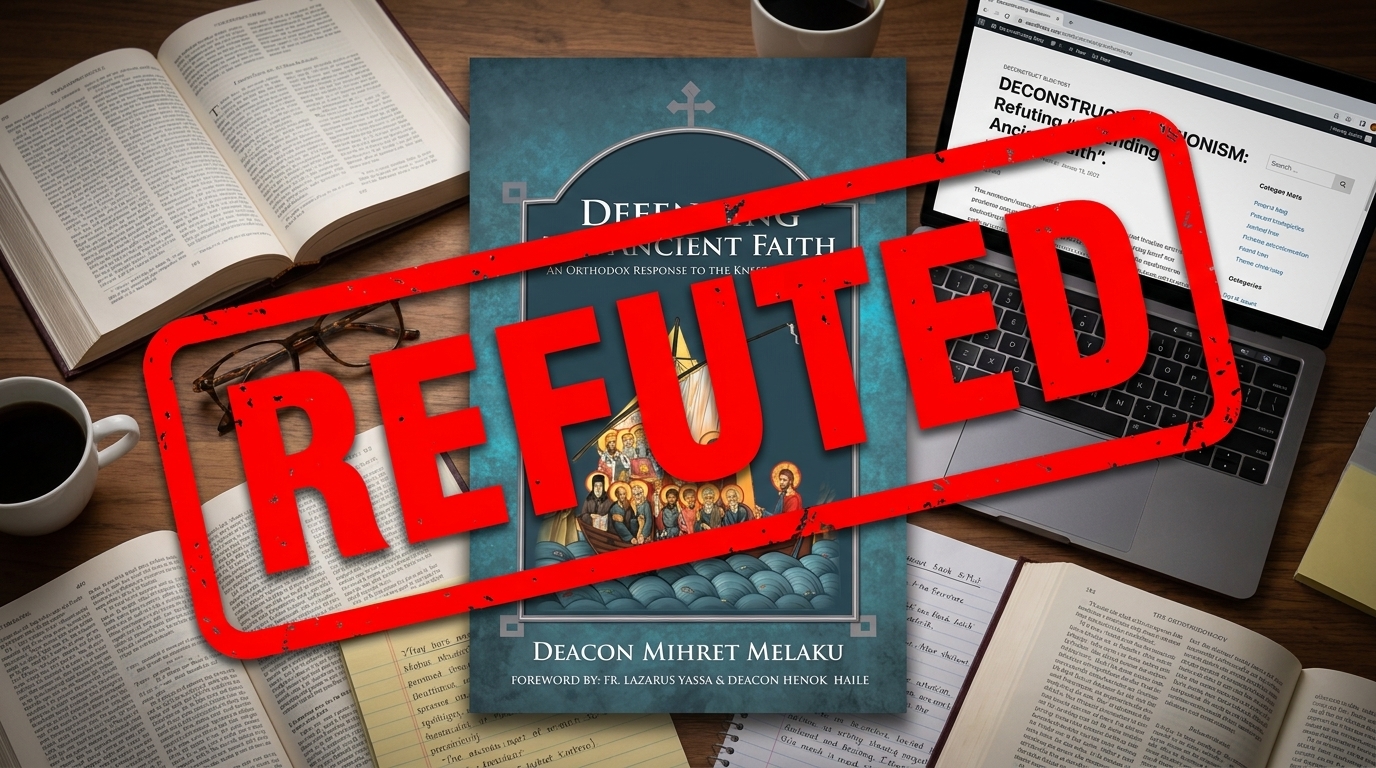
Introduction: Refuting Chapter VIII of “Defending the Ancient Faith”
In his second epistle to Timothy, St. Paul issues a solemn warning regarding those who maintain “a form of godliness, but deny its power” (2 Timothy 3:5). In the Greek original, the Apostle sharply contrasts two concepts: morphōsis (the outward form, aesthetic silhouette, or hollow shell) and dynamis (the inherent power, driving mechanism, and working engine). When applied to theology, St. Paul’s critique exposes a widespread modern theological view of salvation often designated as neo-patristic revisionism. Emergent from twentieth-century anti-Western polemics, this novel view has become popular in many Chalcedonian/Byzantine circles. it reduces the multifaceted mystery of salvation merely to therapeutic healing and the physical conquering of death (“Christus Victor“).
Deacon Mihret Melaku’s explanation of salvation in Chapter VIII of his book “Defending the Ancient Faith”, exemplifies this reductionist and revisionist approach. Deacon Mihret, a deacon in the Ethiopian Orthodox Tewahedo Church and Harvard graduate, gained widespread popularity in Christian apologetics following his commendable public debate against Protestant open-air college evangelists Cliffe and Stuart Knechtle. The debate was regarding sacramental theology and the Church Fathers.
Why Deacon Mihret’s Book Is Dangerous
It is precisely Deacon Mihret’s rising popularity as an Oriental Orthodox apologist that makes Defending the Ancient Faith particularly dangerous. Under the guise of offering an “ancient” and “Orthodox” defense against Protestantism, the book serves as a theological Trojan horse in Oriental Orthodox circles. It smuggles 20th-century Chalcedonian (Byzantine) neo-patristic revisionism directly into Oriental Orthodox communities that now trust his apologetic brand.
What makes this Trojan horse even more dangerous is that the book features a foreword written by a trusted and respected priest in the Coptic Orthodox Church, Fr. Lazarus Yassa (alongside Deacon Henok Haile). Because faithful Coptic and Oriental Orthodox believers naturally trust their respected clergy and priests, an official endorsement from a trusted Coptic priest causes readers to completely lower their theological guard. Readers will falsely assume that Deacon Mihret’s presentation of salvation represents authentic Coptic and Oriental Orthodox doctrine. It does not.
In Chapter VIII, Deacon Mihret adopts the outward form of Orthodox soteriology—retaining pious vocabulary such as “sacrifice,” “expiation” “healing,” “victory,” and “participation”—while systematically dismantling and throwing out the underlying power: Christ’s Godward, substitutionary/propitionary sacrifice to God the Father. He promotes a modern anti-juridical reductionism—denying vicarious substitution, atonement, and divine punishment for transgression—while insisting on an exclusive, reductionist Christus Victor model.
Exposing the Theological Distortion
Throughout Chapter VIII, Deacon Mihret engages in severe theological distortion by declaring that all forms of penal substitution are “completely ludicrous and downright heretical” (p. 207) and “another gospel… at odds with biblical truth” (p. 210). However, a careful study of Church history reveals a glaring fact: no Ecumenical Council, local Synod, or consensus of the Church Fathers has ever condemned substitutionary or penal aspects of the atonement as heretical.
By hurling the anathematizing label of “heresy” at a doctrine firmly rooted in the Holy Scriptures and explicitly taught by primary Church Fathers—most notably St. Athanasius of Alexandria, St. Cyril of Alexandria, and St. John Chrysostom—Deacon Mihret elevates himself to a self-proclaimed ecumenical council. He attempts to unilaterally excommunicate a foundational pillar of apostolic soteriology to promote his own modern anti-Western polemics.
Far from viewing vicarious substitution as a Western distortion, early Church Fathers prior to 451 AD—led by St. Athanasius of Alexandria, St. Cyril of Alexandria, St. John Chrysostom and many other fathers—consistently employed explicit substitutionary and forensic language alongside therapeutic imagery. They affirm that Christ’s death on the Cross fulfilled the divine sentence, discharged the handwritten debt of sin, satisfied divine truth, and served as a vicarious substitutionary sacrifice offered directly to God the Father.
Systematic Roadmap of the Refutation
To systematically dismantle the hollow morphōsis constructed in Chapter VIII of Deacon Mihret’s book, this article aims to accomplish the following:
-
Refute Objections to Vicarious Substitution & Atonement
-
Deconstruct Logical Flaws, Strawmans, and Trinitarian Logic: Refute claims that substitution causes a Trinitarian rupture, forces Nestorianism (pp. 207–208), or logically requires limited atonement (pp. 208–209).
-
Dismante False Dichotomies (Separate Effect from Cause): Expose artificial dichotomies between forensic justification and therapeutic healing (pp. 217–219) and between vicarious substitution and sacramental participation (pp. 232–236).
-
Re-evaluate Old Testament Sacrificial Typologies & Expose the Denial of a Godward Sacrifice
-
Refute “Return to Sender” & Pauline Texts: Expose the author’s unscriptural “return to sender” model (pp. 220–222) and analyze 2 Corinthians 5:21 and Galatians 3:13 through patristic exegesis.
-
Expose the Descent into Hades, “Christus Victor”, and Ransom Errors
I. Refuting the Author’s Core Objections to Substitution & Atonement
1. The Absurdity of “Died With Us, Not Instead of Us” and Patristic Vocabulary of Vicarious Exchange
On pages 225–226, Deacon Mihret asserts that “Christ, in assuming their suffering and death, suffers and dies with them, not in their stead”.
A. Exposing the Theological Absurdity of “Died With Us”
Deacon Mihret’s assertion that Christ died merely “with us” rather than “instead of us” collapses under scriptural and logical scrutiny:
-
Humanity Does Not Die a Divinely Accursed Death on a Tree: In Galatians 3:13, St. Paul explicitly cites Deuteronomy 21:23: “Christ has redeemed us from the curse of the law, having become a curse for us; for it is written, ‘Cursed is everyone who hangs on a tree.'” The “curse” described by Moses and St. Paul is not general human suffering, physical disease, or mortal decay. It is a specific, divine judicial sentence pronounced by God under the Law against lawbreakers. Human beings do not die a divinely accursed execution on a tree on Calvary. Christ alone hung upon that tree. Because He bore a divine curse and judicial sentence that belonged strictly to us, He did not “die with us” in that execution; He died instead of us.
-
Sacramental Dying “With Him” vs. Objective Dying “Instead of Us”: Scripture explicitly teaches that the believer dies “with Christ” spiritually, figuratively, and sacramentally in Holy Baptism (Romans 6:3–4: “or do you not know that as many of us as were baptized into Christ Jesus were baptized into His death?”). However, Christ did NOT “die with us” on the Cross in a shared, equal fate. On Calvary, Christ acted as the single, sinless, vicarious God-Man who stepped into our legal place to absorb the divine sentence of death instead of us. For this reason Scripture reveals about Christ: “I have trodden the winepress alone; and of the people there was none with me…And I looked, and there was none to help; and I wondered that there was none to uphold: therefore mine own arm brought salvation unto me” (Isaiah 63: 3,5)
B. Explicit Patristic Evidence (“Substitute,” “In Our Stead,” “Instead of All,” “In Place Of,” “Exchange”)
Far from avoiding substitutionary terminology, the early Church Fathers prior to 451 AD and authentic Coptic Orthodox liturgical texts explicitly utilize direct prepositions and terms of vicarious exchange (anti, instead of, in place of, substitute, in our stead):
-
St. Athanasius of Alexandria (On the Incarnation, Chapter 2, Section 9):
“He takes to Himself a body capable of death that it, by partaking of the Lord who is above all, might be worthy to die instead of all… And thus taking from our bodies one of like nature, because all were under penalty of the corruption of death He gave it over to death in the stead of all, and offered it to the Father.”
-
St. Athanasius of Alexandria (On the Incarnation, Chapter 4, Section 20):
“Having truly died, surrendering His own temple to death in place of all, to settle man’s account with death and free him from the primal transgression.”
- St. Athanasius of Alexandria (On the Incarnation):He surrendered His body to death instead of all, and offered it to the Father…For this reason, therefore, He assumed a body capable of death, in order that it, through belonging to the Word Who is above all, might become in dying a sufficient exchange for all, and, itself remaining incorruptible through His indwelling, might thereafter put an end to corruption for all others as well, by the grace of the resurrection…For naturally, since the Word of God was above all, when He offered His own temple and bodily instrument as a substitute for the life of all, He fulfilled in death all that was required.
-
St. Gregory Nazianzen (Oration 30.5):
“Christ became a new Adam to take the place of the old, and made our disobedience His own as Head of the whole body.” -
St. Alexander of Alexandria (Epistula ad Alexandrum):
Writing on redemption, St. Alexander states that Christ gave “life for life, blood for blood, body for body, death for death“—defining an explicit, literal life-for-life exchange. -
St. John Chrysostom (Homilies on Galatians, Chapter 3):
“It was like an innocent man’s undertaking to die for another sentenced to death, and so rescuing him from punishment. For Christ took upon Him not the curse of transgression, but the other curse, in order to remove that of others.” -
St. Cyril of Alexandria (Commentary on the Gospel of St. John, Book XII):
“We were, then, accursed and condemned, by the sentence of God, through Adam’s transgression… For we are justified, now that Christ has paid the penalty for us; for by His stripes we are healed, according to the Scripture.” -
St. Cyril of Alexandria (Letter 41 to Acacius):
“The Father made Him a victim for the sins of the world… having endured a condemnation most suitable for the wicked… So He became sin to remit the sins of others: so also He paid the debt that was incurred for us, and we ourselves became righteousness in Him; for those who have been freed from debts are righteous, and are not termed liable.” - St. Cyril of Alexandria (Gospel According to St. Luke):He in our stead paid our debts: He bore our sins; and as it is written, “in our stead He was stricken.” “He took them up in His own body on the tree:” for it is true that “by His bruises we are healed.” He too was sick because of our sins, and we are delivered from the sicknesses of the soul.
-
Authentic Coptic Orthodox Catechesis & Liturgical Teaching:
The Lord Jesus Christ was a substitute for the sinners, was crucified instead of them repaying their debt… taking the penalty upon Himself in man’s stead:
“We are the ones who sinned, and He is the One who suffered. We are the ones who were indebted to divine justice because of our sins, and He was the One who paid the debts on our behalf.” (Fraction to the Son, Coptic Orthodox Divine Liturgy)
To claim that Christ died merely “with us” while denying that He died “instead of us” directly contradicts the explicit patristic explanations that Christ came “to die instead of all,” “in the stead of all,” and “in place of all,” as well as that Christ “paid the penalty for us” and “paid the debt that was incurred for us”.
2. Turning the “Why Do We Still Die?” Argument Against the Author’s Christus Victor View
On page 207, Deacon Mihret argues that substitutionary atonement is logically absurd because if Christ died as a substitute so that we do not have to die, then believers should never undergo physical death. Since Christians still physically die, the author concludes that physical substitution is disproven.
If we apply Deacon Mihret’s flawed, literalistic logic to his own premise—that Christ’s work on the Cross was primarily an ontological conquest and physical defeat of death—we must ask: If Christ conquered death on the Cross, why do Christians still physically die?
By the author’s own standard of reasoning, if physical experience must immediately and visibly mirror the spiritual reality accomplished on the Cross, then Christ’s supposed “conquest of death” was an absolute failure because biological mortality still claims every believer.
In reality, both the conquest of death and vicarious substitution operate on the exact same theological timeline:
-
Objective Accomplishment on the Cross: On the cross, Christ broke the legal power, penal curse, and judicial sentence of terminal death (the wages of sin) by suffering as our vicarious substitute, while simultaneously destroying the spiritual tyranny of death.
-
Subjective and Future Fullness: Physical death remains in the present order not as an uncancelled penal sentence, but as a temporary, sanctified sleep and passage to the bodily resurrection at the Last Day.
St. Athanasius directly addresses and dismantles the author’s exact misunderstanding in On the Incarnation, Chapter 3, Section 21:
“Now, therefore, when we die we no longer do so as men condemned to death, but as those who are even now in process of rising we await the general resurrection of all, ‘which in its own times He shall show.'”
Christ’s substitutionary death abolished physical death as a penal condemnation under the divine sentence. For the Christian, physical death is no longer the execution of a divine curse, but has been transformed into a seed planted for resurrection.
3. Refuting the “Train Tracks” Hero Analogy
On page 207, Deacon Mihret offers a flawed analogy to discredit substitution. He envisions a suicidal man tied to train tracks; a hero runs over, unties the man, pushes him out of the way, and is crushed by the incoming train. The author claims this encapsulates sacrifice but rejects it as substitution.
This analogy fails because it eliminates the divine lawgiver, the judicial sentence, and moral debt. The train is an impersonal, inanimate force of nature, not a holy God whose righteous law was violated. As St. Cyril of Alexandria notes in his Commentary on the Gospel of St. Luke (Sermon XLII):
“For that there is no obedience without reward, and on the other hand, no disobedience without penalty, is made plain by what God spake by His holy prophet to those who disregarded Him.”
In biblical soteriology, humanity is not merely tied to tracks by accident; humanity is under a righteous judicial sentence pronounced by God (“the wages of sin is death,” Romans 6:23). Christ does not merely tackle man off tracks; He steps into the legal courtroom, assumes humanity’s legal guilt and liability, and absorbs the sentence of the law in His own body.
St. Cyril of Alexandria explains in his Commentary on the Gospel of St. John (Book V, Chapter IV) that death was a “Divine sentence” and that Christ ended God’s anger when He destroyed death:
“The sentence of God and Adam’s curse extended over all, since all broke God’s decrees, yet Christ paid the penalty for our sins.”
Regarding the “jumping off a building” claim, death is both a natural consequence of jumping (ontological disease) and a divine judicial decree against transgression. Removing the divine judicial sentence reduces God to a passive observer unable to uphold His own divine truth.
4. The “God Robbed of Forgiveness & Judgment” Fallacy and St. Cyril’s Refutation of “Transferred” Debt
On page 207, Deacon Mihret asserts that if Christ paid a price or satisfied divine truth and judgment, then God does not truly forgive. He writes:
“Forgiveness means for a debt to be cancelled not for a debt to be transferred… God doesn’t give us mercy, He simply finds another vent where He is able to satisfy His wrath.”
He further contrasts Reformed views (“God pushing a person off a building”) with Orthodox views (“man jumping off the building himself”).
This argument displays a fundamental misunderstanding of divine judgment, early patristics, and the living liturgical tradition of the Orthodox Church. While human financial debts can be arbitrarily dismissed, moral jurisprudence involving divine holiness cannot treat transgression as if it never occurred. As St. Athanasius notes in On the Incarnation (Chapter 1, Section 7), for God to simply wave away sin without executing the sentence of death would make God untruthful, since He declared: “In the day that you eat of it you shall surely die.”
A. St. Cyril’s Explicit Refutation of “Cancelled, Not Transferred”
Deacon Mihret’s claim that debt is “cancelled, not transferred” is explicitly contradicted by St. Cyril of Alexandria. In his Commentary on the Gospel According to St. Luke (Sermon LIII), St. Cyril explicitly uses the exact concept and word “transferred” when explaining the Day of Atonement typologies (the two goats of Leviticus 16):
“But the death was our desert, inasmuch as by sin we had fallen under the divine curse. But when the Savior of all Himself, so to speak, undertook the charge, He transferred to Himself what was our due, and laid down His life, that we might be sent away from death and destruction.”
St. Cyril completely dismantles Deacon Mihret’s assertion:
-
Death and the divine curse were “our desert” because of our transgression under the Law.
-
Christ “transferred to Himself what was our due”—taking our legal penalty, curse, and debt upon Himself as our vicarious substitute.
-
Christ “laid down His life” in exchange so that we might be released from death and destruction.
B. Contradicting the Ancient Coptic Liturgical Rite
By denying that sin, debt, and penalty are “transferred” to the sacrificial victim, Deacon Mihret directly contradicts the ancient Liturgical Rite of the Coptic Orthodox Church.
During the Offertory of the Coptic Divine Liturgy—specifically the Rite of the Choice of the Lamb—the priest selects the best, unblemished bread (Prosphora) to become the Lamb. Before the oblation is baptized in water and offered upon the altar, the Coptic priest performs a profound liturgical action: he places his hand upon the Lamb.
Authentic Coptic Orthodox liturgical commentaries explicitly explain the theological meaning of this exact rite:
“The priest places his hand on the sacrifice while praying… This declares that Jesus Christ, the Lamb of God, has carried our sins on His shoulders and taken our transgressions upon Himself, just as the Old Testament priest laid his hands upon the head of the sacrificial victim to signify the transfer of sin onto the sacrifice.” (Coptic Orthodox Liturgical Teaching & Commentary on the Divine Liturgy)
In every single Coptic Divine Liturgy, the physical laying on of hands over the oblation dramatizes the Old Testament rite of Leviticus (Leviticus 1:4; 16:21), proclaiming that our sins, guilt, and liabilities were transferred onto Christ, the Lamb of God who bears the sin of the world.
Deacon Mihret’s theology presents a tragic irony: in his attempt to attack Protestantism, he constructs a revisionist model that forces him to stand in direct opposition not only to Holy Scripture and St. Cyril of Alexandria, but to the very Divine Liturgy celebrated by the Coptic and Oriental Orthodox Church. On the Cross, God’s mercy and judgment met in perfect harmony: divine truth took its full right, and mercy was extended to humanity through the transferred debt borne by the Word.
5. Exposing the Error Regarding the Curse: Tree vs. Incarnation
On pages 222–225, Deacon Mihret attempts to explain Galatians 3:13 (“Christ has redeemed us from the curse of the law, having become a curse for us”) by arguing that Christ became a curse simply by becoming incarnate and entering fallen, corruptible creation. He claims this curse represents general cosmic disorder shared equally between Christ and humanity.
This interpretation fundamentally misreads St. Paul and contradicts Patristic exegesis. St. Paul does not say Christ became a curse merely by taking human flesh; rather, St. Paul explicitly quotes Deuteronomy 21:23: “Cursed is everyone who hangs on a tree.” The curse Christ assumed was the specific, judicial penalty of the Cross—a penal curse that belonged strictly to lawbreakers.
St. John Chrysostom, in his Homily 3 on Galatians 3:13, explicitly refutes the author’s claim that Christ’s curse was an incarnational reality shared with humanity:
“As then both he who hanged on a tree, and he who transgresses the Law, is cursed, and as it was necessary for him who is about to relieve from a curse himself to be free from it, but to receive another curse, Christ took upon Himself this other curse [the curse of hanging on a tree]… For, ‘He had done no violence, neither was any deceit in His mouth.’ And as by dying He rescued from death those who were dying, so by taking upon Himself the curse, He delivered them from it.”
Furthermore, St. Cyril of Alexandria in his Commentary on the Gospel of St. Luke confirms:
“Christ therefore ransomed from the curse of the law those who being subject to it, had been unable to keep its enactments. And in what way did He ransom them? By fulfilling it.”
And in That Christ is One, St. Cyril writes:
“It was, therefore, necessary that by the mouth of Him That had passed sentence of condemnation, the burden of that ancient curse should be removed… the human race was to be freed from that ancient curse, and to be enabled through the gracious love of our Saviour Christ to hope.”
Christ was personally sinless and entirely free from the curse of lawbreaking. We, as lawbreakers, were under the curse of Deuteronomy 27:26. Christ did not break the law; instead, He submitted to the legal curse of Deuteronomy 21:23 by hanging on the tree. This was an asymmetrical exchange: Christ took a specific penal curse that we did not undergo (hanging on the tree as a condemned victim) so that we could be freed from the penal curse that we did deserve (eternal death for lawbreaking under divine judgment).
6. St. Athanasius and St. Cyril on Divine Wrath
The author repeatedly claims that the concept of Christ bearing divine wrath or punishment is a Western heresy. However, St. Athanasius explicitly uses this exact language in his Letter to Marcellinus on the Interpretation of the Psalms:
“Thou hast made Thy wrath to rest upon me, says the one; and the other adds, I paid them things I never took. For He did not die as being Himself liable to death: He suffered for us, and bore in Himself the wrath that was the penalty of our transgression, even as Isaiah says, Himself bore our weaknesses.”
Likewise, St. Cyril of Alexandria explicitly teaches that Adam’s sin brought divine wrath upon human nature, which Christ lifted by bearing our condemnation. In On Worship in Spirit and Truth (Book 11), St. Cyril writes:
“In Adam we became communicants in his transgression… those things committed by him also brought judgment having spread the curse to all, and in a certain manner allotted the wrath to his offspring.”
St. Athanasius and St. Cyril demonstrate that Christ, in His representative humanity, bore in Himself the legal penalty and the divine sentence that rested upon human transgression, satisfying the legal demands of death so that mercy could be extended without violating divine truth.
II. Refuting Logical Fallacies, Strawman Caricatures, and Faulty Trinitarian Logic
1. The Trinitarian Rupture and Nestorianism Fallacies
On pages 207–208, Deacon Mihret claims that substitutionary atonement posits an ontological rupture within the Holy Trinity, forcing a choice between anti-Trinitarian division (Father and Son having different wills/essences) or Nestorianism (only the human nature of Christ being damned, creating two subjects).
This logical construction constitutes a severe caricature. Classical Orthodox soteriology teaches that the Cross proceeds seamlessly from the single, unified divine will of the indivisible Trinity. The Father, Son, and Holy Spirit act in perfect harmony. Out of infinite love for fallen humanity, the Son assumes full human nature in the Incarnation to act as the second Adam. In this voluntary self-offering, Christ acts as a vicarious, representative substitute who willingly carries humanity’s legal liabilities and debt before divine truth and judgment.
When theology speaks of Christ bearing divine wrath or punishment, it does not imply that the Father hated His Son. As St. Cyril of Alexandria clarifies in Letter 41 to Acacius, the Father made Him a victim for the sins of the world out of infinite love, so that by paying our debt He might make us righteous.
Furthermore, regarding Christ’s cry on the Cross—”My God, My God, why have You forsaken Me?” (Psalm 22:1)—St. Cyril of Alexandria and St. Athanasius explain that because Christ assumed human nature and stood in the place of condemned humanity, all of humanity was crying out through Christ’s human voice. Christ voiced the reality of human alienation to bring that alienation to an end through His unifying Cross, without any severance of His divine and human natures.
2. The Fallacy of Compulsory Limited Atonement
On pages 208–209, Deacon Mihret cites an article from GotQuestions.org titled “Limited Atonement – Is It Biblical?” which states:
“If Jesus actually stood in my place and bore my sin on the cross as the Bible teaches, then I can never be punished for that sin. In order for Christ’s atonement to truly be a substitutionary or vicarious atonement, then it must actually secure a real salvation for all for whom Christ died.”
The author uses this citation to argue that holding to substitution logically requires believing that Christ died only for the elect, contradicting 1 John 2:2, 1 Timothy 2:3–6, and 2 Peter 2:1.
This argument confuses the universal sufficiency of Christ’s substitutionary sacrifice with its subjective efficiency or application. In classical patristic soteriology, Christ took universal human nature into personal union with Himself. By offering a human body and soul free from sin, His vicarious sacrifice possessed infinite value, fully sufficient to pay the debt of all humanity. St. Athanasius explicitly uses universal substitutionary language without falling into limited atonement or universalism, stating that Christ offered His body “as an equivalent for all… surrendering His own temple to death in place of all, to settle man’s account with death” (On the Incarnation, Chapter 2, Section 9).
The sacrifice is objective and universal in its availability, but its benefits must be subjectively received through faith, repentance, and participation in the Holy Sacraments. Rejection of salvation by an unrepentant individual does not mean Christ failed to offer a real substitutionary price; rather, it means the individual refuses to abide in the Substitute.
III. Dismantling False Dichotomies:
1. The Forensic-Therapeutic False Dichotomy
On pages 217–219, Deacon Mihret asserts that because ancient Israel lacked modern Western courtrooms, biblical terms like justice (mishpat), righteousness (tzedakah), and justification (dikaiosis) carry no legal or punitive connotations, representing purely restorative and medical realities. He cites Daniel 8:14, where nisdaq is translated as “cleansed,” to argue that justification means purely physical/ritual cleansing without forensic acquittal.
This represents a false dichotomy—an attempt to adopt the form of healing while denying the forensic power that makes healing possible. Holy Scripture and the Church Fathers never isolate man’s legal status from his ontological condition. Human falleness involves two inseparable realities:
-
The Forensic and Juridical Reality: Humanity violated the divine commandment, incurred legal guilt, fell under a judicial divine sentence of death, contracted a spiritual debt before divine truth, and became subject to the curse of the Law.
-
The Ontological and Therapeutic Reality: Humanity suffered internal ontological corruption, spiritual disease, enslavement to demonic powers, and physical mortality.
Far from being mutually exclusive, these two dimensions exist in a direct cause-and-effect relationship. Human disease and ontological corruption are the direct consequences of legal separation from God brought about by transgression. As St. Cyril of Alexandria observes, death is both a divine judicial pronouncement against sin and a natural consequence of straying from the Source of Life. Daniel 8:14 uses nisdaq (cleansed/justified) precisely because ritual cleansing in Israel served to remove the legal defilement and judicial guilt that barred access to God.
2. Substitution versus Participation: A False dichotomy
On pages 232–236, the author pits vicarious substitution against Pauline “participation theology”, claiming that Christ died not “instead of us” (substitution), but “so that we could die in Him” (participation).
In authentic Orthodox soteriology, participation is impossible without substitution. Christ must first act as our vicarious substitute—entering our nature, stepping into our place under the law, and bearing our legal liabilities—so that we, being mystically incorporated into Him through Baptism, can participate in His victory.
St. Cyril of Alexandria explicitly refutes modern attempts to undermine substitution, confirming that Christ paid the penalty for us as our representative substitute:
“For we are justified, now that Christ has paid the penalty for us; for by His stripes we are healed, according to the Scripture.” (Commentary on the Gospel of St. John, Book XII)
Substitution establishes the objective, historical reality of salvation; participation is the subjective, sacramental means by which the believer receives that objective salvation.
IV. Refuting Old Testament & Levitical Errors, and the Denial of a Godward Sacrifice
1. Exposing Deacon Mihret’s Denial of a Godward Sacrifice
A central, catastrophic error in Chapter VIII is Deacon Mihret’s complete rejection of the Godward direction of Christ’s sacrifice. In his attempt to dismantle Anselmian satisfaction, Deacon Mihret denies that Christ offered Himself as a sacrifice to God the Father to satisfy divine truth and fulfill the judicial sentence against sin. He strips the altar of its Godward orientation, claiming that Old Testament sacrifices and Christ’s death were directed either purely downward toward physical/ceremonial cleaning (expiation) or outward toward defeating demons (“return to sender”).
This denial directly contradicts Holy Scripture and the universal Patristic deposit:
-
Scriptural Refutation: Ephesians 5:2 explicitly declares that Christ “has loved us and given Himself for us, an offering and a sacrifice to God for a sweet-smelling aroma.” Hebrews 9:14 states that Christ “through the eternal Spirit offered Himself without spot to God.”
-
Patristic Refutation: St. Athanasius explicitly affirms in On the Incarnation (Chapter 2, Section 9) that Christ took a mortal body and “offered it to the Father.” St. Cyril of Alexandria in Letter 41 to Acacius declares: “The Father made Him a victim for the sins of the world… so also He paid the debt that was incurred for us.”
By denying that Christ’s sacrifice was offered Godward to satisfy divine truth and justice, Deacon Mihret hollows out the Cross, leaving humanity with an offering that has no divine recipient.
2. The Fallacy of Blood as a Sanitizer and the False dilemma of “Expiation vs. Propitiation”
On pages 209–210 and 214, Deacon Mihret constructs a false dilemma by claiming that Old Testament sacrifices and Christ’s death are strictly for “expiation and purification” of sin, carrying no propitiatory or Godward substitutionary value. To support this, he cites Leviticus 5:11 (the poor person’s flour offering) to argue that sacrifices cannot be propitiatory, portraying sacrificial blood as a standalone spiritual disinfectant meant to cleanse moral defilement from human souls and the altar.
This argument contains profound theological and logical errors, misinterpreting both the Levitical system and biblical soteriology:
A. Respecting Biblical Expiation Without Reducing It to Mechanical Hygiene
Holy Scripture explicitly attributes expiation (the cleansing and wiping away of guilt and moral defilement) to the blood of the sacrifice. As Leviticus 17:11 and Hebrews 9:22 affirm, blood cleanses the soul and conscience from sin. We do not diminish or discredit the biblical reality of blood expiation. However, the author commits a severe category error by asserting a false dichotomy between expiation and propitiation—claiming that if blood cleanses man from sin (expiation), it does not also satisfy God’s holy truth and avert divine judgment (propitiation).
In authentic biblical soteriology, expiation and propitiation are two sides of the same coin:
-
Expiation is the Manward/object effect: cleansing the guilt, defilement, and pollution of sin from the human conscience.
-
Propitiation is the Godward/subject cause: fulfilling the divine sentence, satisfying divine truth and righteousness, and turning away the judicial outbreak of divine wrath against transgression.
Expiation (cleansing) occurs because propitiation (satisfaction of the divine sentence) has taken place. To claim expiation without propitiation is to offer an effect without a cause—a hollow morphōsis (form) without dynamis (power).
B. Exposing the “expiation only” Fallacy
By rejecting propitiation and vicarious substitution, the author treats sacrificial blood as if it were some kind of spiritual sanitizer or antiseptic cleanser. But in biblical theology, sin is not a spiritual microbe, germ, or biological stain that requires antiseptic sanitization; sin is lawlessness (anomia, 1 John 3:4), missing the mark, and willful disobedience against a holy God.
Furthermore, blood possesses no intrinsic physical/spiritual antiseptic or cleansing power on its own. If sacrificial blood functioned as an intrinsic cleanser or spiritual sanitizer, an Israelite could simply have brought a syringe, drawn blood from a living animal, and sprinkled it on the altar to “disinfect” the sanctuary and expiate his sin without killing the animal. But this would not have worked.
Why was the animal required to be slain? Leviticus 17:11 provides the explicit answer: “For the life of the flesh is in the blood, and I have given it to you upon the altar to make atonement for your souls; for it is the blood that makes atonement for the soul.” The blood expiates and cleanses only because the animal was slain, and its life was surrendered as a vicarious substitute in exchange for the forfeited life of the sinner. Blood satisfies the divine decree because “the wages of sin is death” (Romans 6:23). St. Alexander of Alexandria captured this vicarious exchange when he wrote that Christ gave “life for life, blood for blood, body for body, death for death”.
C. The Context of the Flour Offering
The author points to the poor man’s flour offering (Leviticus 5:11) to argue that because a bloodless, non-living substance was accepted for forgiveness, the concept of a life-for-a-life sacrifice (substitution) is undermined. The flour offering does not disprove vicarious substitution; rather, it beautifully illustrates its core principles:
-
- It Represents a Day of Life: In biblical measures, one-tenth of an ephah equals one omer—defined in Exodus 16:16 as the exact daily ration required to sustain a single human life. By offering this specific amount, the bankrupt sinner was symbolically surrendering a day of their own life and sustenance to the altar.
- The Substitute is Crushed: Grain must be violently threshed and ground down to become “fine flour.” This structural destruction directly mirrors the vicarious suffering of Christ, the “grain of wheat” (John 12:24) who was “crushed for our iniquities” (Isaiah 53:5).
- It Bears the Stark Weight of Sin: God strictly prohibited adding festive olive oil or sweet frankincense to this offering (Leviticus 5:11). This perfectly models vicarious substitution: Christ on the cross was stripped of visible glory and comfort, bearing the raw, unmitigated grimness of our spiritual poverty (Isaiah 53:2).
- It is Absorbed by a Blood System: The flour was never accepted in a vacuum. Leviticus 5:12 dictates that the priest must burn the flour on the altar “according to the fire offerings made to the Lord.” It was placed directly on top of an altar already continuously drenched in the blood of the daily sacrifices (Exodus 29:38-42).
The bloodless offering was never an alternative, independent path to forgiveness; it was a merciful exception allowing the poorest sinner to merge their personal bankruptcy into a greater, ongoing, blood-bought substitutionary framework. Furthermore, Deacon Mihret’s use of the fine flour offering completely ignores its foundational patristic interpretation. The early Church Fathers—most famously St. Justin Martyr—explain that the Old Testament oblation of fine flour was a prophetic type and figure of the Eucharist (Dialogue with Trypho, Chapter 41). St. Justin explicitly writes:
“And the offering of fine flour, sirs, which was prescribed to be presented on behalf of those purified from leprosy, was a type of the bread of the Eucharist, the celebration of which our Lord Jesus Christ prescribed…”
Far from disproving substitution or propitiation, the fine flour offering prefigures the Eucharistic bread, which Christ instituted as the sacrament of His sacrificial Body given instead of us (“This is My body which is given for you,” Luke 22:19). Because the Eucharist is the unbloody memorial and participation in the one, substitutionary sacrifice of Christ, the fine flour offering is inherently sacrificial and substitutionary in its typological nature.
Thus, asserting ‘expiation only’ while stripping away substitution and propitiation represents a profound depravity of logic and a complete blindness to the Old Testament types. As mentioned, if sacrificial blood were an intrinsic cleanser, an Israelite could simply have drawn blood from a living animal and sprinkled it on the altar without slaying the creature to expiate. By severing the shadow of expiation from the objective death that satisfied the divine sentence (propitiation), Deacon Mihret’s argument reduces the sacred typologies of Scripture to a hollow form without the power.
3. Moses’ Intercession in Exodus 32:30–34
On page 210, Deacon Mihret cites Exodus 32:30–34—where Moses requests to be blotted out of God’s book in place of sinful Israel—claiming that God’s refusal (“Whoever has sinned against Me, I will blot out”) proves that God categorically rejects substitutionary atonement.
This argument ignores the essential Christological distinction made by the Fathers. God rejected Moses’ offer not because substitution is intrinsically unjust, but because Moses was himself a fallen human creature. A sinner cannot offer his own soul to satisfy the legal liabilities of other sinners. God’s statement in Exodus 32 demonstrates the absolute inadequacy of any mere human mediator, establishing the divine necessity for a sinless, God-Man Mediator whose person possesses infinite value.
4. The Day of Atonement and the True Function of the Mercy Seat (Hilasterion)
On pages 211 and 214, Deacon Mihret advances a specific claim regarding Leviticus 16 and Romans 3:25. He argues that when the Old Testament High Priest sprinkled blood upon the Mercy Seat (kapporet) on the Day of Atonement, the ritual served merely as ceremonial hygiene—wiping away human ceremonial “dirt” or moral defilement from physical sanctuary furniture. From this premise, Mihret asserts that when St. Paul calls Christ our hilasterion in Romans 3:25, the Apostle refers strictly to a non-propitiatory “cleansing place” (expiation) rather than a Godward sacrifice that satisfies divine truth and averts divine judgment.
This argument confuses general cleansing with the explicit spatial and covenantal typology of the Holy of Holies. To understand why blood was sprinkled on the Mercy Seat, one must examine the physical and theological layout of the Ark of the Covenant:
-
Above the Lid: The Shekinah glory—the holy, uncreated presence of God—dwelt between the gold cherubim above the lid (Exodus 25:22).
-
Beneath the Lid: Inside the Ark directly beneath the lid lay the two tables of the Law—the very Law that convicted Israel of transgression and pronounced a judicial sentence of death against lawbreakers.
-
Between God and the Law: The golden lid (kapporet / hilasterion) sat directly between God’s holy presence above and the violated Law beneath.
When the High Priest entered the Holy of Holies on Yom Kippur, he did not sprinkle blood to “dust the gold lid” as ceremonial housecleaning. He sprinkled the blood of a slain substitutionary victim directly onto the Mercy Seat to place a life-for-life blood covering (kopher) between a Holy God and the condemned lawbreaker below. The blood stood between divine holiness and human transgression so that God’s holy presence could dwell in Israel’s midst without His righteous judgment consuming the camp. That is the precise definition of propitiation.
When St. Paul applies this exact typology to Christ in Romans 3:25—declaring that God set forth Christ as a hilasterion (Mercy Seat / propitiation) by His blood—the Apostle explicitly grounds it in divine righteousness (dikaiosyne): “to demonstrate His righteousness… that He might be just and the justifier of the one who has faith in Jesus.”
St. John Chrysostom, in his Homilies on the Epistle to the Romans (Homily VII), explicitly refutes Mihret’s reduction of hilasterion to mere ritual cleaning, explaining that Christ’s blood on the Mercy Seat worked complete justification and propitiation before God:
“For he does not say, bare forgiveness, but justification, so as to take away the whole of sin… For if the type of the mercy-seat had such power, much more had the reality.”
Likewise, St. Cyril of Alexandria in De Adoratione in Spiritu et Veritate (Book X) affirms that Christ is our true Mercy Seat who reconciles us Godward to the Father by His blood:
“Christ is the true mercy-seat (hilasterion), through whom and in whom we have propitiation with God the Father.”
Deacon Mihret’s reduction of the Mercy Seat to ceremonial hygiene completely strips Romans 3:25 of its covenantal power. Christ is our hilasterion not because He acts as “soap” for furniture, but because His substitutionary blood covers our lawbreaking beneath the holy presence of God, satisfying divine truth so that God remains both infinitely just and the merciful Justifier of sinners.
5. The Two Birds and Two Goats in Patristic Typology
On pages 218–219, Deacon Mihret attempts to dismantle vicarious substitution by pointing to the Levitical rites of the two birds for cleansing leprosy (Leviticus 14) and the two goats on the Day of Atonement (Leviticus 16). He focuses specifically on the live animal—noting that the high priest confesses Israel’s sins over the live goat and sends it away into the wilderness, while the second bird is dipped in blood and set free into the open field without being killed. From this, Mihret constructs a clever objection: he argues that if penal substitution were true, the specific animal bearing the confessed sins and legal guilt would necessarily be executed on the spot to suffer the penalty of death. Because the sin-bearing animal is released alive, he claims that substitutionary death is disproven.
This argument is completely devoid of patristic grounding, relying instead on shallow human sophistry that stumbles over the fundamental principles of Old Testament typology.
Deacon Mihret’s error lies in treating the two animals as if they were two separate persons, competing entities, or independent subjects with isolated fates. In authentic patristic exegesis, the two goats and the two birds do not represent two different Christs or two separate realities. They represent the single, undivided Person of Jesus Christ viewed through two distinct profiles of His one saving mystery.
Because a single biological animal cannot simultaneously die under the divine sentence to shed its blood and remain alive to depict divine impassibility and resurrection, the Old Testament Law utilized two creatures to portray the one Savior. St. Cyril of Alexandria explicitly warns against splitting these typologies into separate entities. In his Scholia on the Incarnation (§15) and Letter 41 to Acacius, St. Cyril writes:
“Now the birds were clean. For the Lord is truly clean and undefiled, knowing no sin. Even though it says there were two birds, however, we are certainly not saying that we understand there to be two Christs… Therefore Moses, in wanting to describe clearly the mystery of Christ through the law, did not show Him as both dying and living in one goat or bird, so as not to give the appearance of some theatrical spectacle. Rather one goat suffered the slaughter, and the other lived and was released, to show Him living after suffering.”
Furthermore, in his exegesis of Leviticus 14 (the two birds), St. Cyril highlights the explicit substitutionary connection between the slain bird and the living bird: one bird is killed over living water, and the living bird is dipped in the blood of the slain bird before being set free into the field. St. Cyril notes that the living bird receives its freedom strictly through the blood and death of the slain bird. The slain bird represents Christ dying for us in His human flesh, while the living bird—washed in that sacrificial blood—represents the same Christ living in the power of His divine impassibility and resurrection.
St. Cyril applies this exact same indivisible Christology to the two goats of Leviticus 16 in his Commentary on the Gospel According to St. Luke (Sermon LIII):
“For according to the Mosaic law two goats were offered, differing in nothing from one another, but alike in size and appearance. Of these, one was called ‘the Lord:’ and the other, the ‘sent-away.’ And when the lot had been cast for that which was called ‘lord,’ it was sacrificed: while the other was sent away from the sacrifice… And Who was signified by this? The Word, though He was God, was in our likeness, and took the form of us sinners, as far as the nature of the flesh was concerned. The goat, then, male or female, was sacrificed for sins. But the death was our desert, inasmuch as by sin we had fallen under the divine curse. But when the Savior of all Himself, so to speak, undertook the charge, He transferred to Himself what was our due, and laid down His life, that we might be sent away from death and destruction.“
When read through the Fathers rather than human sophistry, the typological unity becomes unmistakable:
-
Both animals represent the ONE Christ: The slain goat/bird and the released goat/bird are two aspects of the same Savior.
-
Freedom is purchased by the Substitute: The second goat is sent away and the second bird is released precisely because the first was slaughtered as a substitutionary sacrifice.
-
The cause and the effect: The slain animal depicts Christ taking “what was our due” (the death we deserved under the curse), while the released animal depicts Christ granting us freedom from death and destruction because that debt was paid.
Deacon Mihret’s argument collapses under its own theological bankruptcy. To claim that the released animal disproves substitutionary death is to use the fruit of Christ’s substitutionary sacrifice (our release from condemnation) to deny the very death that purchased it. The live goat walks free into the wilderness, and the live bird flies into the sky, for one reason alone: because their substitute was slain on the altar in their stead.
V. Refuting “Return to Sender” & Misinterpreted Pauline Texts
1. Exposing the Novelty of “Return to Sender”
On pages 220–222, Deacon Mihret puts forward an unbiblical hypothesis: the “return to sender” theory. He argues that Christ became sin not by bearing divine judgment or standing in our legal place, but by acting as a waste bucket that absorbs sin and carries it down to Hades to hurl it back at the devil and his demons (Azazel).
This “return to sender” model lacks both scriptural authority and patristic precedent. Scripture nowhere depicts the sacrificial scapegoat as paying off, feeding, or returning sin to Satan. In Leviticus 16:21–22, Aaron confessed Israel’s sins over the live goat and sent it into an uninhabited wilderness, symbolizing the complete expiation and removal of legal guilt. By claiming that Christ carries sin back to hand it over to demons, the author inadvertently turns the Son of God into an errand boy to the underworld, completely obscuring the Godward direction of the atonement.
2. Patristic Exegesis of 2 Corinthians 5:21 and Galatians 3:13
To properly evaluate Deacon Mihret’s claims on 2 Corinthians 5:21 and Galatians 3:13, one must first expose his underlying arguments. On pages 220–225, Mihret attempts to strip both passages of any forensic, judicial, or substitutionary meaning:
-
On 2 Corinthians 5:21 (“He made Him who knew no sin to be sin for us”): Deacon Mihret asserts that Christ “becoming sin” does not mean He offered Himself as a vicarious sacrifice, bore legal guilt, or took the judicial status/condemnation of sinners before God. Instead, Mihret argues that Christ became “sin” merely by absorbing the corrupting energy of human decay into His body or by acting as a cosmic waste vessel to carry sin down to Hades. He explicitly rejects the classical biblical and patristic understanding that “sin” is a another name for a sin-offering or a judicial exchange.
-
On Galatians 3:13 (“Christ has redeemed us from the curse of the law, having become a curse for us”): Deacon Mihret claims that Christ became a “curse” simply by virtue of the Incarnation—by taking mortal, corruptible human flesh and entering a disordered world. He argues that this “curse” is merely general human mortality shared equally between Christ and humanity, denying that Christ took a specific, unshared penal curse under the Law in our place.
Refuting Mihret’s Error on 2 Corinthians 5:21
Mihret’s interpretation collapses when tested against the early Fathers, who uniformly explain “sin” in 2 Corinthians 5:21 as two interrelated realities: a sin-offering (khatt’at in Hebrew, translated in the Septuagint as hamartia / sin) and the judicial status of a condemned criminal assumed by Christ as our substitute.
St. Cyril of Alexandria in That Christ is One and Letter 41 to Acacius explicitly refutes Mihret’s non-forensic model:
“The Father made Him a victim for the sins of the world… He was counted among the wicked, having endured a condemnation most suitable for the wicked. So He became sin to remit the sins of others: so also He paid the debt that was incurred for us, and we ourselves became righteousness in Him; for those who have been freed from debts are righteous, and are not termed liable.”
St. Cyril directly states that Christ became “sin” by enduring the judicial condemnation due to the wicked and paying the legal debt incurred by lawbreakers. St. Cyril confirms this forensic exchange in his Commentary on the Gospel of St. John:
“Christ took upon Himself the cross and condemnation that was our due… suffering condemnation for the sin of all, being made sin for us.”
Likewise, St. Ambrose of Milan in The Sacrament of the Incarnation of Our Lord (Chapter 6) refutes the idea that Christ became sin in an ontological or purely physical sense:
“Not so, but, since he assumed our sins, he is called sin. For the Lord is also called an accursed thing, not because the Lord was turned into an accursed thing but because he himself took on our curse.“
Refuting Mihret’s Error on Galatians 3:13
Mihret’s claim that the “curse” of Galatians 3:13 is merely the general condition of being incarnate fundamentally misreads St. Paul. The Apostle does not say Christ became a curse by being born of a virgin; rather, St. Paul explicitly quotes Deuteronomy 21:23: “Cursed is everyone who hangs on a tree.” The curse was not the Incarnation, but the specific, judicial execution of the Cross—a penal sentence that belonged strictly to transgressors of the Law (Deuteronomy 27:26).
St. John Chrysostom, in his Homily 3 on Galatians 3:13, explicitly dismantles Mihret’s claim that this was a shared, incarnational condition:
“As then both he who hanged on a tree, and he who transgresses the Law, is cursed, and as it was necessary for him who is about to relieve from a curse himself to be free from it, but to receive another curse, Christ took upon Himself this other curse [the curse of hanging on a tree]… For, ‘He had done no violence, neither was any deceit in His mouth.’ And as by dying He rescued from death those who were dying, so by taking upon Himself the curse, He delivered them from it.”
Chrysostom points out the asymmetrical exchange: Christ was personally sinless and uncursed. He did not break the Law. Yet, to free us from the curse of lawbreaking, He submitted to an entirely different legal curse—hanging on a tree as a condemned victim—taking that specific penalty instead of us.
St. Cyril of Alexandria confirms this judicial exchange in his Commentary on the Gospel of St. John (Book XII):
“For, in His own Person, He bore the sentence righteously pronounced against sinners by the Law.”
Far from being general cosmic disorder or a waste-bucket experiment, 2 Corinthians 5:21 and Galatians 3:13 depict a glorious, Godward Sacrifice: the sinless Son of God took upon Himself our divine judgment, assumed the judicial status and curse of lawbreakers, paid our debt, and bore the execution of the divine sentence on the cross so that we might be acquitted and justified in Him.
VI. Descent into Hades, “Christus Victor” Myth, and Refuting Ransom Errors
1. Exegesis of 1 Peter 3:19–20: Liberation versus Demonic Taunting
On pages 221–222, Deacon Mihret claims that Christ descended to Tartarus exclusively to confront fallen angels and giants (Nephilim), proclaiming their doom and taunting them, rather than preaching liberation to human souls.
This narrative contradicts the consensus of patristic exegesis and Orthodox hymnology. The early Fathers—including St. John Chrysostom, St. Cyril of Alexandria, and St. John of Damascus—uniformly interpret 1 Peter 3:19–20 as the “Harrowing of Hell” (Anastasis). Christ descended into Hades as God and Conqueror to proclaim the Good News (ekeruxen) of redemption to human souls bound by death since Adam. In his Paschal Homily, St. John Chrysostom writes:
“Hades took a body and met God face to face. It took earth, and encountered Heaven.”
Christ’s descent was an act of royal liberation, breaking the gates of brass to rescue captive humanity.
2. Exposing the 20th-Century “Christus Victor” Myth (Gustaf Aulén)
On pages 226–228, Deacon Mihret enthusiastically invokes “Christus Victor” as the authentic, exclusive “ancient view” of the early Church Fathers. However, “Christus Victor” is neither an ancient patristic term nor an authentic Orthodox consensus.
Rather, “Christus Victor” is a 20th-century academic thesis coined in 1931 by the Swedish Lutheran theologian Gustaf Aulén in his book Christus Victor: An Historical Study of the Three Main Types of the Idea of Atonement. Aulén sought to categorize the history of atonement into three rigid typologies: the “Classic” (Christus Victor) view, the “Latin/Objective” (Anselmian) view, and the “Subjective” (Abelardian) view. Aulén then anachronistically projected his own 20th-century Lutheran “classic” model onto the early Church Fathers, claiming they held exclusively to a dramatic battle against Satan.
Falsely portraying Aulén’s modern academic construct as the monolithic consensus of early Church soteriology involves severe anachronism. In reality, the Church Fathers never isolated Christ’s victory over Satan from His Godward sacrifice, propitiation, and satisfaction of divine truth and the divine sentence. When isolated from propitiation and legal debt payment, the “Christus Victor” model devolves directly into the condemned “ransom to the devil” theory, falsely portraying Satan as a legitimate power who must be tricked, paid off, or dealt with as a contractual party. For an in-depth refutation exposing the historical and theological errors of this modern construct, readers are directed to the detailed analysis in The Myth of Christus Victor.
3. Refuting the Author’s Errors on Ransom to the Devil
On pages 226 and 229–230, Deacon Mihret presents a severely distorted view of the ransom doctrine. He argues that Anselm was forced to create satisfaction theory because the only alternative was paying a ransom to the devil, and then the author embraces St. Gregory of Nyssa’s fishhook metaphor (Great Catechism, Ch. 24) to claim that Christ defrauded and paid off Satan as a commercial transaction or divine con.
This presents a false dichotomy that distorts both Scripture and Patristics. The author fails to understand that rejecting a ransom to the devil does not mean denying a ransom to God. As St. Cyril of Alexandria and the Church Fathers clarify, sin was committed directly against God Himself (Psalm 51:4); therefore, the ransom price (Christ’s precious blood) was offered Godward to Divine Judgment / God the Father, not to Satan.
Scripture explicitly defines the Godward direction of the ransom:
-
Hebrews 9:14: Christ “through the eternal Spirit offered Himself without spot to God.”
-
Matthew 20:28 & 1 Timothy 2:6: Christ gave His life as a “ransom for many” (lutron anti pollon) to deliver humanity from the legal sentence of death.
-
1 Peter 1:18–19: Believers were redeemed “with the precious blood of Christ, as of a lamb without blemish and without spot.”
The devil was merely an unauthorized jailer and accuser (Revelation 12:10; Job 1) who held humanity in bondage through the legal power of sin and death. Satan possessed no legitimate legal right to demand or receive a divine ransom. When Christ satisfied the divine sentence on the Cross, the devil’s legal hold over humanity was destroyed.
Furthermore, St. Gregory of Nazianzus (the Theologian) explicitly condemned the notion that the ransom was paid to the devil as blasphemous in his Oration 45.22:
“To whom was that blood offered that was shed for us, and why was it shed? I mean the precious and famous blood of our God and High Priest and Sacrifice. We were detained in bondage by the Evil One, sold under sin, and receiving pleasure in exchange for wickedness. Now, since a ransom belongs only to him who holds in bondage, I ask, to whom was this offered, and for what cause? If to the Evil One, fie upon the outrage! If the robber receives a ransom, not only from God, but a ransom consisting of God Himself…?”
By asserting that Christ’s ransom was paid to or aimed at bargaining with demons, Deacon Mihret unwittingly promotes the exact “ransom to the devil” heresy condemned by St. Gregory. For a thorough, detailed breakdown of the biblical and patristic doctrine of Godward ransom, see the comprehensive article Ransom and Redemption in Orthodox Soteriology.
4. Colossians 2:13–15, the Recipient of Debt, and Promotion of the “Ransom to the Devil” error
On page 226, Deacon Mihret makes a shocking assertion regarding Colossians 2:14: he claims that the “record of debt” wiped out on the Cross was owed directly to demonic principalities, and that Christ cancelled it without making any Godward payment or satisfying divine truth. On pages 229–230, he further defends this view by embracing the notion that Christ’s death was a transaction directed toward defrauding and paying off the devil.
In doing so, Deacon Mihret shamelessly promotes the “Ransom to the Devil” theory—a concept explicitly condemned as blasphemous by the consensus of the early Church Fathers.
This claim contains two profound theological errors:
A. Making Satan the Legitimate Creditor of Humanity
By asserting that the “record of debt” was owed to demons, Deacon Mihret elevates Satan from an unauthorized, illegal tyrant into a legitimate moral creditor who held a valid legal I.O.U. against human souls. But Scripture and the Fathers never teach that humanity owed a debt to the devil. Sin is lawlessness against God (1 John 3:4; Psalm 51:4). The debt contracted by human transgression was owed strictly to God, whose holy commandment was violated.
St. Irenaeus of Lyons explicitly refutes Mihret’s error in Against Heresies (Book V, Chapter 16, Section 3):
“For in the first Adam we offended God, by not performing His commandment; but in the second Adam we have been reconciled, being made obedient even unto death. For we were debtors to none other than Him whose commandment we had transgressed from the beginning.”
Likewise, St. Cyril of Alexandria confirms in Letter 41 to Acacius that the debt paid by Christ was owed to God to free us from liability:
“So also He paid the debt that was incurred for us, and we ourselves became righteousness in Him; for those who have been freed from debts are righteous, and are not termed liable.”
B. Promoting a Formally Condemned error
By turning the Cross into a transaction directed at the devil, Deacon Mihret falls into the exact error that St. Gregory of Nazianzus (the Theologian) famously condemned as an “outrage” in his Oration 45 (§22):
Deacon Mihret’s theology presents an astounding collapse: in his eagerness to reject a Godward sacrifice, he promotes a model that turns the Son of God into a debtor to Satan, paying off or bargaining with demons. In truth, the ransom was offered Godward to the Father (Hebrews 9:14; Ephesians 5:2). Satan was merely an unauthorized jailer who was disarmed and stripped of his tyranny when Christ satisfied divine truth and canceled our legal debt to God on the cross.
VII. Systematic Comparative Analysis Matrix
The following matrix contrasts the specific claims made across Chapter VIII against pre-451 AD Patristic witness and authentic Orthodox consensus.
| Chapter VIII Revisionist Claim | Page Reference | Patristic Witness (Pre-451 AD) | Authentic Coptic & Universal Orthodox Teaching |
| Heresy Charge against Substitution: Claims penal substitution is “completely ludicrous and downright heretical.” | p. 207 |
St. Cyril of Alexandria: “For our sake He paid the penalty for our sins.” (Comm. John 12.19) |
Patristic & Liturgical Consensus: Affirms substitution and penalty bearing as core apostolic doctrine. |
| “Died With Us, Not Instead of Us”: Denies Christ died in our legal place or as a substitute. | pp. 225–226 |
St. Athanasius: Came “to die instead of all” (De Incarnatione 9); “in place of all” (De Incarnatione 20). |
Bishop Raphael / Coptic Fathers: “Christ died a substitutionary death… instead of us (anti hemon)”. |
| “Why Do We Still Die?”: Claims substitution is false because Christians still experience physical death. | p. 207 |
St. Athanasius: Believers no longer die as men condemned; penal death is abolished (De Incarnatione 21). |
Metropolitan Serapion: Physical death is transformed from a penal sentence into a passage to life. |
| Expiation vs. Propitiation False Binary: Claims sacrifices and Cross are “expiation only” without propitiation or substitution. | pp. 209–210, 214 |
St. Cyril of Alexandria: Father made Him a victim for sins; He paid the debt incurred for us (Let. 41). |
Universal Orthodox Consensus: Expiation/purification is the fruit; propitiation of divine sentence via substitution is the cause. |
| Curse of Galatians 3:13: Claims curse was merely entering corruptible flesh at Incarnation. | pp. 222–225 |
St. John Chrysostom & St. Cyril: Christ took the specific, unshared curse of the tree (Deut 21:23) to free us from lawbreaking (Hom. Gal. 3:13; Comm. Luke). |
St. Cyril of Alexandria: Christ bore the legal sentence and curse of the Law on the tree. |
| Divine Wrath: Denies Christ bore divine wrath, calling it ludicrous and heretical. | p. 207 |
St. Athanasius & St. Cyril: “bore in Himself the wrath that was the penalty of our transgression” (Let. Marcellinus; On Worship 11). |
Pope Shenouda III & Coptic Liturgy: Christ endured the punishment of sin, consumed by divine fire until satisfying divine judgment. |
| Christus Victor as Patristic Consensus: Claims “Christus Victor” is the sole ancient patristic view. | pp. 226–228 |
Historical Fact: Term coined in 1931 by Lutheran Gustaf Aulén; retrofitted onto Fathers. |
Coptic Orthodox Consensus: Rejects reductionist Christus Victor; affirms Godward sacrifice & propitiation. |
| Recipient of Ransom: Claims ransom/debt paid to or defrauded of devil; denies Godward sacrifice. | pp. 226, 229–230 |
St. Gregory of Nazianzus: Rejects ransom to devil as “an outrage” (Oration 45.22). |
St. Cyril & Coptic Consensus: Ransom was paid to Divine Judgment / God Himself, not to the devil. |
| Mercy Seat (Hilasterion): Claims blood on Mercy Seat was ceremonial hygiene for furniture. | p. 214 |
St. Cyril of Alexandria: Propitiatory blood covering transgressed Law to avert divine wrath. |
Coptic Orthodox Consensus: Christ offered Himself as a hilasterion to fulfill the divine sentence (Rom 3:25). |
VIII. Conclusion: Restoring Both the Form and the Power
Chapter VIII of Defending the Ancient Faith presents a tragic example of what St. Paul warns against in 2 Timothy 3:5: “having a form of godliness but denying its power.” Deacon Mihret Melaku retains the pious morphōsis (form) of salvation—using the classical vocabulary of “sacrifice,” “cleansing,” “healing,” “victory,” and “participation”—while systematically destroying the objective dynamis (power) of the Cross: Christ’s Godward, substitutionary sacrifice that satisfied divine truth, fulfilled the divine sentence, and canceled our legal debt.
Authentic Orthodox soteriology does not force a choice between Christus Victor and vicarious substitution, nor between deification (theosis) and propitiation. As demonstrated by St. Cyril of Alexandria, St. Athanasius of Alexandria, St. John Chrysostom, and contemporary Coptic Orthodox authorities, Christ’s victory over death and Satan is anchored directly upon His objective, Godward sacrifice on the Cross. On the tree of Calvary, the sinless God-Man stepped into humanity’s place, bore the legal curse of the Law, satisfied the divine sentence and divine truth, paid the debt of sin, and thereby disarmed the devil, transforming death from a punitive execution into an eternal victory for all who are united to Him. True Orthodoxy refuses to embrace a hollow shell; it holds fast to both the form of the faith and the objective power of the Crucified Redeemer.