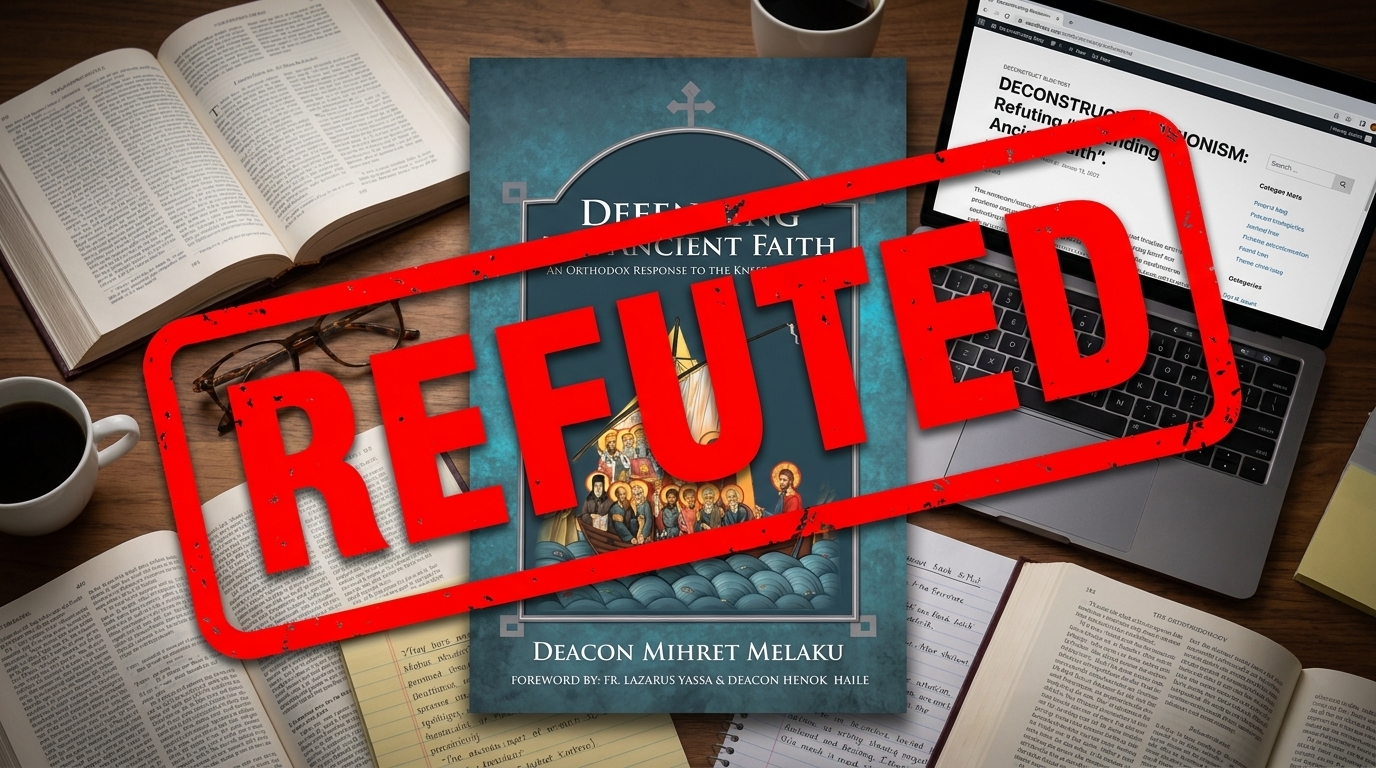
The theological landscape of the twentieth and twenty-first centuries has witnessed the spread of a movement designated by scholars as neo-patristic revisionism. Emerging initially in the aftermath of the 1917 Russian diaspora, this theological movement sought to construct a “purified” Eastern Orthodox identity by radically distancing itself from anything perceived as Western scholasticism or Protestant forensic theology. In their zeal to escape the so-called “Western captivity” of the Church, revisionist theologians began systematically removing juridical, legal, and substitutionary vocabulary from the Orthodox lexicon. This revisionist endeavor routinely relies on false dichotomies, pitting God’s love against His retributive justice, and positioning ontological healing (theosis) as the enemy of legal acquittal (justification).
Chapter IX of Deacon Mihret Melaku’s book, Defending the Ancient Faith, serves as a prime, concentrated artifact of this modern reductionism. In a sweeping attempt to redefine salvation, the chapter aggressively denies the ancient patristic concepts of inherited collective condemnation (original sin), dismisses the biblical doctrine of the imputation of righteousness as a “Protestant mistranslation,” and falsely places the forensic reality of justification in direct opposition to the transformational reality of deification. Furthermore, the author attempts to strip the atonement of its Godward, substitutionary direction, aligning his arguments with condemned historical heresies.
The present analysis will systematically deconstruct and refute the primary theological errors present in Chapter IX. By anchoring the critique strictly in pre-451 AD patristic consensus, ecumenical conciliar decrees, and rigorous scriptural exegesis, the analysis will demonstrate that the author’s paradigm departs significantly from the historic, orthodox faith.
Establishing the Vital Foundations: The Prerequisites for Orthodox Soteriology
To properly diagnose the severe theological missteps within Chapter IX, two vital foundations must first be established. The author’s errors do not exist in a vacuum; they stem directly from a failure to recognize these twin pillars of ancient Christian thought. Without these foundations, any reading of St. Paul or the early Church Fathers collapses into modern individualism and linguistic distortion.
Foundation I: The Crucial Distinction Between Collective and Personal Dimensions
A fatal flaw in modern neo-patristic literature is the pervasive conflation of the collective and personal dimensions of humanity. The early Church Fathers operated on a framework of ontological solidarity, understanding humanity through a dual lens that maintains both corporate headship and individual responsibility.
-
The Collective Dimension: This refers to human nature considered as a single, unified, organic whole. In the patristic mind, humanity is an interconnected organism deeply rooted in its first federal head, Adam, and subsequently recapitulated, healed, and restored in its Second Head, Jesus Christ (the Second or Last Adam). What occurs at the root inevitably dictates the reality of the entire tree. Therefore, human nature as a collective whole fell under a divine sentence of condemnation, legal debt, and ontological corruption due to Adam’s transgression.
-
The Personal Dimension: This refers to the individual appropriation of the collective reality. Individuals commit personal sins for which they bear personal moral responsibility. Likewise, the collective salvation achieved objectively by Christ on the cross must be subjectively appropriated by the individual person through faith, repentance, and participation in the holy mysteries (sacraments) of the Church.
The failure to distinguish between these dimensions inevitably leads to false dichotomies and bad theology. Revisionist theologians frequently assume that because an individual infant did not personally commit Adam’s specific act of eating the fruit (the personal dimension), human nature therefore could not have suffered a collective legal debt, divine wrath, or condemnation under the Fall (the collective dimension). This failure to grasp ontological solidarity forces the author into a theological corner heavily resembling Pelagianism, wherein sin and justification are reduced to mere imitation, biological consequence, or isolated individual actions rather than nature-level realities.
Foundation II: The Linguistic and Theological Equivalence of Imputation and Justification
The second foundation requires establishing the undeniable linguistic and theological equivalence between the “imputation of righteousness” and “justification.” The author dedicates significant space in Chapter IX to denying the entire concept of imputation, labeling it an extrinsic legal fiction and a late Protestant invention.
However, the Greek verb logizomai (λογίζομαι), from which the doctrine of imputation is derived, is an ancient commercial, accounting, and legal term. Its lexical definition means to reckon, to credit, to take into account, or to impute. In biblical soteriology, justification is the divine, forensic act whereby God the righteous Judge does not impute (reckon) sin to the believer, and reckons them as righteous based on the redemptive work of Christ.
Imputation is not opposed to justification; it is the very mechanism of forensic justification described by the Apostle Paul. To deny imputation is to deny the lexical reality of the New Testament text and to obliterate the objective basis upon which a repentant bankrupt sinner stands acquitted before the divine tribunal via faith and grace.
The Heresy of Pelagianism Reborn: Denying Inherited Guilt, Collective Condemnation, and Original Sin
In Chapter IX, the author attempts to dismantle the orthodox doctrine of original sin by vehemently denying that humanity inherited any form of collective guilt, wrath, or condemnation from Adam. The author reduces the Fall merely to the inheritance of biological mortality and a heightened propensity to sin, completely erasing the judicial and penal consequences that befell human nature as a whole.
The Misuse of Deuteronomy 24:16 and the Echoes of Pelagius
To support the denial of inherited collective guilt, the author appeals to the Mosaic Law, writing:
“This however goes against the scriptures. In Deuteronomy 24:16 God says: ‘Fathers shall not be put to death for their children, nor shall children be put to death for their fathers; a person shall be put to death for his own sin.’ This idea is reiterated in Ezekiel 18:20: ‘The soul who sins shall die. The son shall not bear the guilt of the father…’ Not only is inherited guilt unscriptural and unjust, but it is based on an incorrect understanding of sin and of the soul.” (p. 243)
This precise argument—citing Deuteronomy 24:16 and Ezekiel 18 to deny that Adam’s sin brought a sentence of condemnation upon the rest of humanity—was the foundational apologetic utilized by the ancient Pelagians in the early fifth century. Pelagius and his disciple Caelestius argued that it would be fundamentally unjust for a righteous God to blame, condemn, or impute guilt to the human race for an action committed solely by one man, Adam.
The theological error here lies in conflating Mosaic civil jurisprudence with Pauline ontological solidarity. Deuteronomy 24:16 was given by God to govern personal responsibility within the civil justice system of the nation of Israel. An earthly magistrate cannot execute a son for the personal, deliberate crimes of the father. However, Romans 5:12–19 addresses corporate condemnation at the level of human nature. Adam was not merely a private individual committing a private crime; he was the federal head, the root, and the representative of the entire human race.
To illustrate this collective dimension properly, one must consider the analogy of a national representative. When the sovereign ruler of a nation declares war, every single citizen of that nation is instantly placed in a state of hostility with the opposing country. The infant citizens are not personally guilty of drafting the declaration of war, nor did they personally harbor hatred in their hearts, yet they share corporately in the enmity, the legal status, and the devastating consequences of that declaration. Similarly, Adam’s rebellion placed human nature in a state of corporate enmity, legal debt, and condemnation before God.
St. Cyril of Alexandria, writing explicitly against this Pelagian logic, anticipated and utterly dismantled the author’s exact misuse of Deuteronomy 24:16. In his Commentary on Romans 5:18, St. Cyril addresses the objection directly:
“What has Adam’s guilt to do with us? Why are we held responsible for his sin when we were not even born when he committed it? Did not God say: ‘The parents will not die for the children… but the soul which had sinned, it shall die’ [Deut 24:16]?… But we have become sinners through the disobedience of Adam in this way:… Nature became sick with sin through the disobedience of one, that is, Adam. It is in this way that the many have been made sinners—not as though they had transgressed with Adam (for they did not yet exist), but because they are of his nature, the nature that fell beneath the law of sin.”
St. Cyril does not deny that humanity shares in the guilt; rather, he reorients the understanding from personal action to nature-level solidarity. Human nature itself fell under the law of sin and the divine sentence. Furthermore, St. Cyril explicitly connects Adam’s transgression to the inheritance of divine wrath and a collective curse, utterly destroying the author’s claim that the Fall brought only biological mortality. In On Worship in Spirit and Truth, St. Cyril writes:
“You will know this, and very easily, by understanding that in Adam we became communicants in his transgression. But not only that, those things committed by him also brought judgement having spread the curse to all, and in a certain manner allotted the wrath to his offspring.“
Similarly, St. Ambrose of Milan captures this ontological reality of inherited condemnation with profound clarity:
“In Adam I fell, in Adam I was cast out of paradise, in Adam I died. How shall God call me back, except He find me in Adam? For just as in Adam I am guilty of sin and owe a debt to death, so in Christ I am justified.”
If human nature did not collectively fall under wrath, guilt, and judgment in Adam, then human nature was not collectively justified and restored in Christ. The Apostle Paul weaves an unbreakable parallel:
“Therefore, as through one man’s trespass condemnation came to all men, so through one Man’s righteous act justification of life came to all men” (Romans 5:18).
To deny the collective condemnation of the first Adam is to deny the collective justification achieved by the Last Adam.
The Conciliar Condemnation of the Author’s View
The denial of original sin and collective condemnation is not merely a matter of academic theological debate; it is a formally condemned heresy. During the Pelagian controversy, the Church universally recognized that if infants are born completely free from any inherited condemnation, legal debt, or original sin, then the sacrament of infant baptism for the remission of sins is rendered entirely meaningless.
In 418 AD, the Council of Carthage convened to address this precise error, issuing explicit, binding canons that codified the orthodox doctrine of original sin against the Pelagian framework. Canon 2 of the Council of Carthage declares:
“Likewise it seemed good that whosoever denies that infants newly from their mother’s wombs should be baptized, or says that baptism is for remission of sins, but that they derive from Adam no original sin, which needs to be removed by the laver of regeneration… let him be anathema. For on account of this rule of faith even infants, who could have committed as yet no sin themselves, therefore are truly baptized for the remission of sins, in order that what in them is the result of generation may be cleansed by regeneration.“
The Council of Carthage anathematized anyone who denied that infants carry an original sin derived from Adam that requires the laver of regeneration for the explicit remission of sins. This was not a localized Western phenomenon restricted to St. Augustine. The anti-Pelagian decrees of Carthage were ecumenically ratified by the universal Church. The Third Ecumenical Council of Ephesus (431 AD) formally confirmed the condemnation of the Pelagians (including Caelestius).
Centuries later, the Council in Trullo (the Quinisext Council, 692 AD), acting in an ecumenical capacity within the Chalcedonian tradition, explicitly ratified the canons of Carthage in its second canon, elevating them to universal, binding canon law for the entire Chaledonian Churches. This ratification was subsequently confirmed by the Seventh Council (Nicaea II, 787 AD).
By denying that humanity inherits a state of collective condemnation requiring the remission of sins through generation, the author places his views under the direct, explicit anathemas of Carthage and the ecumenical ratifications of the universal Church.
The Fatal Reliance on a Condemned Heresiarch
In a devastating blow to the chapter’s credibility, the author attempts to bolster his rejection of original sin by quoting a historical figure as a representative of the orthodox East. The author writes:
“This understanding of original sin was so solidified in the east that even the rival of St. Cyril, Theodore of Mopsuestia writes in the same manner, saying: ‘by becoming mortal, we acquired greater urge to sin…The assertor of the wondrous original sin could perceive none of these, especially since he had not been exercised in divine Scriptures…he fell into this new idea that God commanded Adam to be mortal in anger and fury, and because of his one offense, he punished all humans, even those not yet born, with death.’” (p. 248)
The author utilizes Theodore of Mopsuestia as a witness to an allegedly “Orthodox” Eastern view of the Fall. This is a catastrophic theological and historical oversight. Theodore of Mopsuestia is not an orthodox witness; he is a condemned heresiarch. His Christology and writings were explicitly condemned by St. Cyril of Alexandria, and he was personally anathematized by the Chalcedonian Church at the Fifth Council (the Second Council of Constantinople, 553 AD).
Furthermore, historical records demonstrate that when the Pelagian heretics (who denied original sin and collective condemnation) were deposed and exiled from the West, they fled to the East and sought refuge and theological sympathy specifically from Theodore of Mopsuestia. Theodore subsequently authored a polemical treatise explicitly titled Against Those Who Say that Men Sin by Nature and Not by Will (also referenced as Against the Defenders of Original Sin). This work was a direct attack on the orthodox doctrine of inherited condemnation and an apologetic defense of Pelagian concepts.
For the author to cite a condemned heretic—one who provided safe harbor to the Pelagians and wrote treatises defending their theology—as a standard-bearer for the “Orthodox view” exposes the profound historical and theological bankruptcy of the neo-patristic revisionism promoted in the chapter.
A more detailed explanation of the Orthodox doctrine of original sin can be found here.
Refuting the Author’s Denial of Imputation and His Contradiction of St. Paul
Having vehemently rejected the collective legal and penal consequences of the Fall, the author proceeds to reject the legal and forensic realities of salvation. Specifically, Chapter IX launches a sustained attack on the doctrine of the imputation of righteousness, claiming it is an artificial, extrinsic fiction completely foreign to the mind of St. Paul.
The author asserts:
“The word here accounted, which many Protestant translators often mistranslate as ‘imputed’ is actually the Greek word ‘elogisthi’ which in Ancient Greece was originally a term used when estimating the value of a currency. God weighed Abraham as one weighs a coin, and found him to be righteous. This is the same way the Hebrew defines it in Genesis 15:6… God regarded, recognized, and considered Abraham to be righteous for his loyalty to Him.” (p. 259-260)
“Orthodoxy strongly condemns the Protestant idea that righteousness is ‘imputed’ to the believer... Imputation thus makes out God to be inconsistent with Himself, and even capable of being deceived… Can God truly be just and truthful if He is regarding as righteous those who truly are not righteous? Certainly not.” (p. 266-267)
“Imputation, aside from intentional mistranslations by Protestant authors, is altogether a foreign concept to the mind of St. Paul…” (p. 269)
The assertion that “imputation” is a Protestant mistranslation of logizomai (λογίζομαι) is linguistically false and contextually invalid. The Greek verb logizomai is fundamentally a commercial, accounting, and legal term meaning to reckon, to credit, to place to one’s account, or to impute. When an accountant credits a sum to a ledger, that sum is imputed to the account holder.
The author argues that God simply “weighed” Abraham and found him to be intrinsically righteous based on his loyalty. However, if logizomai merely means that God recognizes an inherent, pre-existing righteousness within a person, then the entire Pauline doctrine of justification by grace is destroyed. St. Paul explicitly uses logizomai in Romans 4 to demonstrate that God reckons righteousness to those who are not intrinsically righteous, apart from their works.
Consider the deep biblical proof from Romans 4, where the concept of imputation is undeniably woven into the text to explain justification:
Romans 4:3:
“For what does the Scripture say? ‘Abraham believed God, and it was accounted [imputed/logizomai] to him for righteousness.‘”
Romans 4:6–8:
“David also describes the blessedness of the man to whom God imputes [logizomai] righteousness apart from works: ‘Blessed are those whose lawless deeds are forgiven, and whose sins are covered; Blessed is the man to whom the LORD shall not impute [logizomai] sin.‘”
Romans 4:23–25:
“Now the words ‘it was credited [imputed/logizomai] to him’ were written not only for Abraham, but also for us, to whom righteousness will be credited [imputed/logizomai]—for us who believe in Him who raised Jesus our Lord from the dead. He was delivered over to death for our trespasses and was raised to life for our justification.”
In Romans 4:6-8, St. Paul defines the imputation of righteousness as strictly synonymous with the non-imputation of sin. If a repentant sinner committed “lawless deeds” and requires forgiveness (meaning they are not intrinsically perfect or inherently righteous), yet God does not impute that sin to them, God is actively engaging in a forensic, legal acquittal:
The author asks, “Can God truly be just and truthful if He is regarding as righteous those who truly are not righteous?” (p. 267). The Apostle Paul answers this directly declaring that God is the one “who justifies the ungodly”:
But to him who does not work but believes on Him who justifies the ungodly, his faith is accounted for righteousness (Romans 4:5)
If God only justified those who were already completely transformed and intrinsically perfect, no human being could ever be saved.
The author’s denial of imputation forces a theology of works-righteousness, where God merely recognizes human effort (“weighing the coin”), rather than a theology of grace, where God justifies the bankrupt but repentant sinner based entirely on the objective work of Christ, faith, and grace.
It must be emphasized that Orthodox theology does not affirm a hollow, purely extrinsic “double imputation” where a sinner remains unrenewed—a caricature the author rightfully criticizes. Instead, the orthodox mechanics of justification are inextricably bound to the believer’s union with Christ via the Holy Spirit. St. Cyril of Alexandria, in his Commentary on John, beautifully illustrates this by describing the Holy Spirit as a seal or stamp upon the heart and soul of the believer. When the believer receives this divine seal, the very image of Christ is stamped upon them, making the indwelling of His Spirit their actual, objective righteousness.
This aligns perfectly with St. Paul’s declaration that in Christ we become “the righteousness of God”:
He made Him who knew no sin to be sin in our behalf, so that we might become the righteousness of God in Him (2 Corinthians 5:21).
In his commentary on this verse, St. John Chrysostom astutely points out that the Apostle does not say we become righteous (which might imply a mere intrinsic moral improvement), but rather that we become righteousness itself—the very righteousness of God. This demonstrates that our righteousness is not a self-generated quality, but the objective presence of Christ in us. Thus, it is not a legal fiction, but a profound reality realized through the seal of the Spirit.
The Reality of Justification: Collective and Personal Dimensions
The absurdity of denying the Scriptural doctrinal of imputation/justification becomes entirely clear when viewed through the orthodox framework of the collective and personal dimensions of salvation.
At a collective level, human nature was completely justified, recreated, and deemed righteous on account of the obedience and flawless sacrifice of the Second Adam, Jesus Christ. Because the incarnate Word lived a life of perfect obedience, human nature was justified on account of His righteousness. St. Cyril of Alexandria captures this collective justification beautifully in his Commentary on Luke:
“Thus has the guilt of the disobedience that is by Adam been remitted: thus has the power of the curse ceased, and the dominion of death been brought to decay. And this too Paul teaches, saying, ‘For as by the disobedience of the one man, the many became sinners, so by the obedience of the One, the many became righteous.’ For the whole nature of man became guilty in the person of him who was first formed; but now it is wholly justified again in Christ. For He became for us the second commencement of our race after that primary one; and therefore all things in Him have become new. And Paul assures of this, writing, ‘Therefore every man who is in Christ is a new creation; and the former things have passed away: behold, they have become new.'”
Human nature has its boast entirely in Christ. As St. Cyril further explains in That Christ is One:
“For therefore was He also named the last Adam, not enduring to be sick of the things of the first one, but rather ridding in Himself first the nature of man from the blame of that ancient transgression. For it was condemned in Adam, but in Christ was seen most approved and worthy of wonder. Earthy therefore is he, but Christ heavenly. And it was put to shame in the first, borne down to disobedience which is sin, but in Christ hath it preserved untransgression, and as in a second firstfruits of the race, was seen both unwounded by sins, and superior to curse and doom and death and decay.”
At a personal level, this collective justification is applied to the individual believer when their personal sins are remitted and original sin is cleansed through baptism and faith. When a believer is united to Christ, the legal debt of their sin is canceled—it is not imputed to them (Romans 4:8).
The Mechanism of Justification: The Patristic “Sweet Exchange”
While the early Church Fathers did not utilize the expression “double imputation,” they championed the objective, forensic transaction of justification using the similar language of the “Great Exchange” or “Sweet Exchange,” ensuring it is not a hollow, purely extrinsic reckoning where a sinner remains unrenewed. This exchange is expressed first and foremost by St. Paul:
He made Him who knew no sin to be sin in our behalf, so that we might become the righteousness of God in Him (2 Corinthians 5:21).
In this exchange, an objective transfer occurs: Christ assumes our legal debt, curse, and death, and in return, bestows upon us His righteousness, life, and sonship via the Holy Spirit. This foundational truth is immortalized in the ancient Coptic Psalmody (The Friday Theotokia), echoing the theology of St. Athanasius:
“He took what is ours and gave us what is His.”
This exchange is not merely a metaphor for ontological healing; it is a strict, forensic, and substitutionary transaction. St. Alexander of Alexandria captures the explicit penal and substitutionary nature of this exchange, writing:
“...life for life, blood for blood, to undergo death for death? For Christ, by dying, hath discharged the debt of death to which man was obnoxious.”
As the ancient Epistle to Diognetus describes this objective transaction:
“O sweet exchange! O unsearchable operation! O benefits surpassing all expectation! that the wickedness of many should be hid in a single righteous One, and that the righteousness of One should justify many transgressors.”
Furthermore, St. Cyril emphasizes that because Christ paid our legal debt, we objectively become righteousness in Him:
“So also He paid the debt that was incurred for us, and we ourselves became righteousness in Him“.
How do we become “the righteousness of God” (2 Corinthians 5:21) if it were not Christ’s righteousness? And how does Scripture say He is “our Righteousness” (Jeremiah 23:6) if it were not His righteousness covering us?
Just as the moon shines by reflecting the sun rather than generating its own light, and a drowning person becomes buoyant and is saved by clinging to an extrinsic life preserver, rather than mutating into a buoyant creature, humanity is rescued from sin not by generating intrinsic righteousness, but by uniting with Christ, who is our objective righteousness. All this maintains that it is not a hollow reckoning, but a profound reality followed by the non-imputation of sin on account of Christ’s sacrifice (Justification) and unity with Christ via the Spirit. To deny justification is to deny the very means by which a sinner partakes in the objective salvation accomplished on the cross.
Redefining Grace to Erase Divine Acquittal
In a further attempt to eradicate forensic concepts from soteriology, and having already dismissed the entire Biblical concept of imputation, the author goes on to distort the biblical concept of grace (charis), redefining it exclusively as the “uncreated energies” and “divine power”
He writes:
“Grace is not an abstract declaration of righteousness, it is the power of God itself, the energies of God which St. Paul mentions throughout his epistles… The grace of God is the divine power working in St. Paul… What must our logical conclusion be? That the grace of God is His energies. Is this grace then a created thing, an abstract favor or declaration that God willed through fiat? Certainly not…” (p. 267)
This argument relies on the fallacy of totality. He commits a fatal error by asserting that grace is only the power of God, completely excluding the biblical usage of grace as unmerited divine favor, pardon, and legal acquittal.
Scripture routinely utilizes the Greek word charis (grace) to denote the disposition of God’s favor and the forensic act of canceling a debt. The most devastating proof against the author’s reductionism is found in Romans 3:24:
“...being justified freely by His grace [charis] through the redemption that is in Christ Jesus, whom God set forth as a propitiation by His blood…”
In this passage, grace is the unmerited favor by which God freely justifies the sinner. It is directly tied to the remission of sins and the payment of a redemption price. A judge who pardons a convicted criminal extends grace and favor through a declaration of acquittal. To claim that grace cannot encompass a “declaration that God willed” is to deny the sovereign prerogative of God the Judge to issue a decree of pardon over humanity.
By restricting grace exclusively to “uncreated energies”, the author strips the Gospel of its most comforting promise: that while humanity was yet powerless and ungodly, God, out of sheer unmerited favor (grace), canceled the legal debt of sin and declared the ungodly to be justified through the blood of Christ through faith. As St. Cyril of Alexandria writes in his Commentary on the 12 Prophets:
“So although we were disturbed from the beginning in suffering the effects of divine wrath, in the approach of the years when Christ was acknowledged and brought to light at the time determined of old, then he remembered mercy. We have been justified, in fact, not ‘by the works of the Law,’ as Scripture says, nor ‘because of any works of righteousness that we have done, but according to his great mercy.'”
Pitting Justification against Theosis: The False Dichotomy
Having already denied the forensic reality of justification and the imputation of righteousness, as well as altered the definition of “grace“, the author goes on to pit imputation (justification) against Theosis (transformation) and chooses the latter over the former. In doing so, he creates a false dichotomy as if the two were mutually exclusive.
In the middle of page 266, the author starts a section with the title “Righteousness is Through Transformation Not Imputation” and goes on to argue:
“In connection with this, Orthodoxy strongly condemns the Protestant idea that righteousness is ‘imputed’ to the believer…Imputation is inherently an extrinsic action, not an actual internal transformation of the person. In the Reformed thought, we continue being the depraved and corrupt people we always were, but we simply are forensically considered righteous.” (p. 266)
Salvation is not an extrinsic declaration of our innocence, but an internal transformation whereby the attributes of God become ours… This is what in Orthodox we call theosis or deification...” (p. 268)
While the author is right to challenge some modern, pop-evangelical reductions of imputation that treat Christ’s righteousness merely as a “metaphorical bank account” or a legal trick devoid of actual renewal, he uses this caricature to throw out the entire biblical and Pauline doctrine of imputation. Even if some contemporary Protestant streams fall into that reductionist error, this provides no grounds to reject the forensic reality of logizomai or to construct a false dichotomy between justification and theosis.
True patristic and biblical soteriology embraces both: the objective, forensic declaration of acquittal based on Christ’s substitutionary work, and this lays the vital non-meritorious foundation for the ongoing, synergistic process of internal transformation (sanctification/theosis) via the Holy Spirit. Therefore, justification (the remission of sins and the non-imputation of sin) and transformation/theosis are two inseparable sides of the same redemptive coin. Theosis depends entirely upon justification. A person who remains under the legal guilt of sin, condemned by the divine tribunal and in a state of enmity with God, cannot partake in the Holy Spirit. The extrinsic declaration of innocence (Justification) and the non-imputation of sin through faith, are the absolute prerequisites for internal transformation (sanctification/theosis) .
Exposing the Palamite Intrusion: The Fallacy of “Uncreated Energies”
In his revisionist effort to dismiss the concepts of imputation and redefine grace, the author introduces a profoundly anachronistic and distinctly (Chalcedonian/Byzantine) concept into his soteriology: the Palamite doctrine of “uncreated energies.” He repeatedly treats the phrase “uncreated energies” as synonymous with God’s active presence and the Holy Spirit, writing:
“We receive the uncreated energies of God (grace) when we are born again of water and the Spirit.” (p. 272)
By utilizing the exact phrase “uncreated energies” synonymously with the Holy Spirit, the author actively imports 14th-century Palamite theology into his arguments. Oriental Orthodoxy fundamentally rejects the theological framework of Gregory Palamas, which enforces a real ontological distinction within the Godhead — between His “Essence” (Ousia) and His “Uncreated Energies” (Energeiai). While Oriental Orthodox theology is not at odds with speaking of God’s divine energies or operations from a philosophical and metaphysical standpoint to describe His action in creation, it adamantly rejects the Palamite premise that these energies are ontologically distinct realities in the Godhead. This theology inevitably introduces composition into God no matter how much Gregory Palamas tried to deny it. Oriental Orthodoxy maintains the simplicity of God, and does not partition Him ontologically, nor speak of His operational energies synonymously as if they were God Himself.
Furthermore, the specific phrase and theological construct of “uncreated energies” is nowhere to be found in the writings of the pre-451 AD early Church Fathers. While early Fathers such as Saint Basil the Great (whom the author attempts to co-opt on page 268) speak of God’s operations or activities (energeiai) descending to us while His essence remains inaccessible, Saint Basil was employing conceptual and epistemological language to explain how humans know God. He was absolutely not positing a real ontological split within the Godhead as Gregory Palamas did.
The rejection of Palamism by Oriental Orthodoxy is also not an adoption of the Western Thomist view of absolute divine simplicity. Classical patristic theology avoids both extremes: it rejects Palamism’s real ontological division between divine essence and energies without capitulating to Thomism’s rigid, rationalistic absolute simplicity. Patristic orthodoxy affirms that God is simple essence and that he acts truly, dynamically, and unalterably in creation without requiring a multi-tiered ontology within the divine nature itself.
The Palamite essence and energies doctrine is refuted in more detail here.
Exposing Further Neo-Patristic Revisionism: The Denial of Penal Substitution
The denial of original sin, collective condemnation, imputation, and legal acquittal does not exist in a vacuum within Chapter IX. It is part of the Author’s broader neo-patristic agenda in Chapter VIII to dismantle the orthodox doctrine of the atonement, specifically the reality of vicarious substitution.
The author’s complete denial of forensic justification in Chapter IX is merely the logical consequence of his denial of vicarious substitution. If Christ did not legally pay a debt on behalf of humanity (substitution), then God cannot legally justify the believer. By destroying the objective, forensic atonement, the author is forced to construct a subjective, transformational model of justification that ultimately relies on the believer’s internal state, echoing the very Pelagian errors the early Church fought so fiercely to eradicate.
A more detailed explanation of atonement in the early Church can be found here.
Summarizing the Theological errors
To provide a structured overview of the theological errors present in the chapter, the following table contrasts the author’s neo-patristic assertions with the established patristic and conciliar orthodoxy:
| Theological Doctrine | Deacon Mihret’s Revisionist Assertion (Chapter IX) | Patristic, Conciliar, and Scriptural Orthodoxy |
| Original Sin & The Fall | Denies inherited guilt and collective condemnation. Claims the Fall only brought biological mortality and an urge to sin. Appeals to Deut 24:16 and Theodore of Mopsuestia. | Human nature corporately fell under a divine sentence of condemnation, wrath, and the law of sin (Rom 5:18). Denying this incurs the anathema of Carthage (418 AD) Canon 2, ratified by Trullo. |
| Imputation (Logizomai) | Claims it is a Protestant mistranslation. Denies God can regard someone as righteous if they are not intrinsically righteous. | A biblical accounting term used repeatedly by St. Paul (Rom 4:3-8) referring to the non-imputation of sin and the objective ‘sweet exchange’ where the believer becomes righteousness in Christ. |
| Justification vs. Theosis | Creates a false dichotomy. Claims salvation is not an extrinsic declaration of innocence, but exclusively an internal transformation (theosis). | The two are inseparable. The extrinsic declaration of innocence (Justification) and the non-imputation of sin are the absolute prerequisites for internal transformation (Theosis). |
| Grace (Charis) | Restricts grace exclusively to the “uncreated energies” and explicitly denies it can refer to a legal declaration or abstract favor. | Commits a fallacy of totality. Scripture explicitly defines grace as the unmerited favor by which God freely issues a legal acquittal (justification) over the sinner (Rom 3:24). |
| Uncreated Energies & Divine Simplicity | Employs 14th-century Byzantine Palamite theology, using the phrase “uncreated energies” synonymously with God Himself, projecting an ontological Essence/Energies division onto the Godhead. | Oriental Orthodoxy and the pre-451 AD Fathers strictly maintain the simplicity of God. While acknowledging God’s energies (operations) from a philosophical and metaphysical standpoint, they firmly reject any real ontological distinction or partition within the Godhead. Furthermore, the specific expression “uncreated energies” is foreign to early patristic tradition, especially when “energies” are used synonymously with God Himself. |
| Atonement & Substitution | Rejects penal substitution and debt-cancellation, portraying salvation merely as a victory over demons without a Godward sacrifice to satisfy divine truth. | Christ acted as a vicarious substitute, offering His body Godward to the Father, paying the penal debt, and bearing the wrath due to human transgression (Fraction to the Son, Athanasius, Cyril). |
Conclusion
The analysis of Chapter IX of Defending the Ancient Faith reveals a theological framework that is fundamentally at odds with the apostolic and patristic witness. Under the guise of defending Orthodoxy against perceived Western distortions, Deacon Mihret introduces distortions of his own using neo-patristic revisionism that systematically dismantles the forensic, and legal dimensions of salvation.
By blurring the vital distinction between the collective and personal dimensions of humanity, the author revives the ancient arguments of the Pelagians, utilizing Mosaic civil law (Deuteronomy 24:16) to deny the collective condemnation of human nature in Adam. This denial places the chapter in direct opposition to the ecumenically ratified canons of the Council of Carthage (418 AD) and forces the author into the regretful position of citing Theodore of Mopsuestia—a condemned heresiarch—to articulate the author’s view of “Orthodoxy.”
Furthermore, the author’s aggressive rejection of imputation (logizomai) as a mere “Protestant mistranslation” demonstrates a profound failure to grapple with the lexical reality of Romans 4. By denying that God issues an extrinsic declaration of innocence over the ungodly, the author redefines the word “grace”, and pits justification against theosis, stripping the believer of the objective comfort of the “sweet exchange,” wherein Christ’s perfect, substitutionary righteousness covers them and they become the righteousness of God. Grace is thereby reduced from a sovereign, unmerited decree of pardon to a strictly ontological energy, robbing the cross of its propitiatory and debt-canceling power.
In contrast, the pre-451 AD Fathers—spearheaded by St. Athanasius and St. Cyril of Alexandria and others—maintained a robust, multidimensional soteriology. They affirmed that human nature fell under a collective sentence of wrath and death, and that Christ, as the Second Adam, acted as a vicarious substitute, paying the penal debt to divine justice on the cross. It is precisely because Christ secured this objective, legal victory that God freely extends grace, does not impute sin, and justifies the believer, laying the unbreakable foundation upon which the Holy Spirit accomplishes the transformational work of sanctification and theosis.
Deacon Mihret’s errors in Chapter XIII are refuted in more detail here.
Special thanks to servant and seminarian Alex Malek for his review and feedback of this article