Introduction: Theological Context and Problem Statement
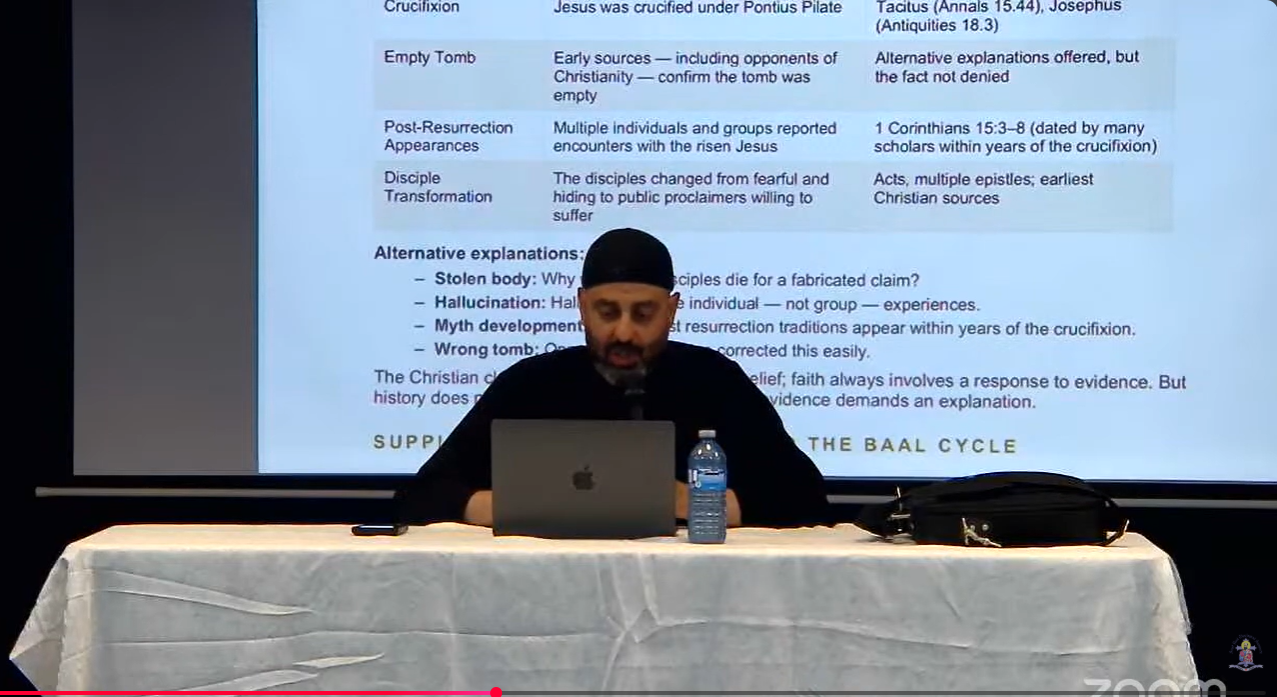
This article provides a detailed dogmatic and patristic critique of a lecture delivered by Fr. Paul Guirgis at St. Paul Theological Seminary, Canada. While the lecture purports to articulate the authentic Coptic Orthodox view of salvation, it instead propagates a series of theological reductionisms and logical and theological fallacies.
Fr. Paul attempts to introduce a revisionist soteriological framework that has gained traction in many modern Byzantine/Chalcedonian circles. This framework operates by constructing artificial false dilemmas between the otherwise distinct yet harmonious dimensions of Christ’s redemptive work. Specifically, he systematically minimizes the forgiveness of sins, denies that Christ died as a vicarious substitute paying the debt of sin, dismisses propitiation and sacrifice to God the Father, and falsely attributes these core patristic doctrines to eleventh-century Anselmian scholasticism or sixteenth-century Protestant Calvinism.
A careful examination of the Holy Scriptures and patristic consensus — particularly the writings of St. Athanasius and St. Cyril of Alexandria — demonstrates that Alexandrian soteriology has never pitted the penal, judicial, and substitutionary aspects of the Cross against the ontological conquest of death. Far from being mutually exclusive, the satisfaction of the divine sentence of death and cancellation of the debt of sin are the necessary logical and ontological prerequisites for the destruction of death and the deification (theosis) of believers. This analysis aims to expose both the symptoms and the underlying causes of the theological revisionism introduced in the lecture.
Deconstructing the Soteriological False Dilemmas
False Dilemma I: Minimizing Forgiveness of Sins and Severing it from the resurrection
Fr. Paul constructs an initial false dichotomy between forgiveness of sins and the defeat of death, asserting that modern Protestant theology overemphasizes forgiveness while the Orthodox Early Church treated it as a minor matter:
“And as we’re gonna see, the early church was more concerned or had a bigger concern, actually, and that concern was death itself… Forgiveness of sins was a minor concern compared to that.” [Audio 00:03:54–00:04:17]
This statement presents a false dichotomy that fundamentally misunderstands the biblical cause-and-effect relationship between sin and death. In Scripture, death is not an arbitrary, self-subsisting biological entity; it is explicitly defined as the “wages of sin” (Romans 6:23) and the ultimate penalty for violating God’s commandment (Genesis 2:17). Any attempt to categorize forgiveness of sins as a “minor concern” relative to the conquest of death is theologically flawed. Death maintains its hold over humanity precisely because of unremitted guilt and sin. Therefore, Christ conquers death precisely because He forgives and atones for the sins that gave death its legal power over humanity.
St. Athanasius whom Fr. Paul attempts to enlist in support of his view, directly contradicts this separation in On the Incarnation. St. Athanasius explains that humanity was perishing because the law of death was active due to human transgression. The removal of sin’s condemnation through Christ’s offering is what neutralizes the power of death.
St. Cyril of Alexandria similarly teaches that Christ “put away sin” by offering Himself as an unblemished sacrifice, thereby destroying the root cause of corruption:
But sin being destroyed, how could it be that death which was of it and because of it should not altogether come to nothing? The root dying, how could the shoot yet survive? Wherefore should we yet die, now that sin has been destroyed? Therefore jubilant in the Sacrifice of the Lamb of God we say: O death, where is your sting? O grave, where is your victory? (Commentary on the Gospel of St. John)
Thus, by marginalizing remission of sin, Fr. Paul dismantles the biblical mechanism of salvation, reducing sin to an incidental flaw rather than the spiritual catastrophe that alienated humanity from God and caused death in the first place.
False Dilemma II: The False Antithesis Between Substitutionary atonement and Victory over death
Fr. Paul repeatedly insists that viewing the Cross as a satisfaction of debt or as a substitutionary sacrifice is incompatible with the Orthodox view which he maintains is ontological healing and resurrection:
“Now, at this point, it’s important to address something like the elephant in the room. The language of debt… But it’s important for us to understand what is meant by debt… whether it was paid or canceled, because those are two different things.” [Audio 00:16:28–00:17:01]
“But also penal substitution or substitutionary atonement… Where essentially salvation is understood in this sense of substitution as the fulfillment of legal demands… But that doesn’t address the problem of being. We’re still corrupt.” [Audio 00:25:09–00:26:41]
“So Orthodox theology emphasizes healing over punishment, victory over mere legal transfer or change of legal status, and participation over substitution.” [Audio 00:55:37–00:56:05]
These statements present classic false dilemmas: According to Fr. Paul, Christ’s death is either a legal substitutionary payment of debt, OR it is an ontological healing and victory. The continuous witness of Coptic Orthodox theology and the Early Church Fathers proves that it is unequivocally both. The assertion that substitution and debt payment are modern Western novelties is directly disproved by St. Athanasius’s explicit text in On the Incarnation:
“He takes to Himself a body capable of death, that it, by partaking of the Word Who is above all, might be worthy to die in the stead of all… by offering an equivalent… He satisfied the debt by His death.” (On the Incarnation, 2.9)
” That the debt owing from all might be paid.” (On the Incarnation, 4.20)
St. Athanasius explicitly employs three key technical concepts:
-
Vicarious Substitution: Expressed through anti panton (“in the stead of all“), indicating that Christ suffered death in place of humanity.
-
Debt Satisfaction: Expressed through eplērou to opheilomenon (“satisfied the debt“), establishing that human sin incurred an ontological and legal debt that required full discharge.
-
Propitiatory Exchange: Expressed through prosagein to axion (“offering an equivalent“), affirming that the infinite Person of the incarnate Logos constituted a sufficient sacrifice to pay the debt of humanity and satisfy the divine consistency/truth.
St. Cyril of Alexandria repeatedly confirms this vicarious, penalty-bearing substitution:
“He took upon Himself the punishment that the Law justly assigns to sinners.” (Commentary on John, 19:16)
The Coptic Orthodox Church, through its modern hierarchs and theologians, has explicitly repudiated the false dichotomies presented in the lecture. His Eminence Bishop Raphael, former Secretary of the Coptic Holy Synod, directly refutes those who attempt to deny Christ’s substitutionary death and divine punishment:
“Currently, there are some who call themselves the ‘illumined’. They say things the church fathers never said, which they claim the fathers said. They say that ‘God doesn’t punish.’ You will see in the words of Athanasius that God does punish. They also say that there is no ‘substitutionary death’, or for anyone to die ‘instead of’ someone else… This is mere sophistry. You will find that St. Athanasius speaks of a ‘substitutionary death’ and death ‘instead of’ us.”
By presenting substitution and healing as mutually exclusive, Fr. Paul constructs a caricature that distorts patristic soteriology and Scripture.
False Dilemma III: Propitiation, Divine Wrath, and Sacrifice to God the Father
Fr. Paul attempts to discredit the doctrine that Christ’s death was an atoning, substitutionary sacrifice offered to God the Father, dismissing the concept by equating it with crude pagan appeasement:
“So you offer sacrifices just to keep Him happy, just to keep Him away from you… There’s no union with a wrathful God. There’s only appeasement. There’s only a sacrifice that is offered, so He stays off of our back, right?” [Audio 00:28:13–00:28:26]
To bolster this claim, he relies on a selective reading of St. Gregory the Theologian (Nazianzen):
“St. Gregory the Theologian in Homily Forty-Five, he writes… To whom was that blood offered that was shed for us, and why was it shed?… If to the Father, he says, I ask first how? For it was not by him that we were being oppressed… Is it not evident that the father accepts him, but neither asked for him nor demanded him…” [Audio 00:35:50–00:38:16]
Fr. Paul’s argument relies on a fundamental misreading of St. Gregory’s famous passage in Oration 45 (Second Oration on Easter, 22). In context, St. Gregory is refuting two specific errors: first, the absurd notion that a ransom was paid to the Devil (which would make the devil a tyrant receiving God Himself as payment); and second, the pagan misconception that God the Father is a bloodthirsty tyrant who demanded or delighted in the Son’s blood out of vindictive wrath.
Far from declaring sacrifice unnecessary or denying a Godward offering, St. Gregory explicitly affirms that “the Father accepts Him.” If the Father accepts the offering, it is by definition a Godward sacrifice. St. Gregory clarifies why the Father accepts the Son without having compelled the sacrifice out of wrath: it was offered voluntarily by the Son “on account of the incarnation, and because humanity must be sanctified by the humanity of God.” The sacrifice was not extorted by an angry deity, but offered freely by the incarnate Word as our High Priest to sanctify humanity within the divine economy.
Furthermore, the biblical analogy St. Gregory employs in this exact passage—the sacrifice of Isaac (Genesis 22)—directly undermines Fr. Paul’s thesis. St. Gregory notes that the Father “would not receive even Isaac when he was being offered by his father, but changed the sacrifice, putting a ram in the place of the human victim.” Rather than disproving sacrifice or substitution, this example establishes both. Just as God rejected human blood and provided a substitutionary ram to be offered to Himself, so too God provided the incarnate Son as the ultimate substitutionary Lamb offered to the Father.
Throughout his writings, St. Gregory Nazianzen repeatedly affirms the propitiatory, substitutionary, and Godward efficacy of Christ’s blood. He explicitly defines Christ as both Ransom and Sacrifice offered for our sake:
“We needed an Incarnate God, a God put to death, that we might live… He is called Ransom because He frees us who were held in bondage… He is called Sacrifice because He is the blameless Victim offered for us.” (Oration 30.20)
Fr. Paul’s conflation of biblical propitiation with pagan appeasement ignores the vital distinction between the two. In paganism, a terrified human attempts to bribe a fickle deity. In Christian soteriology, God in His infinite love provides the substitutionary victim Himself—offering His own Son to satisfy divine truth and holiness. Scripture explicitly terms Christ our propitiation (hilasmos / hilastērion, Romans 3:25; 1 John 2:2; 1 John 4:10), denoting an objective sacrifice that satisfies the divine sentence and turns away righteous judgment.
This Godward, substitutionary sacrifice is foundational to Alexandrian theology. St. Cyril of Alexandria explicitly teaches that Christ stood as High Priest to offer Himself to the Father to satisfy divine justice and appease the sentence against human sin:
“As our truly great and all-holy high priest, Christ appeases the wrath of His Father by His prayers, sacrificing Himself for us.” (Explanation of Twelve Chapters, Anathema 10)
“Then, since He is a High Priest, insomuch as He is Man, and, at the same time, brought Himself a blameless sacrifice to God the Father, as a ransom for the life of all men…” (Commentary on the Gospel of St. John)
Late Pope Shenouda III of Alexandria provided an authoritative Coptic Orthodox summary of this issue, directly refuting Fr. Paul’s assertion that a sacrifice cannot be paid to God:
“The ransom was paid to the Divine Justice. The Old Testament sacrifices were symbols of the sacrifice of the cross. These sacrifices were not offered to the devil but were offered to God. Since sin is committed against God (Ps 51:4), then the price of this sin should be paid to God Himself; the devil has no right to ask or to accept a ransom.” (Comparative Theology)
By reducing propitiation to “pagan appeasement” and stripping St. Gregory Nazianzen’s quote of its context, Fr. Paul creates a false dilemma that sets God’s love against His divine truth/judgment, rejecting the unified witness of Scripture, and patristic consensus.
False Dilemma IV: “Debt cancelled” does not contradict “Debt paid”
At timestamp Audio 00:38:37–00:39:04, Fr. Paul explicitly attempts to dismantle substitutionary atonement by declaring: “The debt is not paid, it’s canceled. The parable of the rich man does not say that somehow you must find payment or I will pay for your debt. He freely forgave them both.” This false dilemma pits cancellation against payment, conflicting directly with New Testament theology and Alexandrian patristics.
In Colossians 2:14, St. Paul explains that the wiping out of the handwriting of debt occurred precisely because God “nailed it to the cross”—demonstrating that the legal record of debt was blotted out because its sentence was executed and satisfied in the crucified body of Christ.
St. John Chrysostom emphasized that Christ paid our legal debt in full on the cross:
“Christ paid far more than we owed, and as much more as the illimitable ocean is greater than a tiny drop… He did not merely cancel the handwritten record of our debt (chirographon), but tore it up, nailing it to the Cross.” — St. John Chrysostom (Homilies on Romans, Homily X)
St. Athanasius explicitly refutes the idea that God would simply cancel the debt by decree without the Cross, affirming in On the Incarnation (9:1–3, 20:5) that Christ “satisfied the debt by His death” by offering an “equivalent” to fulfill the law and preserve divine truth. Likewise, St. Cyril of Alexandria teaches that as man Christ paid the penalty for our sins, while as God He forgave our debts. In authentic Alexandrian Orthodox soteriology, a spiritual debt is both paid and cancelled simultaneously: it is freely cancelled on account of the sinner, but fully paid on account of Jesus Christ through His voluntary, substitutionary sacrifice on the Cross. The debt is cancelled precisely because the debt is paid.
False Dilemma V: The Cross Is Not Eclipsed by the Resurrection
Fr. Paul attempts to discredit substitutionary atonement by claiming that the early Church Fathers and St. Paul were primarily focused on the Resurrection rather than the Cross. In doing so, he constructs an artificial dichotomy that downplays the Crucifixion and pits the Lord’s death against His Resurrection:
“The cross is not the focus of… either the Fathers or, or St. Paul” [Audio 00:41:58–00:42:18]
“What is accomplished is accomplished in the resurrection. It’s not accomplished on the cross.” [Audio 00:42:27–00:42:35]
These assertions are foreign to apostolic tradition and are directly contradicted by Holy Scripture and the witness of the Church. St. Paul explicitly refutes any attempt to minimize the Crucifixion, declaring to the early believers: “For I decided to know nothing among you except Jesus Christ and Him crucified” (1 Corinthians 2:2). Throughout the New Testament, direct, objective saving efficacy is attributed specifically to the Cross. It is on the Cross that Christ gives His life as a ransom, pours out His blood for the remission of sins, dies in our place, reconciles us to God, cancels the record of our debt by nailing it to the wood, and becomes a curse for us to redeem us from the curse of the Law. To claim that redemptive accomplishment belongs exclusively to the Resurrection distorts and invalidates the biblical narrative.
Fr. Paul further contends that St. Paul’s statement in 1 Corinthians 15:17—“If Christ has not been raised, your faith is futile”—proves that the Resurrection is inherently more central to salvation than the Crucifixion. However, this argument misinterprets the immediate context of apostolic teaching. St. Paul does not elevate the Resurrection above the Cross; rather, he demonstrates that without the Resurrection, there is no proof that the sacrifice of the Cross was accepted or that death was defeated. Without the Cross, there is no remission of sins. Without remission of sins, the cause of death abides. Hence without the Resurrection as the seal of remission of sins, “you are still in your sins”.
St. John Chrysostom directly addresses the inner logic of 1 Corinthians 15:17, illustrating how the Cross and the Resurrection form an indivisible, co-dependent unity:
“For behold, says one, ‘the Lamb of God, which takes away the sin of the world.’ (John 1:29) But how does He take it away? By His death… But if He rose not again, neither was He slain: and if He was not slain, our sin is not taken away: and if it is not taken away, you are in it.” (Homily 39 on First Corinthians)
Thus, the Orthodox formula is neither “the Cross only” nor “the Resurrection is more important than the Cross”. Rather, Christ’s Cross is the once-for-all sacrificial, ransom-paying, sin-bearing, and curse-bearing act by which He deals decisively with sin and its legal sentence, making the glory of the Resurrection possible.
Scriptural Misrepresentations
Misinterpreting Debt, Jubilee, and the Census Ransom
To undermine the biblical concept that sin creates a legal “debt” before God requiring satisfaction, Fr. Paul mischaracterizes Old Testament civil law:
“But the problem, the problem here is that debt is seen as something sinful, something that is, uh, not desirable to be had… So for God to turn around and become himself the keeper of debt, it kind of flips everything on its head and it becomes, uh, like hypocritical. When, when God tells the Israelites not to keep, not to hold debt, and then he holds debt… Debt is something that is seen as something undesirable… It’s not paid. There’s nothing paid back. It’s just released.” [Audio 00:19:19–00:20:20]
Fr. Paul conflates financial indebtedness between human neighbors under Israelite civil law with the spiritual and moral debt created by human rebellion against the Holy Creator. Calling God “hypocritical” for requiring satisfaction for sin ignores the reality of His divine holiness and governance.
Moreover, Fr. Paul argues that whatever “debt” existed, it was cancelled, not “paid” essentially denying Christ’s atonement. St. Athanasius refutes Fr. Paul’s claim that nothing is paid, that ransom has no debt/debtor sense, or that the cross is only release without a Godward sacrificial satisfaction:
There was a debt owing which must needs be paid … all men were due to die. … [The Word] might offer the sacrifice on behalf of all, surrendering His own temple to death in place of all, to settle man’s account with death and free him from the primal transgression. (St. Athanasius, On the Incarnation of the Word. Chap. 4:20)
The debt is not a mortgage owed to a needy creditor as Fr. Paul caricaturizes the Divine mystery. It is the liability that arises when the creature violates the Creator’s command: the sentence of death, the curse, condemnation, alienation from the source of life, and corruption. The payment is Christ’s voluntary self-offering of the human nature He assumed, not a commercial transfer of wealth. The result is cancellation/remission for those united to Christ; the means is the costly sacrifice and representative death of the sinless Word.
St. Irenaeus supplies the Godward dimension in clear language. Humanity became enemies by transgressing the Creator’s command; Christ restored friendship through the Incarnation, “propitiating indeed for us the Father against whom we had sinned,” and cancelling disobedience through His own obedience. Irenaeus explains the prayer “forgive us our debts” by saying that God is “our Father, whose debtors we were, having transgressed His commandments.” He then says that Christ remits those debts and destroys the handwriting of debt by fastening it to the cross.
Fr. Paul’s assertion that Old Testament law knows no payment of debt or ransom offered to God is also refuted by Scripture. In Exodus 30:11–16, God mandates the Census Ransom (Kopher):
“When you take the census of the children of Israel… then every man shall give a ransom (kopher) for his soul to the Lord… a half shekel shall be the offering to the Lord… to make atonement for your souls.” (Exodus 30:12–15)
As detailed in patristic and Coptic biblical analyses, the Hebrew term kopher and its Greek equivalent lytron denote a concrete price paid to God for a life exposed to divine judgment. The Census Ransom was not a human civil debt; it was an explicit, God-ordained payment offered directly to the Lord to avert a plague of judgment. The Old Testament sacrificial system (Leviticus 1–7) consistently establishes that sin creates a moral debt that requires expiation by blood before a Holy God.
Moreover, the Torah cannot be reduced to Deuteronomy 15. The same Pentateuch contains the following countervailing data:
| Old Testament text | What it establishes | Why it matters |
| Exodus 30:11‒16 | Each Israelite in a census gives a “ransom for their lives to the Lord”; the money is expressly called atonement money | Ransom language is not merely generic deliverance; it can be Godward and given for life. |
| Exodus 13:11‒16 | The firstborn belongs to the Lord; the firstborn donkey is redeemed by a lamb or dies | The Torah itself contains a concrete substitute-or-death structure. |
| Leviticus 17:11 | God gives blood on the altar to make atonement for life | Atonement is sacrificially ordered by God. |
| Leviticus 5‒6 and Exodus 22 | Sin/guilt offerings and restitution appear alongside mercy laws | Torah does not cancel justice, atonement, restoration, or payback of debt for wrongdoing |
| Genesis 22 | God provides a ram in Isaac’s place. | The narrative gives a paradigmatic substitute provided by God rather than a vague rescue without substitution. |
Borrowing Calvinist Logic to Attack Orthodox Alexandrian Soteriology
Throughout the lecture (specifically at Audio 00:34:49–00:35:41), Fr. Paul introduces Calvinist premises as the absolute definition of what “paying a debt” means and uses the same premises to discredit substitutionary atonement. He argues that if Christ paid a debt on the Cross, logical consistency demands either Calvinist limited atonement (Christ paid only for a predestined elect) or Apokatastasis (universal salvation where hell is empty because the debt is already paid). The fatal flaw in this argument is it treats the Atonement as an automated financial transaction, completely disregarding the biblical necessity of human faith, free will, and synergy in appropriating Christ’s salvation.
If it were not troubling enough that a Coptic Orthodox priest is trying to discredit substitutionary atonement and the payment of a debt (since these are Scriptural concepts explicitly taught by the Alexandrian Fathers), it is equally troubling that he attempts to utilize flawed Calvinist polemics to do so.
Actually, the exact Calvinist logic Fr. Paul utilizes to attack substitutionary atonement collapses his preferred “Christus Victor” model. This is because if in the case of substitutionary atonement, faith/synergy are disregarded resulting in limited atonement or universal salvation, then by the same token, Christ universally conquering Death and Hades must likewise equal a limited victory (Christ conquered death only for those whom He predestined) or Apokatastasis (all are saved because death is conquered automatically for all).
Reductive Mythological Parallelism in Psalm 24 and the Harrowing of Hades
In the final portion of his main address, Fr. Paul introduces an extended narrative regarding Ugaritic and Babylonian mythology—specifically the conflict between Baal, Yam, Nahar, and Mot—to explain Psalm 24 and the Harrowing of Hades:
“The Israelites were not living in a vacuum… the Babylonians had a god named Baal… Yam means sea, Nahar means river… So when you see the icon of the harrowing of Hades… they’re responding to the Baal story and saying, ‘No, it’s not Baal that defeats all of these enemies… It is the Lord.’… And this is the whole entire story of salvation. It’s about defeat of the devil, defeat of death. It’s not just a mere transaction.” [Audio 00:58:01–01:05:34]
By framing salvation almost entirely as a polemical counter-narrative to Canaanite myth, Fr. Paul tries to reduce the Cross to an act of cosmic power — the mere conquest of death.
This perspective minimizes the sacrificial, temple-based typology of Holy Scripture. The Cross is not merely a mythological victory over cosmic sea-monsters; it is the fulfillment of the Levitical Day of Atonement, the Isaianic Suffering Servant who “bore our iniquities” (Isaiah 53:5), and the Paschal Lamb whose sprinkled blood shelters humanity from the Destroyer (Exodus 12). By overemphasizing mythological parallels, Fr. Paul obscures the core biblical theme of atonement and reconciliation with God through blood sacrifice.
Analysis and Refutation of the Question and Answer Session
The Question and Answer session following the lecture highlights additional soteriological errors.
In response to Question 1 [Audio 01:06:24–01:07:50], an audience member asks whether forgiveness of sins coincided with the Cross or depended on it, and if God could have verbally forgiven humanity without Golgotha. Fr. Paul replies:
“What’s the point of forgiveness of sins if your ontological problem is not solved?… there is no point… Otherwise you end up with a problem… legally you’re not guilty, but you’re full of corruption.” [Audio 01:07:11–01:07:48]
Fr. Paul dismisses legal justification as “pointless” without immediate physical transformation — failing to recognize that God does not bypass His own divine consistency and truth. As St. Athanasius notes in Chapter 7 of On the Incarnation, mere repentance or a verbal decree of forgiveness would violate God’s truthfulness, leaving the penalty of the Law unfulfilled and God proved a liar.
In response to Question 3 [Audio 01:15:05–01:16:40], an audience member inquires about the Old Testament principle of “an eye for an eye” (lex talionis) and its relationship to divine justice. Fr. Paul responds:
“This was a concession in the Old Testament. But this was the extent of human justice. And Christ comes along and shows you the extent of divine justice, which is ‘forgive seven times seventy’… Scripture describes many things, but they’re not prescribing… describing the reality of sin.” [Audio 01:15:24–01:16:37]
Fr. Paul dismisses Old Testament retribution as mere “human justice” or a sin-tainted concession. In doing so, he undermines the holy law of God. While lex talionis restrained personal vengeance, it reflected the principle of divine retribution: that sin deserves a proportionate penalty. Divine justice is not opposed to divine mercy; on the Cross, divine justice is satisfied so that divine mercy can be extended without breaking the Law.
Moreover, the command to disciples to forgive personal wrongs does not eliminate God’s role as Judge. St. Paul commands Christians not to avenge themselves but to leave room for God’s wrath; he immediately speaks of civil authority as God’s servant who bears the sword against wrongdoing. Personal forgiveness and divine judgment are therefore not opposed categories.
Fr. Paul’s framing thus deprives God of his judicial role and creates a moral dilemma: either God forgives exactly as humans are commanded to forgive, or He acts like a pagan avenger. Scripture and the Fathers reject the premise. God is neither a private party defending injured pride nor a creature subject to human limitations. He is the holy Judge and merciful Savior. The Church’s prayer that mercy and righteousness meet in the Cross does not divide God into competing attributes; it confesses their indivisible harmony.
In response to Question 4 [Audio 01:16:46–01:21:41], questioner Anton asks how to respond to the view that Christ’s cry on the Cross—”My God, My God, why have you forsaken me?” (Psalm 22:1)—indicates He was bearing the punishment and wrath due to sin. Fr. Paul responds:
“Ask them if they’ve read Psalm 22… He’s saying these words because these words carry a much deeper meaning… What they’ve been waiting for all of these centuries is being fulfilled… If your friend is saying this is pointing to penal substitution, tell them, ‘Have you read Psalm 22?'” [Audio 01:17:10–01:18:32]
Fr. Paul reduces Christ’s cry on the Cross to a pedagogical reference to a prophetic text. While Christ is fulfilling Psalm 22, He is also expressing the actual spiritual reality of His redemptive suffering. As St. Paul writes, Christ “became a curse for us” (Galatians 3:13) and “was made sin for us” (2 Corinthians 5:21). On the Cross, Christ experienced the existential alienation and abandonment of human judgment, taking our place under the curse of sin to deliver us from it. Christ is not personally abandoned in His divine Sonship, nor is there a rupture in the Trinity. Yet the incarnate Son truly undergoes the shame, suffering, death, curse, and dereliction appropriate to His voluntary assumption of humanity’s fallen condition—without becoming personally sinful. This is why St. Athanasius can say that “He bore in Himself the wrath that was the penalty of transgression”, and St. Cyril can say that “He bore the sentence and the Cross that were our due”.
Diagnosis of Root Causes and Theological Fallacies
To address the errors effectively, one must look beyond individual statements to identify their underlying root causes. The lecture reflects a contemporary trend in certain Byzantine/ Chalcedonian circles that reacts strongly against Western scholasticism and Calvinism. In attempting to distance themselves from extreme formulations of penal substitution, proponents of this view adopt an equally extreme, anti-juridical position.
The fundamental flaw of this revisionist theology is its assumption that God’s love and God’s justice exist in a state of conflict. It operates on the premise that if God is loving, He cannot exercise retributive justice or demand satisfaction for sin. This philosophical posture leads to four major analytical blunders:
-
Category Blunder Regarding Divine Justice: Revisionist theology treats divine justice as if it were an ungodly desire for personal revenge. In Alexandrian theology, Divine Justice is the expression of God’s innate holiness, truth, and moral order. God cannot simply ignore sin, because doing so would violate His divine consistency and make Him unfaithful to His word.
-
Historical Anachronism: Fr. Paul attributes the concepts of debt, substitution, and legal satisfaction entirely to Anselm of Canterbury in the eleventh century and John Calvin in the sixteenth century. Yet these concepts appear explicitly in the writings of St. Athanasius and St. Cyril of Alexandria centuries earlier. This does not mean that every later Calvinist deduction is therefore Coptic Orthodox. It means that the lecture commits a historical fallacy: it treats a later system’s possible distortions as proof that the underlying patristic vocabulary is unavailable to the Church. The Fathers used substitutionary, sacrificial, ransom, curse-bearing, and penal language long before Anselm and Calvin. The Coptic critique is not that Calvinism is the standard; it is that Fr. Paul incorrectly treats ancient Coptic and Alexandrian language as though it were intrinsically Calvinist.
-
Strawman Caricatures: Fr. Paul contrasts his position with caricatures of God as a “wrathful tyrant” who demands blood to be pacified. He then uses these caricatures to reject the biblical doctrines of propitiation, ransom paid to the Father, and vicarious substitution.
-
Logical Fallacy of Exclusive Categorization: The lecturer assumes that if salvation involves participation and deification (theosis), it cannot also involve legal justification and substitutionary debt payment. Orthodox Alexandrian theology holds these realities together in a unified vision.
Comparative Analysis of Soteriological Frameworks
The following comparative table summarizes the key soteriological themes, contrasting Fr. Paul’s statements with authentic Coptic Orthodox patristic doctrine and texts:
| Soteriological Theme | Erroneous View (Timestamp) | Authentic Coptic Orthodox & Patristic Position | Primary Patristic / Coptic Proof Texts |
| Forgiveness of Sins |
A “minor concern” relative to conquering death; secondary importance. [cite: 1] |
The vital prerequisite for overcoming death; removing sin removes death’s legal power over humanity. |
St. Athanasius, De Inc. 2.8–9; Romans 6:23. |
| Christ’s Death as Substitution |
Denies substitution (“instead of us”); claims Christ died only “for us” as an exemplar or participant. [cite: 1] |
Christ died explicitly as a vicarious substitute, suffering death “in the stead of all” (anti panton). |
St. Athanasius, De Inc. 2.9; H.G. Bishop Raphael. |
| Sin as a “Debt” |
Denies sin creates a debt to God; calls the idea of God holding debt “hypocritical.” [cite: 1] |
Sin creates an infinite moral debt against a Divine sentence that humanity could not pay, which Christ satisfied on the Cross. |
St. Athanasius, De Inc. 2.9, 4.20; H.H. Pope Shenouda III. |
| Propitiation & Sacrifice to the Father |
Rejects sacrifice to the Father as pagan “appeasement”; claims Father did not demand or accept blood. [cite: 1] |
Christ offered Himself as an atoning sacrifice (hilasmos) to God the Father as atonement for sin |
St. Cyril of Alexandria, Explan. Ch. 10; H.H. Pope Shenouda III. |
| Divine Punishment & Retribution |
Denies that God punishes sin; reduces punishment to purely natural, automatic consequences. [cite: 1] |
God’s divine judgment imposes a righteous sentence or penalty upon sin, which Christ bore in His own body on the tree. |
St. Cyril, Comm. John 19:16; H.G. Bishop Raphael; Gal 3:13. |
| Old Testament Ransom (Kopher) |
Reinterprets OT ransoms as non-transactional metaphors or mythic polemics. [cite: 1] |
The OT census ransom (kopher) was a price offered directly to God for a life to avert judgment, prefiguring Christ’s ransom. |
Exodus 30:11–16; 1 Timothy 2:6. |
| Patristic Origin of Satisfaction |
Attributes satisfaction and debt theories exclusively to Anselm (11th c.) and Calvin (16th c.). [cite: 1] |
Satisfaction of debt and divine consistency are core fourth-century Patristic doctrines taught long before Western Scholasticism. |
St. Athanasius, De Inc. 2.9, 7.1; Tyndale Bulletin Analysis. |
The following table summarizes some of the key reductionist manuevers employed by Fr. Paul and often utilized by others who try to advance the new revisionist theology
| Biblical or patristic term | Reductionist maneuver | Result |
| Death | Defined only as an ontological consequence. | Its status as the sentence/wage/penalty of sin is denied or minimized. |
| Debt | Reduced to exploitative human lending. | The moral and covenantal liability of transgression is ignored. |
| Ransom/redemption | Reduced to powerful deliverance. | The price, substitute, Godward claim, and sacrificial offering are emptied out. |
| Sacrifice/propitiation | Redefined so that it cannot answer anything in relation to God’s judgment or punishment. | The cross becomes a symbolic revelation instead of a real atoning self-offering. |
| “For us” or “in our stead” | Dismissed as medieval/Protestant legalism. | Athanasius’s and Cyril’s explicit representative language is excluded. |
| Old Testament judgment | Treated as incompatible with New Testament love. | The unity of the one God of both covenants is functionally weakened. |
| Divine punishment | Reduced to divine fatherly discipline | God’s judicial role and retributive punishment is ignored. God’s love is over-emphasized. |
Conclusion
The lecture presented at the Coptic seminary purports to offer an authentic Orthodox perspective on salvation. However, a rigorous analysis of its contents reveals that it introduces an imbalanced soteriological model. By constructing false dichotomies, the lecturer pits the judicial aspects of salvation against its ontological outcomes. He minimizes the forgiveness of sins, denies vicarious substitution, rejects the satisfaction of debt owed to Divine Justice, and thus misrepresents both Scripture and the Early Church Fathers.
Authentic Coptic Orthodox soteriology, rooted in the Alexandrian patristic tradition of St. Athanasius and St. Cyril, presents a complete and unified vision of redemption. The Liturgy of St. Gregory speaks of the “sentence of death” and of Christ turning “punishment into salvation.” The Coptic eucharistic tradition confesses the Body and Blood for remission of sins, while constantly proclaiming resurrection and life. This is neither bare legalism nor bare therapeutic restoration. It is the full Paschal mystery.
On the Cross, our Lord Jesus Christ offered Himself as a sinless, substitutionary victim and an atoning sacrifice to God the Father. By bearing our sins in His own body and enduring the penalty of the Law in our stead, He paid the debt of our disobedience and endured the curse due to us. In doing so, He satisfied the demands of God’s righteous sentence, cancelled the bond of our condemnation, and deprived death of its legal right over humanity.
Christ descended into Hades, shattered its iron gates, trampled down death by His resurrection, and granted incorruption and deification (theosis) to mankind. The judicial satisfaction of sin’s debt and the victory over corruption are not opposing soteriological models. Rather, debt satisfaction is the foundational act that enables the eternal triumph of mercy, life, and resurrection. Educational institutions must maintain this complete patristic synthesis, resisting modern revisionism and upholding the faith handed down by the Alexandrian Fathers.
Any Coptic Orthodox presentation of salvation that suppresses or undermines the cross, forgiveness of sins, divine judgment, sacrifice to the Father, substitution, ransom, debt, and Christ’s curse-bearing—does not correct a Western error. It departs from the very Alexandrian Fathers it invokes. The remedy is not to adopt a reductionist or caricatured theory of atonement, but to confess the whole Paschal mystery: Christ has died for our sins, offered Himself for us to the Father, borne our curse and sentence, reconciled us to God, defeated death, risen incorruptible as our first-fruit, and united us to Himself in the Church.
YouTube Lecture link: https://www.youtube.com/live/nlsdhnQS4J0?is=0HDhGvqc6FH8qkM3